A Humanitarian Disaster Unfolds,Gaza Faces Catastrophe as Aid Plan Sparks Outrage Amid Starvation Crisis. As famine looms in Gaza, Israeli Prime Minister Benjamin Netanyahu has announced a new Gaza aid plan, which critics argue could worsen the already catastrophic humanitarian crisis.
More than 14,000 children are at risk of dying from starvation within 48 hours according to United Nations officials.
The death toll from the ongoing conflict has surpassed 53,000, pushing Gaza to the brink of collapse. Despite Netanyahu’s pledge to address the crisis, the international community remains unconvinced, with many labeling the new initiative as a cover for further displacement and control over Gaza’s population.
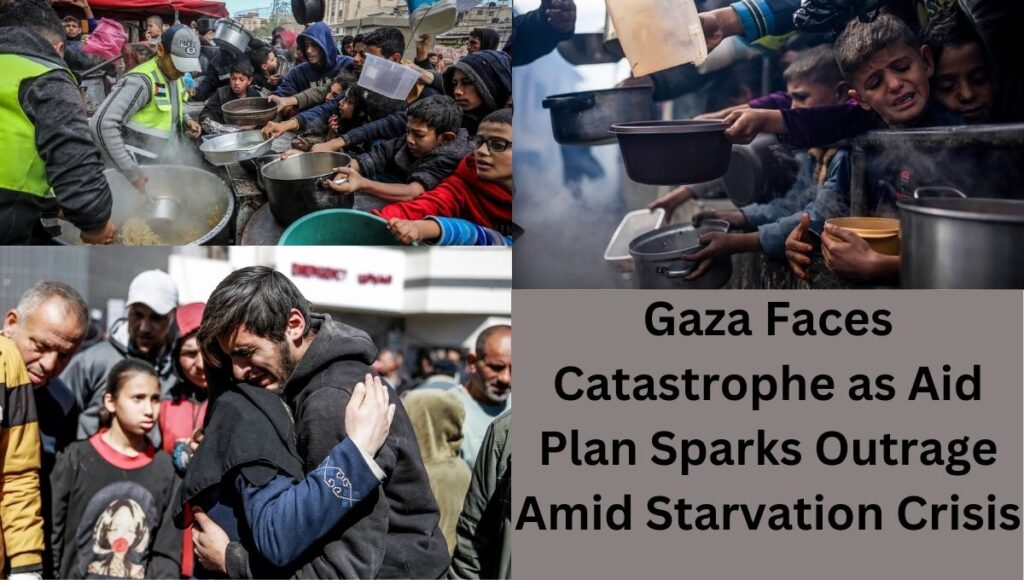
Gaza Faces Catastrophe as Aid Plan Sparks Outrage Amid Starvation Crisis
Blocked Relief: Aid Trucks Stalled at Kerem Shalom
On May 21, 2025, over 100 aid trucks entered Gaza through the Kerem Shalom crossing marking the first such delivery in weeks.
However, humanitarian agencies report that the supplies remain stranded due to Israeli-imposed logistical constraints, rampant looting, and an unsafe environment for aid workers.
According to Stéphane Dujarric, spokesperson for the UN Secretary-General, Israel’s restrictions including arbitrary time limits and driver rejections have effectively paralyzed aid distribution.
The World Food Programme (WFP) confirmed that at least 78 trucks are stuck, unable to deliver urgently needed food and medical supplies.
“Sterile Zone” Sparks Global Backlash
Netanyahu’s proposed “sterile zone” in southern Gaza intended to be free of Hamas and managed by a U.S.-backed private entity called the Gaza Humanitarian Foundation (GHF) has been met with condemnation.
The plan involves relocating displaced Palestinians to these zones, raising serious legal and ethical concerns.
The United Nations and major humanitarian organizations argue this move constitutes forced displacement, which is a violation of international law.
Critics also warn that placing aid under the control of armed private contractors risks militarizing humanitarian assistance and eroding the neutrality of relief efforts.
Starvation Crisis Deepens: A Drop in the Ocean
Despite the arrival of aid trucks, the WFP and IFRC describe the current flow as “a drop in the ocean.” Gaza’s 2.3 million residents require 1,000 to 1,200 trucks per day to meet basic needs, yet only a fraction of that number is entering.
At makeshift soup kitchens, families survive on watery lentil broth often their only meal for days. “Even dogs wouldn’t eat this,” lamented Somaia Abu Amsha, a mother waiting in line for food.
With no bread, rice, or infant formula, the most vulnerable especially children are slipping into malnutrition and starvation.
UN Warns: 14,000 Children May Die Within 48 Hours
The UN’s humanitarian chief, Tom Fletcher, delivered a chilling update: 14,000 children could die in the next 48 hours if aid does not reach them immediately.
The Gaza Government Media Office reported that nearly 290,000 children are now at risk due to a lack of food, medicine, and clean water.
Doctors Without Borders and other medical organizations highlight that collapsing hospitals and shortages in critical supplies are leading to a “silent death” for thousands suffering from chronic illnesses like cancer and kidney failure.
Health Care System on the Brink of Collapse
Recent Israeli airstrikes forced the closure of several major hospitals, including Al Awda and Kamal Adwan, severely limiting medical care across Gaza.
The once-operational Indonesian Hospital in northern Gaza has also shut down, and even facilities in the south remain offline due to bombardment.
The International Committee of the Red Cross (ICRC) reported receiving only one truckload of medical supplies for its field hospital in Rafah.
Meanwhile, displacement orders have led to the abandonment of Gaza’s largest desalination plant, worsening the water crisis and compounding the humanitarian disaster.
Diplomatic Fallout After West Bank Incident
Tensions escalated further when Israeli forces fired warning shots near international diplomats visiting the Jenin refugee camp in the West Bank.
Although no injuries were reported, countries including France, Canada, Germany, Austria, and Italy have demanded investigations.
The Israeli military claimed the delegation had deviated from an approved route. Still, the incident highlights the volatile security situation throughout the occupied territories as Israeli military operations intensify.
Controversy Over the Gaza Humanitarian Foundation
The Gaza Humanitarian Foundation (GHF), tasked with managing aid in the proposed sterile zones, insists it will not support forced relocations.
However, many question the neutrality of a U.S.-backed private entity armed with contractors to control aid delivery.
The foundation’s plan to establish four aid hubs is being viewed with skepticism. International organizations argue that private control of humanitarian aid could undermine global aid norms and enable Israel to use basic necessities as tools of leverage.
Growing Global Outcry and Calls for Immediate Action
The global response to Netanyahu’s Gaza aid plan has been overwhelmingly critical. UN agencies, the IFRC, and NGOs have called for an unconditional lifting of the blockade and unimpeded access for humanitarian workers.
Many world leaders warn that Israel’s policies may constitute collective punishment and are pushing for a permanent ceasefire to allow safe, sustained aid deliveries.
With starvation and death accelerating, they insist that time is running out to prevent an even greater catastrophe.
Israeli Government Under Pressure at Home and Abroad
At home, Netanyahu is facing increasing scrutiny. Opposition leader Yair Golan has warned that Israel risks international isolation.
Recent polls show that 70% of Israeli citizens support a ceasefire if it facilitates the return of hostages.
Internationally, Israel’s allies, including the United States, Britain, and Canada, are urging restraint and transparency.
Many have distanced themselves from the GHF initiative, citing concerns over the legality and ethics of the proposed aid model.
Conclusion: A Race Against Time for Gaza’s Survival
The partial entry of aid trucks into Gaza is not enough. Without safe and immediate distribution of food, water, and medicine, Gaza’s civilian population will continue to suffer and die.
The Netanyahu Gaza aid plan, viewed by many as a means to reshape Gaza rather than relieve it, is failing to stem the tide of hunger, displacement, and death.
The global community must act now before Gaza’s cries become irreversible silence.
Also Read: Gaza on the Brink: UN Warns of Imminent Famine Amid Aid Chaos and Airstrikes
Also Read: Israel’s new aid delivery system for Gaza is sparking outrage. Why is it so problematic?
Related Posts:
- Gaza on the Brink of Famine as Israel's Blockade…

- Gaza Journalist Sells Camera to Buy Food Amid…

- Gaza on the Brink: UN Warns of Imminent Famine Amid…
- Gaza Faces “Mass Starvation” as Death Toll from…

- Gaza Starvation Crisis Worsens Despite Israeli Aid Claims
- Trump Acknowledges Gaza Famine Crisis, Proposes U.S.…