Aid agencies accuse Israel of blocking life-saving supplies as Gaza Starvation Crisis Worsens Despite Israeli Aid Claims. The Gaza humanitarian crisis has reached a catastrophic peak, with 127 reported deaths due to hunger and malnutrition including 85 children according to Gaza’s Health Ministry. The death toll reveals the devastating impact of the Israeli siege on Gaza’s already fragile food systems, turning the region into a hotspot of what many are now calling a Gaza famine.
Aid groups say the mounting deaths are not simply a consequence of war, but the outcome of deliberate policies. These include Israel’s aid restrictions and targeted dismantling of distribution systems that previously supported millions.
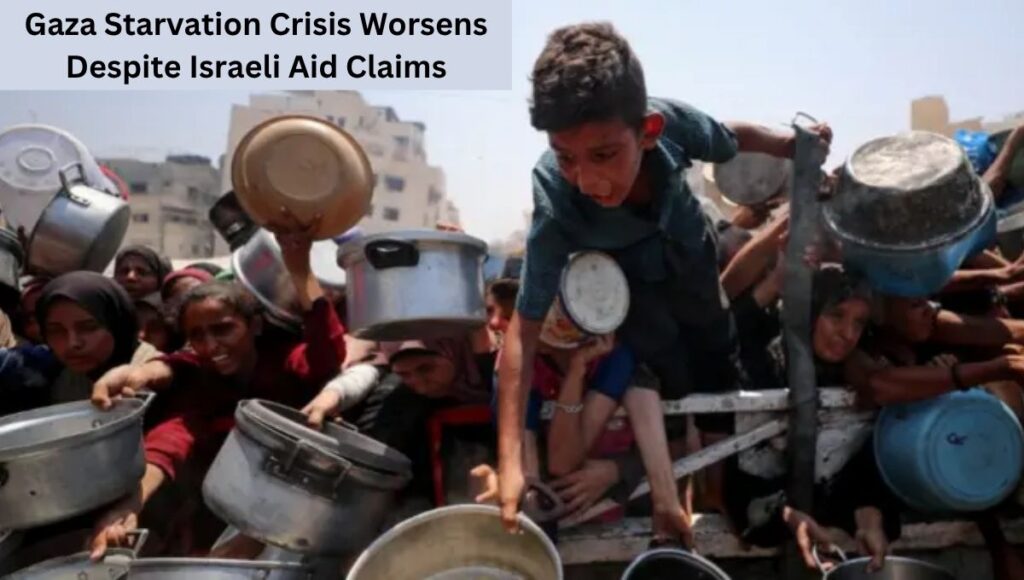
Gaza Starvation Crisis Worsens Despite Israeli Aid Claims
Netanyahu’s March 2024 Blockade Marked a Turning Point
Tensions dramatically escalated in March 2024, when Israeli Prime Minister Benjamin Netanyahu halted all humanitarian aid to Gaza.
Justified as a tactic to pressure Hamas into a ceasefire, the move was swiftly criticized by international leaders and aid agencies alike.
Ironically, that same ceasefire was broken by Israeli forces later that month.
Since then, humanitarian aid flow has been inconsistent and insufficient. By September 2024, 15 major international relief organizations publicly accused Israel of blocking 83% of aid meant for Gaza.
Israel, however, continues to blame UN inefficiency and Hamas interference for the crisis.
Aid Distribution: From 400 Access Points to Just Four
Before the siege, over 400 aid distribution points were active in Gaza, operated by the United Nations and NGOs.
But in May 2024, the U.S. and Israel replaced the UN system with a controversial new model introducing the Gaza Humanitarian Foundation (GHF), which operates only four Israeli-controlled centers in central and southern Gaza.
These GHF points, managed by the Israeli military and U.S. contractors, have become sites of violence and chaos.
Over 1,000 Palestinians have been killed while attempting to access food, many reportedly shot near these aid centers.
Humanitarian workers argue that this new system worsens the Gaza food crisis instead of solving it.
Israel Denies Starvation, Despite Evidence
The Coordinator of Government Activities in the Territories (COGAT) has continued to deny that a famine exists in Gaza, instead claiming only “localized food access issues.”
But this narrative is contradicted by almost every international aid agency and medical professional on the ground.
Dr. Omar Abdel-Mannan, a British-Egyptian pediatric neurologist, described the suffering as a “very cruel, slow death,” explaining how children’s bodies break down fat, then muscle, then bone as starvation sets in.
UN-Hamas Collusion Accusations Unfounded
Israel’s government has accused the United Nations of collaborating with Hamas, even naming UN aid chief Tom Fletcher as allegedly working with the group.
These accusations, however, remain unsubstantiated.
A formal review of UNRWA operations earlier this year found no evidence of Hamas infiltration.
Fletcher publicly challenged Israel to provide proof, stating that defaming humanitarian workers without evidence undermines international efforts to help civilians.
Who’s Really Stealing Aid?
Contrary to Israeli claims that Hamas is looting aid, both the New York Times and USAID have reported no systematic theft by the group.
Instead, the chaos in Gaza has allowed criminal gangs some allegedly linked to GHF contractors to hijack portions of aid shipments.
With little oversight and breakdowns in communication, these gangs control what little aid does make it through, exacerbating the Gaza starvation emergency.
UN: Bureaucracy and Violence Blocking Aid Access
Humanitarian groups cite Israeli bureaucracy and military obstacles as the leading causes of aid delays.
According to UN spokesperson Stéphane Dujarric, over 50% of food convoy requests to the Israeli military are denied. These denials often occur without explanation.
Dujarric also reported that aid trucks are being attacked, looted, or even fired upon during offloading. These conditions make safe and efficient aid distribution in Gaza nearly impossible.
Israel Responds with Airdrops and “Humanitarian Corridors”
Following global backlash, Israel announced a resumption of airdrops and the creation of “humanitarian corridors.”
Israeli officials say these efforts prove their commitment to easing the Gaza humanitarian crisis.
However, aid groups dismiss these measures as superficial. Philippe Lazzarini, head of UNRWA, called the air drops “expensive, inefficient, and dangerous.”
According to him, 6,000 aid trucks are currently stalled in Jordan and Egypt, awaiting Israeli clearance.
Driving these trucks in, he says, would be faster, safer, and more effective than any air campaign.
Airdrops Slammed as “Grotesque Distraction”
More than 100 international aid organizations criticized the recent air drops as a “grotesque distraction.”
While visually dramatic, air drops are too small in scale to support Gaza’s 2.1 million residents.
BBC analysis found that over 160 military cargo planes would be required just to feed the population one meal a day an impossible task given current aircraft availability.
With only 10 planes from Jordan and 8 from the UAE, the numbers don’t add up.
Deaths at Distribution Points, Aid Boats Intercepted
Despite intensified airdrop efforts, tragedy continues on the ground. Gaza’s civil defense agency reported over 50 deaths on Saturday alone, including 14 near food aid centers allegedly shot by Israeli forces.
Israel also intercepted the Handala, a boat from the Freedom Flotilla Coalition attempting to break the blockade.
The ship’s live feed was abruptly cut as Israeli forces stormed it mirroring a similar fate met by the Madleen weeks earlier.
Gaza’s Society in Collapse
The siege has devastated Gaza’s health, sanitation, and food systems. Over 90% of homes are damaged or destroyed, while hospitals are overwhelmed and supplies scarce.
Children are the most vulnerable especially infants and toddlers with fast metabolisms and no body fat reserves.
The Gaza food crisis has spiraled into a man-made humanitarian disaster, worsened by political inflexibility and a lack of decisive international pressure.
Humanitarian Leaders Demand Ceasefire and Full Land Access
A coalition of 109 aid organizations, including Mercy Corps, MSF, and the Norwegian Refugee Council, have jointly demanded a permanent ceasefire and unrestricted humanitarian access.
“This is not a logistics issue it’s political,” said a UN official. “There is food, water, and medicine. What’s missing is the will to let it in.”
UK Joins Airdrop Mission Amid Criticism
The UK, under Prime Minister Keir Starmer, has pledged support for Jordan-led air drops and the evacuation of severely malnourished children.
However, the move has drawn domestic backlash due to the UK’s continued arms exports to Israel with over 8,600 munitions shipped since September 2024.
More than 200 British MPs are now calling for the UK to recognize a Palestinian state, adding diplomatic pressure ahead of the UN General Assembly in September.
Conclusion: Only Land Access Can Prevent Gaza Famine
Despite Israeli claims of active humanitarian efforts, the reality in Gaza is dire. Airdrops, while symbolic, cannot replace sustained, land-based aid access. With 127 starvation deaths, including dozens of children, the international community must shift from optics to action.
The Gaza famine is a preventable tragedy. Aid is ready. The infrastructure exists. What’s needed is the political courage to lift the siege, open the borders, and restore dignity to a population on the brink of collapse. Until then, Gaza remains trapped in one of the worst man-made humanitarian disasters in modern memory one that history will remember not only for its suffering, but for how long the world waited to act.
Also Read: Gaza Faces “Mass Starvation” as Death Toll from Hunger Climbs Amid Ongoing Israeli Strikes
Also Read: Israel will have to make decision, says Trump as Gaza crisis worsens