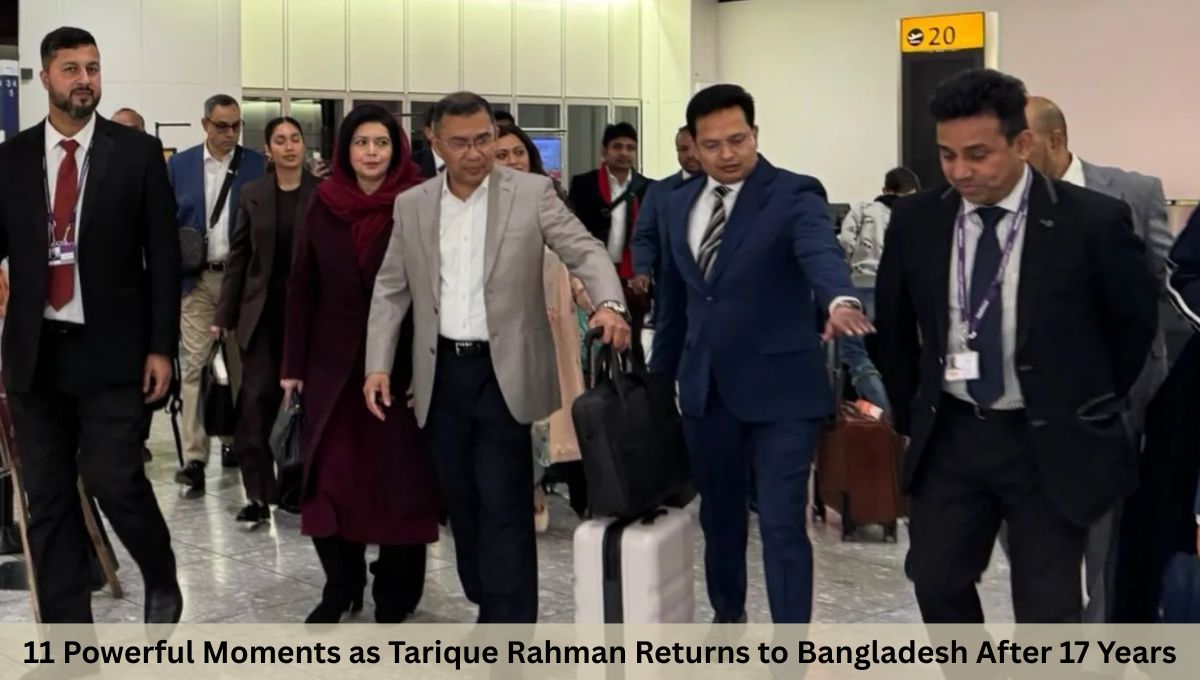
11 Powerful Moments as Tarique Rahman Returns to Bangladesh After 17 Years in exile amid unrest and regional tensions. Tarique Rahman’s return to Bangladesh after more than 17 years in exile is being widely described as one of the most consequential political moments in the country’s recent history.
As the acting chairman of the Bangladesh Nationalist Party (BNP) stepped barefoot onto Bangladeshi soil at Dhaka’s Hazrat Shahjalal International Airport, the symbolism was unmistakable — a political heir reclaiming his place at a moment of national uncertainty.
The 60-year-old leader, son of former prime minister Khaleda Zia and late president Ziaur Rahman, arrived from London with his wife Zubaida Rahman and daughter Zaima. Tens of thousands of supporters gathered across the capital to welcome him home, transforming his arrival into a mass political spectacle.
With parliamentary elections scheduled for February 12 under an interim government led by Nobel laureate Muhammad Yunus, Rahman’s return has injected new momentum into the BNP and reshaped Bangladesh’s already volatile political equation.
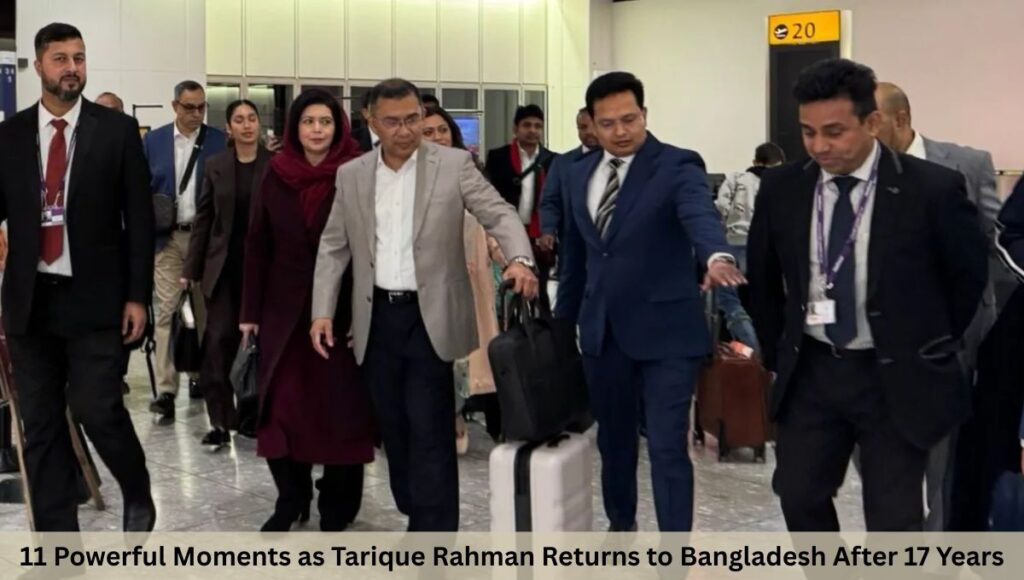
11 Powerful Moments as Tarique Rahman Returns to Bangladesh After 17 Years
Walking Barefoot on Home Soil: A Symbolic Return
Shortly after disembarking from his flight, Rahman removed his shoes and walked barefoot on the grass outside the airport.
In video footage shared on social media, he is seen bending down to scoop up a handful of soil — a deeply symbolic gesture in South Asian political culture, signifying reverence for the motherland.
The images quickly went viral, reinforcing the emotional resonance of his homecoming. Supporters described the act as a pledge of loyalty to the nation and a signal that Rahman intends to lead from the front during a period of upheaval.
Security around the airport and across Dhaka was unprecedented. Thousands of police officers, paramilitary personnel, and soldiers were deployed.
Authorities imposed bans on drone usage near the airport and hospital zones, and restricted photography at major reception venues.
A Nation on Edge as Rahman Returns
Rahman’s arrival comes at a tense and fragile moment for Bangladesh. The country has been grappling with renewed unrest following the killing of youth leader Sharif Osman Hadi, a key figure in last year’s student-led uprising that culminated in the fall of Sheikh Hasina’s government.
Hadi’s death triggered violent protests, arson attacks, and growing anti-establishment anger. His killing has also strained relations with India, after unsubstantiated allegations of Indian involvement circulated widely on social media.
Against this backdrop of instability, Rahman’s return is seen by supporters as a stabilising force — and by critics as a test of whether the BNP can manage law and order while navigating a deeply polarised society.
Who Is Tarique Rahman?
Tarique Rahman is the eldest son of former president Ziaur Rahman and former prime minister Khaleda Zia — two of the most influential figures in Bangladesh’s post-independence history.
He rose to prominence during his mother’s second term as prime minister from 2001 to 2006, emerging as a powerful figure within the BNP.
However, that period also brought allegations of corruption, cronyism, and political violence — accusations the BNP has long dismissed as politically motivated.
Rahman went into exile in 2008 after being released on bail during a military-backed caretaker government. He cited medical treatment and political persecution as reasons for his departure and subsequently settled in London.
From exile, Rahman continued to lead the BNP as acting chairman, maintaining organisational cohesion through virtual meetings and remote leadership — a rare feat in Bangladeshi politics.
Years of Exile and Legal Battles
Rahman’s exile coincided with the return to power of Sheikh Hasina and the Awami League in 2009. Over the next 15 years, the BNP faced sustained crackdowns, with many leaders jailed or forced underground.
Rahman himself was convicted in absentia on multiple charges, including money laundering and involvement in a 2004 grenade attack on an Awami League rally. International observers and BNP leaders argued that the cases were politically driven.
Following the August 2024 uprising that ousted Hasina, many of the cases against Rahman were stayed or overturned, removing the legal barriers to his return.
Khaleda Zia’s Illness and Personal Urgency
Rahman’s return also carries deep personal significance. His mother, Khaleda Zia, 80, has been critically ill and hospitalised at Evercare Hospital in Dhaka since November.
Before leaving London, Rahman said his desire to be near his mother during her illness was “the natural instinct of a son.” Shortly after his arrival, he visited her in the intensive care unit.
Despite years of imprisonment and declining health, Khaleda Zia had vowed in November to campaign in the upcoming elections, a pledge that now appears increasingly unlikely due to her condition.
BNP’s Electoral Momentum
With the Awami League barred from contesting the February elections under the Anti-Terrorism Act, the BNP has emerged as the clear frontrunner.
A December survey by the US-based International Republican Institute showed the BNP leading with 30 percent support, followed by Jamaat-e-Islami at 26 percent. Bangladesh’s first-past-the-post electoral system means a plurality could be enough to secure power.
Rahman’s physical presence in the country is expected to galvanise grassroots supporters and unify party factions that have operated independently during his absence.
Jamaat-e-Islami: From Ally to Rival
One of the most significant shifts in Bangladesh’s political landscape is the BNP’s evolving relationship with Jamaat-e-Islami.
Once close allies during the BNP’s 2001–2006 rule, the two parties are now competitors for political space after the Awami League’s exit from the electoral field.
Analysts believe Rahman is deliberately repositioning the BNP as a centrist, secular-leaning force to attract voters uneasy about Islamist politics.
Rahman’s First Speech: Unity and Safety
Addressing tens of thousands of supporters at a public rally shortly after his arrival, Rahman struck a conciliatory tone.
“This country belongs to people of the hills and the plains — Muslims, Hindus, Buddhists, and Christians,” he said. “We want to build a safe Bangladesh where every woman, man, and child can leave their homes safely and return safely.”
Invoking Martin Luther King Jr., Rahman said, “Like he said, ‘I have a dream.’ I want to say: I have a plan for Bangladesh.”
Outreach to Minorities and International Signals
Rahman’s emphasis on minority protection and peace has been widely interpreted as a strategic signal to both domestic and international audiences.
Intelligence assessments suggest the BNP is pursuing an “India-neutral” posture, seeking to reassure New Delhi without appearing subordinate.
His rhetoric marked a departure from the BNP’s more confrontational image during the early 2000s.
The softer tone is also aimed at Western governments that have historically viewed the BNP with scepticism due to allegations of corruption and political violence.
Strained Bangladesh–India Relations
Rahman’s return coincides with deteriorating ties between Dhaka and New Delhi. India has expressed concern over attacks on minorities and called for a thorough investigation into recent violence.
Anti-India sentiment has surged in Bangladesh following Sharif Osman Hadi’s killing, further complicating regional dynamics.
Rahman’s careful avoidance of overt anti-India rhetoric suggests an effort to prevent further escalation while maintaining nationalist credibility at home.
The Fall of Sheikh Hasina and a Changed Political Order
The political vacuum Rahman steps into was created by the dramatic fall of Sheikh Hasina in August 2024.
After weeks of student-led protests over job quotas and governance failures, security forces launched a brutal crackdown that the United Nations says killed up to 1,400 people.
Protesters eventually overran Hasina’s residence, forcing her to flee to India. Hasina was later tried in absentia and sentenced to death for crimes against humanity — charges she denies.
The Yunus Interim Government Under Pressure
Since taking office, interim leader Muhammad Yunus has struggled to restore law and order while preparing the country for elections.
Human rights groups have raised concerns about press freedom and the growing influence of Islamist groups, adding to uncertainty ahead of the polls.
Rahman’s return places additional pressure on the Yunus administration to deliver a credible and peaceful election.
A Political Heir at a Crossroads
Supporters see Rahman as the natural successor to his mother and the embodiment of the BNP’s resilience after years of repression.
Critics, however, warn that his past controversies and concentration of power within the Zia family could revive old patterns of dynastic politics.
Former US diplomat Jon Danilowicz described Rahman’s return as “the final piece of the puzzle” before elections, noting that both Rahman and the electorate must adapt to how much Bangladesh has changed over the past 17 years.
What Lies Ahead for Bangladesh
With elections looming, Tarique Rahman faces the challenge of converting popular enthusiasm into effective governance promises.
He must integrate loyalists who stood by him during exile with party leaders who managed the BNP on the ground, while navigating unrest, economic pressures, and regional sensitivities.
As Bangladesh approaches one of the most consequential elections in its history, Rahman’s barefoot steps on home soil may be remembered as the moment the country’s political future decisively shifted.
Also Read: 7 Critical Updates on Khaleda Zia’s Health and Tarique Rahman’s Return
Also Read: Tarique Rahman, The ‘Dark Prince’ And A ‘Shadow PMO’ That Ran Bangladesh