

7 Explosive Revelations from Declassified Putin–Bush Transcripts, years before the Ukraine war. Newly released declassified transcripts from private meetings and phone calls between Russian President Vladimir Putin and former US President George W. Bush offer a rare, unfiltered glimpse into how both leaders viewed some of the most consequential geopolitical fault lines of the 21st century — long before they erupted into open crises.
Released by the US-based National Security Archive after a lengthy legal process, the documents cover conversations between 2001 and 2008.
They show that many of today’s defining conflicts — Russia’s war in Ukraine, fears over Pakistan’s nuclear stability, Iran’s nuclear ambitions, and China’s rise as a global challenger — were already being discussed candidly behind closed doors.
What stands out most is not the surprise factor, but the continuity. Putin’s views on Ukraine, sovereignty, and post-Soviet borders were already hardened years before Russian tanks crossed into Crimea in 2014 or Ukraine in 2022.
Similarly, Washington and Moscow shared strikingly aligned anxieties about nuclear proliferation in South Asia and the Middle East, even as their broader relationship deteriorated.
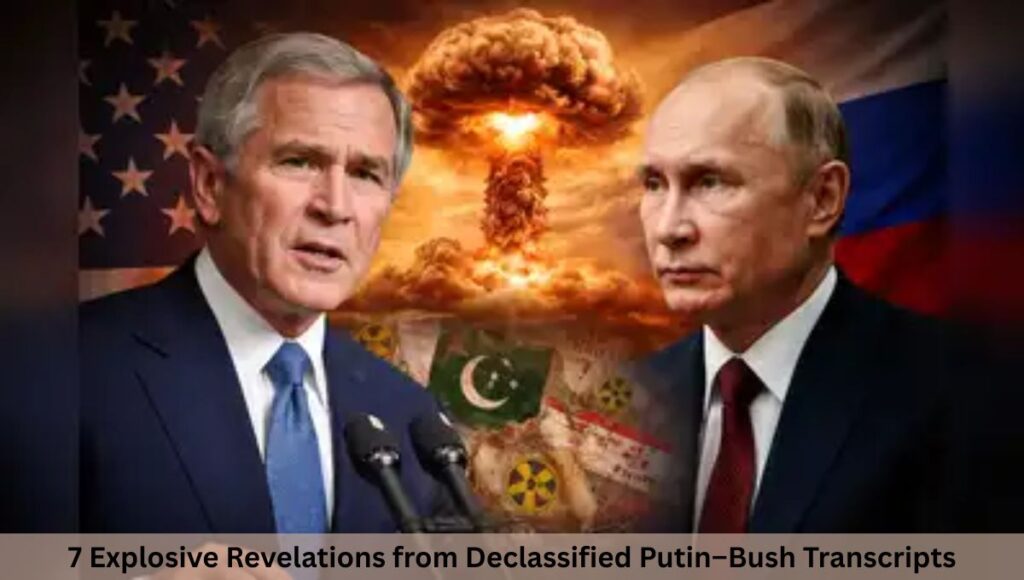
7 Explosive Revelations from Declassified Putin–Bush Transcripts
Ukraine as an ‘Artificial State’: Putin’s Long-Held View
One of the most consequential revelations in the transcripts concerns Putin’s repeated characterisation of Ukraine as an “artificial state,” a phrase that would later become central to Russian public rhetoric justifying military action.
According to the documents, Putin told Bush in private conversations that Ukraine was not a naturally formed nation but a political construct assembled during the Soviet era.
“This is not a nation built naturally. It is an artificial state created in Soviet times,” Putin said, according to the transcripts.
Putin argued that Ukraine’s borders were the result of a series of administrative decisions rather than organic historical development.
He pointed out that western Ukraine incorporated territories taken from Poland, Romania, and Hungary after World War II, while eastern regions were transferred from Russia during the 1920s and 1930s.
He also referenced the 1956 transfer of Crimea to Ukraine. In Putin’s framing, these decisions undermined Ukraine’s claim to permanent sovereignty, portraying the country as a fragile entity whose borders were historically reversible.
Soviet Collapse: ‘Voluntary’ Loss or Historical Grievance?
The transcripts show that Putin consistently rejected the idea that the collapse of the Soviet Union represented decolonisation. Instead, he framed it as a voluntary sacrifice made by Russia.
During an early meeting with Bush on June 16, 2001, in Slovenia, Putin stated that Moscow had “voluntarily gave up thousands of square kilometers of territory,” including Ukraine, which he claimed “had been part of Russia for centuries.”
This interpretation reveals a fundamental divergence between Russian and Western views of post-Cold War Europe.
While the West largely viewed the emergence of independent states as the restoration of sovereignty, Putin viewed it as a historical injustice imposed on Russia.
That grievance, clearly articulated years before the Ukraine war, underpins much of Russia’s later foreign policy.
NATO and the Red Line on Ukraine
By 2008, Putin’s language toward Ukraine had hardened further. In talks with Bush that year, he warned explicitly that bringing Ukraine into NATO would trigger a lasting confrontation between Russia and the West.
He described Ukraine as inherently unstable, again citing its “artificial” nature, and argued that NATO expansion would fracture the country internally.
Putin also claimed that a significant portion of Ukraine’s population was ethnically Russian and culturally opposed to Western military alignment.
According to the transcripts, Putin insisted that most Ukrainians viewed NATO as a hostile force, portraying Western integration as something imposed from outside rather than chosen domestically.
Seen in hindsight, these warnings foreshadowed both Russia’s actions in 2014 and its full-scale invasion in 2022.
Pakistan: ‘A Junta With Nuclear Weapons’
Beyond Europe, the transcripts reveal deep anxieties shared by both leaders over Pakistan’s nuclear arsenal — concerns that remain highly relevant today.
In their first personal meeting in Slovenia in June 2001, Putin delivered a blunt assessment of Pakistan under military ruler Pervez Musharraf.
“I am concerned about Pakistan. It is just a junta with nuclear weapons. It is no democracy, yet the West does not criticize it,” Putin told Bush.
The remark echoed long-standing Indian concerns about Pakistan’s nuclear programme, particularly the risks posed by military control and weak civilian oversight.
While the United States was publicly forging a close post-9/11 partnership with Islamabad, the transcripts show that privately, Washington shared Moscow’s unease.
The Shadow of A.Q. Khan and Nuclear Leakage
A recurring theme in the conversations is the fear of nuclear leakage from Pakistan to other states.
The transcripts capture candid exchanges about Iran’s clandestine nuclear facilities and their links to Pakistani technology. In one exchange, Putin noted that uranium of Pakistani origin had been found in Iranian centrifuges.
Bush acknowledged that Iran had failed to declare this material to the International Atomic Energy Agency (IAEA), calling it a clear violation.
“It was of Pakistani origin. That makes me nervous,” Putin said.
“It makes us nervous, too,” Bush replied.
These discussions took place against the backdrop of the A.Q. Khan network, which later admitted to supplying nuclear technology to Iran, Libya, and North Korea — a scandal that strained relations between Washington and Moscow.
Iran’s Nuclear Ambitions: ‘No Doubt’
The declassified documents also show that Putin privately expressed far greater certainty about Iran’s nuclear intentions than Moscow often acknowledged publicly.
In the same June 2001 meeting in Slovenia, Putin told Bush:
“There is no doubt that the Iranians want to obtain nuclear weapons.”
He added that he had instructed Russian experts not to transfer sensitive nuclear or missile-related information to Tehran.
Putin also warned that certain individuals and networks were attempting to profit financially from cooperation with Iran.
Bush, for his part, was blunt. In a 2005 Oval Office meeting, he stated:
“We don’t need religious extremists with nuclear weapons.”
The phrase was clearly directed at Iran’s leadership.
Strategic Differences on How to Handle Iran
Despite shared concerns, the transcripts reveal tactical disagreements between Washington and Moscow.
Putin cautioned that premature pressure on Iran could push it down a path similar to North Korea’s. While he accepted that referral to the UN Security Council might eventually be justified, he warned against rushing the process.
Bush, meanwhile, argued that Tehran was “testing and probing” Western resolve and exploiting divisions among European powers.
The exchanges highlight how cooperation on nonproliferation coexisted with growing mistrust over methods and timing.
China: Bush’s Private Warning
One of the most striking revelations in the transcripts is how early China featured in private US–Russia discussions.
Bush repeatedly warned Putin that China represented the biggest long-term strategic challenge facing both nations.
“China is the biggest long-term problem for both of us,” Bush told Putin during a 2005 Oval Office meeting.
Putin was sceptical, replying: “More for you.” Bush acknowledged geography but argued that China’s ambitions would eventually affect Russia as well.
These exchanges reveal a divergence in priorities. While Bush viewed China as a systemic challenger to the global order, Putin remained more focused on NATO expansion and US missile defence in Europe.
Why These Transcripts Matter Today
Taken together, the declassified documents challenge the notion that today’s geopolitical crises emerged suddenly.
Putin’s dismissal of Ukraine’s sovereignty, fears over Pakistan’s nuclear stability, certainty about Iran’s ambitions, and early debates over China’s rise were all articulated years before they became headline issues.
For India, the transcripts offer international confirmation of long-held concerns about Pakistan’s nuclear assets and the risks posed by military dominance and radical networks.
For Europe, they underscore how deeply rooted Russia’s grievances over NATO and post-Soviet borders have been.
And for the broader world, they show a moment when Washington and Moscow, despite growing rivalry, shared stark assessments of global nuclear danger.
Continuity, Not Surprise
Perhaps the most important takeaway from the declassified Putin–Bush transcripts is continuity.
Putin did not suddenly reinvent his worldview in 2014 or 2022. The arguments he later used publicly to justify Russia’s actions were already being voiced privately more than two decades ago.
Likewise, US concerns over proliferation in Pakistan and Iran were not products of hindsight but real-time anxieties discussed at the highest level.
As history continues to unfold, these documents serve as a reminder that today’s crises were long in the making — and that warnings, often ignored at the time, were already clearly on the table.
Also Read: 7 Explosive Turns in Trump’s Bill Releasing the Jeffrey Epstein Files
Also Read: Declassified Papers Detail Putin’s Take on Ukraine in Bush Talks
Related Posts:
- Afghanistan–Pakistan War 2025: Inside the 48-Hour Ceasefire

- 11 Explosive Revelations From Ted Cruz’s Leaked…

- 5 Major Takeaways from the US Supreme Court's…

- 7 Powerful Measures: Trump Sanctions Russian Oil…

- 7 Heartbreaking Facts About Venezuela's Earthquake Disaster
- In 8 Moves, EU Targets China-Linked Refineries and…
