7 Shocking Realities as Deadly Asian Floods Leave Thousands Dead and Millions Displaced, exposing the region’s fragile climate resilience. A series of rare and powerful cyclones have unleashed catastrophic flooding across Southeast Asia, wiping out homes, destroying livelihoods, and leaving a trail of devastation across Indonesia, Sri Lanka, Thailand, Malaysia, and beyond.
Thank you for reading this post, don't forget to subscribe!In just one week, more than 1,200 people have been killed, with hundreds still missing and over a million displaced. Triggered by a rare combination of Cyclone Senyar, Cyclone Ditwah, and monsoon-enhanced weather systems, this disaster is now being described by officials, survivors, and climate experts as one of the worst multi-country flood crises in decades.
This long-form report compiles survivor accounts, on-ground assessments, and updates from Indonesia, Sri Lanka, Thailand, and neighboring nations—offering a comprehensive picture of the ongoing humanitarian emergency.
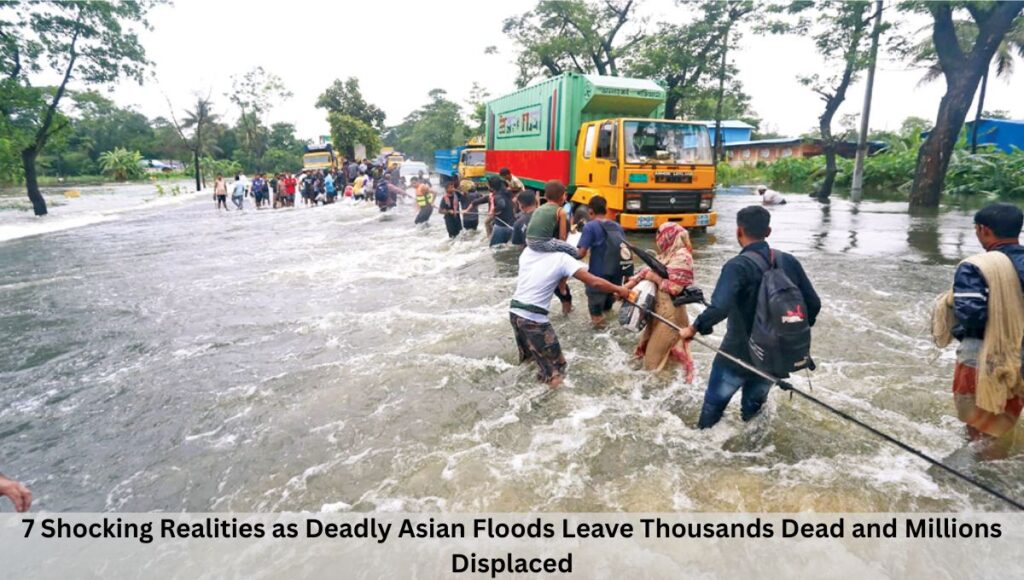
7 Shocking Realities as Deadly Asian Floods Leave Thousands Dead and Millions Displaced
Indonesia’s Flood Victims Pick Up the Pieces as Entire Communities Collapse
Indonesia has emerged as the epicenter of the catastrophe, with the death toll climbing beyond 631 and expected to rise sharply as rescue teams battle mud, debris, and inaccessible terrain.
The hardest-hit regions—Aceh, North Sumatra, and West Sumatra—are facing unprecedented destruction from floods and landslides triggered by Cyclone Senyar, a highly unusual storm that formed near the equator where cyclones rarely develop.
“I was waiting to die”: A survivor’s battle against rising waters
For 71-year-old Nurdin from Langsa in Aceh Province, survival felt almost accidental. As floodwaters crashed into his home late at night, Nurdin, who is wheelchair-bound after a stroke, could do nothing but crawl onto his bed with his wife as waters rose rapidly around them.
“I was just waiting to die. I didn’t want to leave my home,” he said.
“As the water rose, I thought: This is it.”
It took desperate neighbors braving chest-deep waters at 4 a.m. to reach the couple.
A sudden surge knocked rescuers off their feet, sending Nurdin and his neighbor plunging into the floodwater.
“I started to drown… I thought my time had come,” he recalled.
Miraculously, the couple made it to safety—only for the rains to intensify further, forcing them to be evacuated by soldiers using a table as a makeshift stretcher. At the temporary shelter, the devastation around Langsa became clearer.
One resident told Nurdin he watched bodies float out of a cemetery, carried by the violent currents. When Nurdin’s brother finally visited the house days later, almost everything was destroyed. “Maybe 1 percent can be saved,” Nurdin said. “My clothes, furniture, kitchen… everything was covered in mud.”
Landslides, impassable roads, and thousands still cut off
Much of Sumatra remains out of reach. Landslides have buried villages, roads are covered in thick sludge, and communications have collapsed in several districts.
Aid workers say 1.5 million people have been affected, and nearly one million have been evacuated. Even where floodwaters have receded, homes sit half-buried in mud up to half a meter deep, with survivors digging through ruined belongings and waiting for food.
“Everything was submerged”: Families lose homes, food, and security
In Kuta Makmur, 70-year-old Nurkasyah lost nearly every household item. Her fridge, washing machine, rice cooker, and even bags of rice dissolved in the muddy water. Only her bed might be salvageable after days in the sun.
Floodwaters first rose on Tuesday, then dropped—only to return violently after a night of torrential downpours. As water surged through her windows, she fled with 300 others to a community center.
“We just ate rice, instant noodles, and some eggs,” she said. “There wasn’t enough food. My home is full of mud now. I can’t live there.”
A five-day bus nightmare
While residents struggled at home, her son Nasir was trapped in a different nightmare. He boarded a bus from Banda Aceh to Medan—a routine 12-hour trip that stretched into five days of isolation when floodwaters swallowed Kuala Simpang.
Passengers climbed to the roof of the bus as waters rose around them. “There was no going forward or back,” he said. By Sunday, a group of passengers decided to escape on their own. They found a fisherman with a boat, then hitched a ride in a pickup truck.
Nasir now plans to fly home. “I cannot risk the roads again.”
“Like a tsunami”: Thailand reels as floodwaters swallow Hat Yai
As Indonesia battles Cyclone Senyar’s impact, Thailand is facing its own nightmare. Floodwaters up to eight feet high submerged Hat Yai in southern Thailand, leaving nursing homes, hospitals, and hundreds of communities isolated.
For Wassana Suthi, who runs a nursing home, the week felt like a disaster movie. “It rained so much you couldn’t leave the house,” she said. “We worked by candlelight. The oxygen tanks were running out.” A Thai Army helicopter became their only lifeline, dropping supplies onto the rooftop.
When the waters receded, the aftermath resembled an apocalypse:
- abandoned cars
- debris-covered streets
- missing-person signs
- families searching for loved ones
Thailand has reported 181 deaths, most of them in Hat Yai’s Songkhla Province.
Sri Lanka’s worst floods in a decade: Cyclone Ditwah’s deadly trail
Across the Indian Ocean, Sri Lanka is facing its deadliest flooding in ten years after Cyclone Ditwah stalled over the island, dropping half a meter of rain in a matter of days. The death toll has climbed to 410, with 336 still missing, and entire districts remain underwater.
India and Pakistan have deployed:
- helicopters
- rescue personnel
- naval ships
- humanitarian aid
Foreign nationals stranded in tourist regions were among those rescued. Sri Lanka has declared a national emergency, calling Cyclone Ditwah the largest disaster in its modern history.
Tourism wiped out at peak travel season
The floods struck during the high tourism season for Thailand, Vietnam, and Sri Lanka—between November and March.
These countries rely heavily on tourism:
- 15% of GDP in Thailand
- 14–15% of GDP in Vietnam
- 12% of GDP in Sri Lanka
Hotels, airports, rail lines, beaches, and major attractions have suffered severe damage. Tourists stranded in resorts described scenes of panic as water levels rose and power outages spread.
With more than 40 natural disaster incidents reported in November alone, experts warn the economic losses could run into billions.
Global aid pours in as governments face public anger
International help is arriving from:
- Japan (emergency supplies to Thailand)
- UK, US, South Korea, New Zealand (aid to Vietnam)
- India (Operation Sagar Bandhu in Sri Lanka)
- Pakistan (military rescue teams to Sri Lanka)
However, domestic criticism is growing—especially in Indonesia and the Philippines—over alleged failures in preparedness, bureaucracy, and environmental mismanagement.
Activist groups have accused governments of ignoring long-standing warnings about:
- deforestation
- mining impacts
- poor river management
- illegal land clearing
Indonesia’s President Prabowo Subianto visits disaster zones, promises action
Indonesian President Prabowo Subianto visited multiple devastated regions on Sumatra, assuring survivors that help is on the way. He acknowledged that some areas remain unreachable but insisted that emergency response efforts are expanding every hour.
“We face this disaster with resilience and solidarity,” he said. “Local governments must safeguard the environment and prepare for extreme weather caused by climate change.” Rescuers are still searching for nearly 500 missing people, using helicopters and boats to reach isolated communities.
Queues for food, electricity, and clean water continue to grow, with some residents stating they have eaten nothing for two to three days. In Central Aceh, thousands lined up outside government buildings where Starlink devices had been installed to provide temporary internet access.
Why were the floods so deadly? Weather experts explain
Meteorologists across the region attribute the flooding to a convergence of rare and extreme weather events.
1. The northeast monsoon intensified
The seasonal monsoon between November and March brought unusually high rainfall due to warmer ocean temperatures.
2. Cyclone Ditwah stalled over Sri Lanka
A slow-moving system delivered record rainfall amounts, overwhelming rivers and dam systems.
3. Cyclone Senyar formed abnormally close to the equator
Cyclones rarely form within 5 degrees of the equator, but Senyar defied expectations—triggering catastrophic floods in Sumatra.
4. Chains of tropical storms affected Vietnam and southern Thailand
Successive storms saturated the soil, making landslides more deadly.
5. Climate change supercharged the rainfall
Warmer atmospheres hold more moisture, making extreme rainfall events more intense.
Scenes of loss, resilience, and unanswered questions
As excavators dig through thick mud in West Sumatra’s Twin Bridges landmark, families wait with dread and hope. Mariana, whose son is among the missing, watches in agony.
“How will they find him? Will he still be intact?
Maybe their faces won’t even be recognisable.”
In North Sumatra, mothers fight for the last packets of instant noodles. In Hat Yai, elderly patients lie silently in darkened rooms, tended by staff working by candlelight.
In Sri Lanka, villages remain marooned, with boats the only means of communication. The human stories emerging from this disaster demonstrate not only the scale of the destruction but also the resilience of those who refuse to give up.
Conclusion: A region confronts its climate future
Southeast Asia is no stranger to monsoons—but the scale, speed, and severity of the recent floods signal a dangerous new era.
Environmental experts warn that without:
- stronger climate resilience
- improved disaster preparedness
- sustainable land management
- early warning systems
- investment in resilient infrastructure
future storms may bring even greater devastation. For now, survivors across Indonesia, Sri Lanka, and Thailand are left waiting for food, water, shelter, and answers—while the world watches one of the worst multi-country flood disasters in modern Asian history unfold in real time.
Also Read: 41 Shocking Deaths as Relentless Rains Devastate Central Vietnam
Also Read: At least 1,250 people dead: What caused the devastating Asia floods?
Related Posts:
- 7 Alarming Facts: Rare Senyar & Ditwah Cyclones…
- 9 Explosive Impacts After US Submarine Sinks Iran’s…

- 7 Heartbreaking Facts About Venezuela's Earthquake Disaster

- 5 Major Takeaways from the US Supreme Court's…

- Trump Targets Sri Lanka, BRICS with Sweeping Tariffs

- 7 Alarming Facts About Super Typhoon Fung-wong