Kathmandu, Nepal — 63 Dead as Heavy Rains Devastate Nepal, disrupting travel during the Dashain festival. At least 63 people have been killed and dozens are still missing as relentless monsoon rains wreak havoc across Nepal, triggering widespread landslides, flash floods, and lightning strikes that have cut off access to the capital, Kathmandu, and left thousands stranded during the country’s busiest travel period.
The government has declared a national emergency, closing highways, grounding domestic flights, and urging people to stay indoors as weather forecasts predict severe rainfall until October 6. Officials say rescue teams are working around the clock to reach remote mountain villages hit hardest by the disaster.
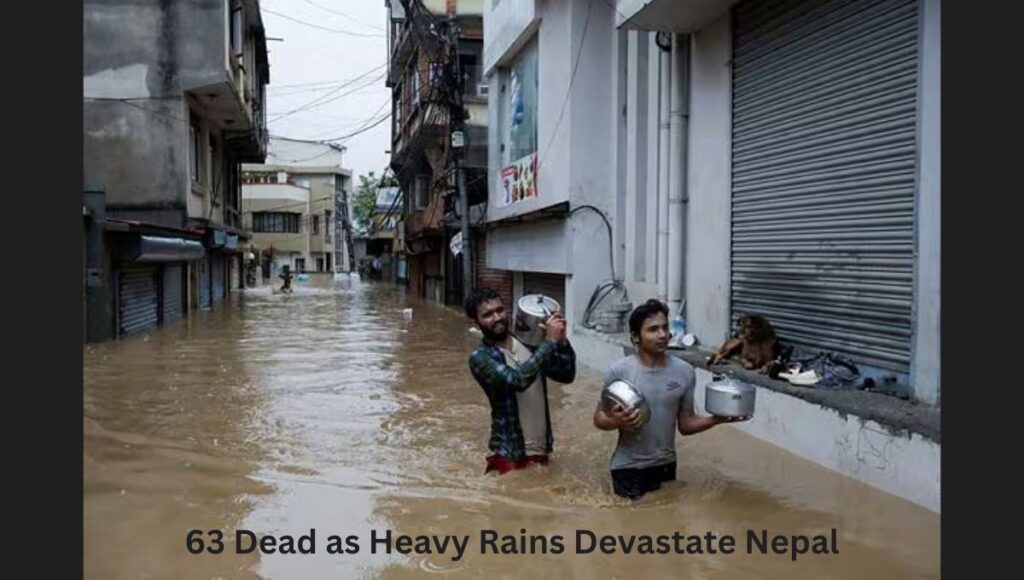
63 Dead as Heavy Rains Devastate Nepal
Landslides Sweep Away Villages in Eastern Nepal
The worst devastation has been reported in Ilam district, a hilly region bordering India, where entire settlements were buried under landslides following days of unrelenting rain.
According to Kalidas Dhauboji, spokesperson for Nepal’s Armed Police Force, 35 people were killed in separate incidents in Ilam alone, while nine others remain missing after being swept away by flash floods.
“Rescue efforts for the missing persons are ongoing despite difficult conditions,” said Shanti Mahat, a spokesperson for the National Disaster Risk Reduction and Management Authority.
In one tragic case, six members of a single family were killed when a massive landslide crushed their home as they slept, according to Bholanath Guragai, an assistant administrative officer in Ilam.
Roads Washed Away, Kathmandu Cut Off
The continuous downpour has cut off all major routes leading to the Kathmandu Valley. The Araniko Highway, which connects Nepal to China, has been rendered impassable after multiple road collapses, while the BP Highway, linking eastern Nepal, is buried under debris.
Police officials confirmed that “all entry points into Kathmandu” were blocked on Sunday morning. Hundreds of travelers returning from the Dashain festival — the country’s largest annual celebration — were stranded as highways turned into rivers of mud and stones.
Authorities warned motorists to avoid landslide-prone zones and use alternative routes where possible. However, many roads remain submerged or destroyed, further complicating rescue and relief operations.
Air Travel Disrupted Amid Poor Visibility
The Civil Aviation Authority of Nepal suspended all domestic flights on Saturday due to poor visibility and heavy rainfall, though international operations at Kathmandu’s Tribhuvan International Airport have largely continued.
“Domestic flights are largely disrupted but international flights are operating normally,” said Rinji Sherpa, a spokesperson for the airport.
Helicopters have been requested from the central government to airlift stranded residents and deliver emergency supplies to isolated communities.
Koshi River Above Danger Level; All 56 Sluice Gates Opened
In the country’s southeast, the Koshi River, Nepal’s largest and one of South Asia’s most flood-prone waterways, is flowing well above danger levels.
Dharmendra Kumar Mishra, district governor of Sunsari, said authorities have opened all 56 sluice gates of the Koshi Barrage — compared to 10–12 in normal conditions — to release rising water levels.
“The Koshi is swelling rapidly and posing a serious threat to nearby settlements,” Mishra warned, adding that vehicular movement across the barrage bridge has been suspended as a precaution.
The Koshi River often causes devastating floods downstream in India’s Bihar state, which has also issued flood alerts in bordering districts.
Lightning Strikes and Flash Floods Add to Toll
While landslides accounted for most deaths, several people were killed by lightning strikes and flash floods in southern Nepal.
Police spokesman Binod Ghimire said three people died after being struck by lightning, while one person was killed in flooding in Udayapur district.
In total, at least 63 people have lost their lives, 11 remain missing, and more than 100 others have been rescued across various provinces, including Koshi, Madhesh, Bagmati, and Gandaki.
Also Read: PM Modi Expresses Solidarity With Nepal Over Losses Caused By Heavy Rains, Offers Assistance
Public Holidays Declared, Disaster Alerts in 12 Districts
As rescue operations intensified, the Ministry of Home Affairs declared Sunday and Monday as national holidays, allowing emergency teams to focus on relief efforts.
“Your safety is our utmost concern. Do not hesitate to seek necessary assistance,” said Prime Minister Sushila Karki, adding that the government had mobilized the Army, Police, and Armed Police Force for emergency response.
The Department of Hydrology and Meteorology has issued red alerts in over a dozen districts, warning of possible flood surges, debris flows, and new landslides.
“Residents near rivers and steep slopes should evacuate immediately,” said department chief Kamal Ram Joshi, adding that heavy rainfall is likely to continue through Monday.
Dashain Travel Chaos: Roads Jammed Amid Rising Waters
The floods struck just as millions of Nepalis were returning from their hometowns after the Dashain festival, the country’s most significant cultural celebration. Thursday marked the festival’s main day, when families gather to exchange blessings and celebrate together.
With highways closed and bridges washed away, hundreds of thousands of travelers have been stranded. The Prithvi Highway, which connects Kathmandu with the western region, saw vehicles backed up for miles as authorities assessed the damage.
In Kathmandu, some rivers overflowed their banks, flooding low-lying neighborhoods. However, officials reported no major casualties in the capital itself.
Rescue Operations and Relief Measures Underway
Rescue teams, supported by the Nepal Army and Armed Police Force, have rescued more than 114 people so far. However, continuous rainfall and blocked roads are slowing progress.
“The rain is hampering efforts to reach remote villages,” said Bholanath Guragai, an official in Ilam. “We urgently need helicopters for medical evacuations and to deliver relief materials.”
Authorities have set up temporary shelters for displaced families, while medical teams have been deployed to prevent outbreaks of waterborne diseases.
Regional Impact: Darjeeling Suffers Parallel Devastation
Across the border in India’s Darjeeling district of West Bengal, at least 20 people were killed after heavy rainfall unleashed landslides and flash floods overnight.
Footage on Indian television showed rescue teams using cables and ropes to reach stranded residents as swollen rivers destroyed homes and infrastructure.
“Seven dead bodies have already been recovered from the debris,” said Abhishek Roy, a local police official. “We have information about more missing persons, and work is underway to recover their bodies.”
Indian Prime Minister Narendra Modi expressed grief, saying he was “pained by the loss of lives” and assured that rescue efforts were being “closely monitored.”
Government Response and International Aid
Prime Minister Sushila Karki addressed the nation on Sunday, assuring citizens that relief operations are in full swing and that foreign aid agencies are being contacted for support if the situation worsens.
“Nepal’s disaster management teams are fully mobilized. Helicopters, rescue boats, and emergency shelters have been deployed to the most affected areas,” she said.
The International Federation of Red Cross and Red Crescent Societies (IFRC) has offered assistance, while neighboring India has said it is monitoring the situation and is ready to provide help.
Climate Change Intensifies Monsoon Disasters
Experts warn that climate change is intensifying Nepal’s monsoon disasters, increasing the frequency and severity of extreme rainfall events.
The International Centre for Integrated Mountain Development (ICIMOD), based in Kathmandu, said in June that rising temperatures are “amplifying the risk of water-induced disasters such as floods, landslides, and debris flows.”
Over the past decade, monsoon-related disasters have claimed hundreds of lives annually in Nepal. In 2024 alone, more than 220 people died in similar incidents during the same period.
“Rising global temperatures mean the atmosphere holds more moisture, leading to heavier and less predictable downpours,” said ICIMOD hydrologist Dr. Kamal Aryal. “What used to be once-in-a-decade events are now happening every year.”
Economic and Humanitarian Impact
The timing of the disaster has compounded its impact, striking just as the tourism season was about to begin. Several trekking routes in the Annapurna and Everest regions have been closed due to landslide risks.
Agricultural lands across the Terai plains have also been submerged, raising fears of crop losses and food shortages in coming months.
The government estimates billions of rupees in damages to infrastructure, homes, and farmland. In the coming days, temporary bridges, relief camps, and medical outreach programs are expected to be established across the hardest-hit districts.
Monsoon Season Nears Its End — But Dangers Persist
Nepal’s monsoon season typically runs from mid-June to mid-September, but this year’s rains have extended into October, making it one of the longest and deadliest in recent memory.
Weather officials say the current system is likely to weaken by October 6, though isolated heavy rains could continue in the eastern and central regions.
For now, rescue teams remain on high alert as swollen rivers, blocked highways, and saturated hillsides pose continued risks of fresh landslides and flooding.
A Nation in Mourning and Resilience
As Nepal mourns its losses, communities are coming together to help one another. Volunteers in Kathmandu have launched donation drives, while local organizations are distributing food, blankets, and clean water in affected areas.
“Our hearts go out to all those who have lost loved ones,” said Prime Minister Karki. “Together, we will rebuild and recover from this tragedy.”
For a nation accustomed to battling nature’s fury, Nepal’s spirit of resilience once again shines through — even amid the destruction wrought by one of the deadliest monsoon disasters in recent years.
Related Posts:
- Flash Floods Slam New Jersey: Roads Submerged,…

- 7 Shocking Realities as Deadly Asian Floods Leave…

- Texas Flash Floods Kill 24; 23 Girls Missing from…
- 7 Alarming Facts: Rare Senyar & Ditwah Cyclones…
- 41 Shocking Deaths as Relentless Rains Devastate…
- 7 Heartbreaking Facts About Venezuela's Earthquake Disaster