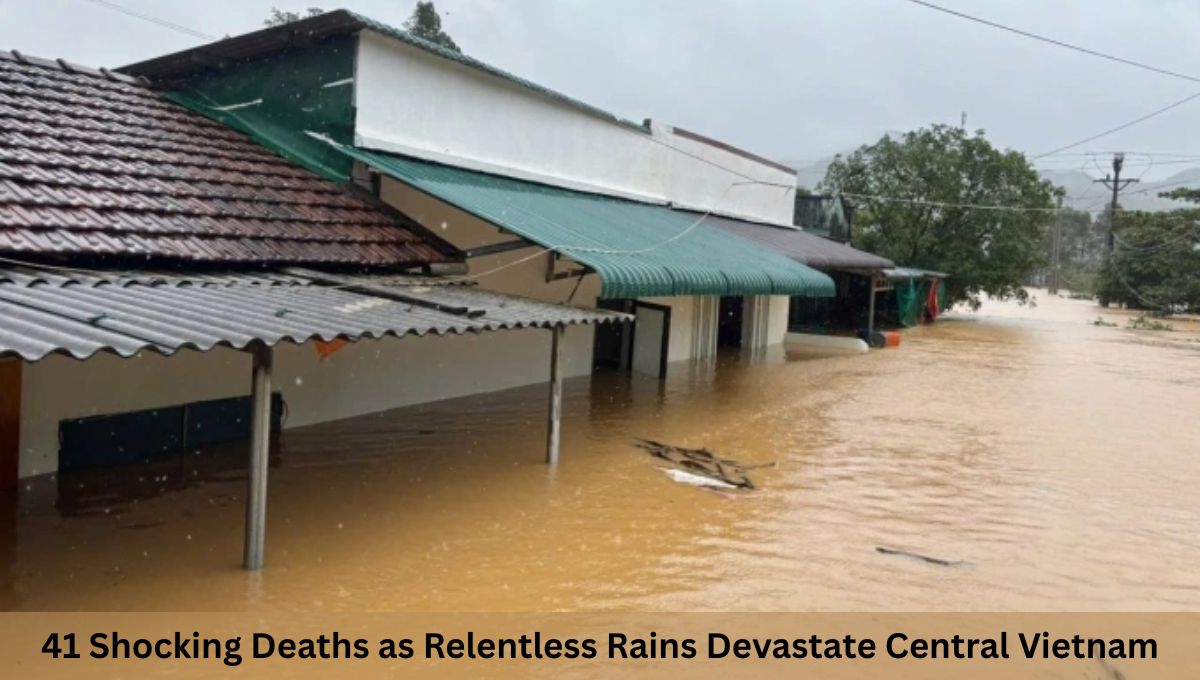
41 Shocking Deaths as Relentless Rains Devastate Central Vietnam; authorities rush to save stranded residents. Catastrophic floods, deadly landslides, and days of unrelenting rain have plunged central Vietnam into a severe humanitarian and environmental crisis. At least 41 people are confirmed dead, nine remain missing, and tens of thousands have been displaced as water levels continue to rise across multiple provinces.
The extreme weather — among the worst in decades — has submerged entire towns, swept away bridges, cut power to nearly one million homes, and caused widespread destruction in what officials call one of Vietnam’s deadliest rainfall events in years.
The relentless downpours, which began over the weekend, have affected major provinces including Khanh Hoa, Dak Lak, Gia Lai, Lam Dong, and coastal tourist hubs Hoi An and Nha Trang. Authorities warn that the crisis is far from over.
41 Shocking Deaths as Relentless Rains Devastate Central Vietnam
A Region Submerged — 52,000 Homes Flooded
Across central Vietnam, the scale of flooding is staggering.
Water Levels Break 1993 Records
Rainfall exceeded 1.5 meters (5 feet) in several areas within 72 hours — and in some pockets, levels rose beyond the 1993 flood peak of 5.2 meters, a grim milestone etched into the country’s disaster history.
Half a Million Families Without Power
Government data and local reports confirm:
- Over 52,000 homes flooded
- Nearly 62,000 people evacuated
- 1 million electricity customers affected
- Major highways blocked by landslides
- Thousands of vehicles submerged
Drone footage circulated on social media shows residents stranded on rooftops, waving for help as floodwaters swallow streets and homes.
Nha Trang and Tourist Belt Hit Hard
The coastal city of Nha Trang — one of Vietnam’s top tourist destinations — has been among the worst affected.
Entire City Blocks Underwater
Photo reports reveal hundreds of submerged cars, hotel lobbies filled with muddy water, and ground-level shops completely inundated.
Local business owner Bui Quoc Vinh, watching helplessly from his 24th-floor apartment, said:
“My restaurants and shops are under a metre of water. I cannot do anything now. The rain has not stopped, and the water isn’t going to recede soon.”
Nearby, residents scrambled to save belongings as water levels rose rapidly, flooding homes up to 2 meters deep in some districts.
Tourism Wiped Out Overnight
Hotel owner Vu Huu Son in Da Lat said tourist arrivals had collapsed:
“All tourists left before the rain. Most tours were cancelled. The landslides have blocked every road except one.”
The hospitality sector, already struggling from previous typhoons Kalmaegi and Bualoi, now faces another major economic setback.
Deadly Landslides Cut Off Mountain Routes
In the highlands around Da Lat, landslides triggered by the torrential rain have caused major disruptions.
- A 100-meter section of the Mimosa Pass collapsed into a ravine
- Two major mountain routes were closed due to landslide risks
- The Da Nhim suspension bridge was swept away
- Railway lines between the north and south were suspended
Videos published online show massive chunks of earth sliding down hillsides, carrying trees, rocks, and debris onto highways.
Deputy Prime Minister Ho Quoc Dung ordered immediate deployment of the army, police, and emergency units to:
“Promptly relocate and evacuate people to safe areas.”
Rescuers Race Against Time
In the hardest-hit districts of Gia Lai and Dak Lak, rescue teams used boats to pry open windows, break roofs, and pull residents out of partially submerged homes.
Social Media Becomes a Lifeline
A message posted by a desperate resident of Khanh Hoa went viral:
“Any group out there please help! We’ve been sitting on the roof since 10pm last night, including kids and adults.”
Images shared online show entire families — including elderly people and infants — huddled on rooftops as floodwaters rage below.
Hospitals Running Out of Supplies
In the coastal city of Quy Nhon, doctors and patients at one hospital survived on:
- Instant noodles
- Bottled water
- Flashlight power
for three days, until rescue teams arrived with food and emergency supplies.
Agriculture and Coffee Belt Hit Devastating Losses
The central highlands — home to Vietnam’s crucial coffee production belt — are facing severe damage.
Vietnam is the world’s second-largest coffee exporter, and disruptions in this region could hit global supply chains.
Farmers, already facing harvest delays due to earlier storms, now confront:
- Submerged fields and plantations
- Destroyed crops
- Damaged farm equipment
- Cut-off transport routes
For communities dependent on agriculture, the economic toll will be long-lasting.
Toxic Hazard — Barrels of Acid Swept Away
Authorities issued an urgent public safety warning after floodwaters in Dak Lak swept away 100 barrels of sulfuric acid from a sugar factory.
The Ministry of Public Security cautioned residents:
“Avoid any contact with the dangerous liquid.”
Teams are now attempting to locate the drifting barrels before they contaminate water sources.
Climate Crisis Driving Extreme Rainfall
Vietnam experiences heavy rain between June and September, but scientists warn the frequency and severity of extreme weather events are accelerating due to climate change.
The past months alone saw:
- Typhoon Kalmaegi
- Typhoon Bualoi
- Multiple rounds of severe monsoon flooding
- Storm-induced harvest delays
Natural disasters have killed 279 people and caused over $2 billion in damage from January to October, according to the national statistics office.
Meteorologists say the current rainfall pattern is consistent with climate-driven intensification, where storms bring heavier rain over shorter periods.
Government and Military Mobilise Nationwide Relief
Prime Minister Pham Minh Chinh directed provincial leaders to:
- Deploy military and police for search and rescue
- Provide food, clean water, and emergency shelter
- Stabilise electricity in safe areas
- Monitor river levels and landslide-prone zones
- Protect industrial sites from chemical leaks
Relief teams are distributing essentials to isolated communities, while helicopters stand on standby for emergency airlifts.
Infrastructure Paralysed Across Provinces
Transport Breakdown
- Railway lines connecting north and south Vietnam suspended
- Major highways blocked
- Rural roads washed away
- Bridges collapsed
Power and Communication Disruptions
Power grids failed in several regions, leaving:
- Families without electricity
- Hospitals using backup power
- Businesses closed
- Phone signals weakened
Officials warn that full restoration may take days due to dangerous conditions.
Voices from the Ground — Stories of Fear and Survival
Residents across central Vietnam describe terrifying nights and uncertain days.
“The water rose too fast”
A mother in Dak Lak recounted how she grabbed her two children and climbed onto the roof as the floodwaters surged at midnight.
“Everything we own is gone”
A farmer near Gia Lai said his entire year’s coffee harvest — and the tools he uses for farming — were washed away within hours.
“We couldn’t sleep, we just waited for light”
A group of students trapped in a boarding house said they spent the night fearing the building would collapse.
Weather Forecast — More Danger Ahead
The National Center for Hydrometeorological Forecasting warns that:
- Heavy rain will continue through Sunday
- Flooding will intensify in several provinces
- Landslide risks remain extremely high
- River levels are expected to rise further
Authorities advise residents to avoid low-lying areas and remain alert for evacuation orders.
A Nation Braces for the Days Ahead
The situation in central Vietnam is still dangerous and evolving. With more rain forecast and rivers approaching dangerous limits, the death toll could rise further.
Emergency teams continue to search for the nine people still missing, while hundreds remain stranded or waiting for rescue.
For now, the people of central Vietnam face a difficult reality: destroyed homes, lost livelihoods, unreliable power, blocked roads, and the looming threat of more extreme rainfall.
As the climate crisis amplifies extreme weather around the world, Vietnam’s tragedy stands as another reminder of the urgent need for resilient infrastructure, disaster preparedness, and global climate action.
Also Read: At Least 12 Dead, Hundreds of Thousands Evacuated as Typhoon Bualoi Slams Vietnam
Also Read: Vietnam sees 35 rainfall records broken in October