Bangladeshi Diaspora Protests Yunus Govt at UN, Alleges Minority Atrocities and illegal ouster of Sheikh Hasina. Outside the United Nations headquarters, thousands of Bangladeshi expatriates raised their voices in protest against Muhammad Yunus, interim Chief Adviser of Bangladesh.
Holding banners that read “Stop Killing Minorities in Bangladesh” and chanting slogans such as “Yunus is Pakistani, Go Back to Pakistan”, demonstrators accused Yunus of transforming Bangladesh into a “semi-Taliban nation” while persecuting Hindus, Buddhists, Christians, and other minorities. The protests coincided with the 80th United Nations General Assembly (UNGA), where Yunus delivered his second speech since assuming power following the ouster of Prime Minister Sheikh Hasina in August 2024.
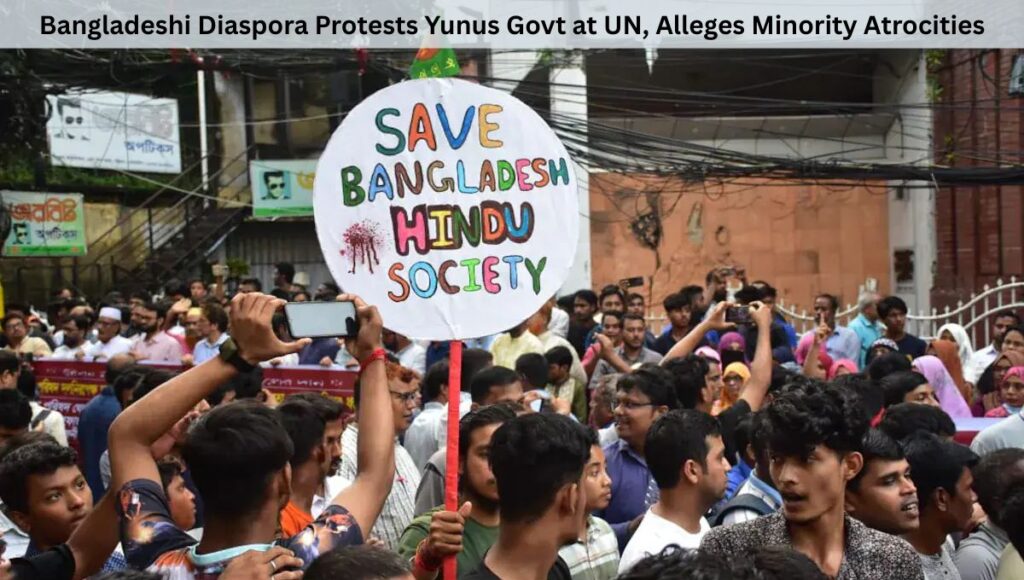
Bangladeshi Diaspora Protests Yunus Govt at UN, Alleges Minority Atrocities
Sheikh Hasina Supporters Drive the Protest
The protesters were largely members of the Bangladeshi diaspora aligned with Sheikh Hasina’s Awami League, which had ruled the country for 15 years before her dramatic exit in August 2024.
One demonstrator told ANI:
“We are protesting against the illegal Yunus regime. Since Sheikh Hasina had to leave Bangladesh for security reasons, minorities are being attacked and killed. Hindus, Buddhists, and Christians are forced to flee.”
Supporters claimed Hasina’s government was illegally ousted following a youth-led uprising. They accused Yunus of colluding with Islamist forces and terrorist organizations to dismantle Bangladesh’s secular democratic system.
Protest Banners and Slogans at the UN
The UN protest featured striking visuals:
- Banners read “Stop Killing Minorities in Bangladesh” and “Say No to Islamist Terrorism in Bangladesh”.
- Loud chants of “Yunus is Pakistani” and “Go Back to Pakistan” echoed through the crowd.
- Placards compared Dhaka under Yunus to Taliban-controlled Afghanistan.
A protester declared:
“Dr Yunus is making Bangladesh a Taliban country, a terrorist country. He must step down and call for free elections.”
Allegations of Atrocities Against Minorities
Diaspora members highlighted a deteriorating human rights climate since August 2024. According to a report by the Bangladesh Hindu Buddhist Christian Unity Council:
- 32 Hindus were killed between August and December 2024.
- 133 temples were attacked.
- 13 women were raped or harassed.
- Thousands of families were displaced.
Many protesters argued that Yunus had failed to protect minorities, instead enabling extremist groups to target Hindus and other religious communities.
Call for the Release of Hindu Priest
The crowd also demanded the release of Chinmoy Krishna Das, an ISKCON priest arrested in 2024 on sedition charges. His detention has sparked widespread anger within minority groups.
A protester said:
“We demand the release of Hindu priest Chinmoy Krishna Das, who has been unlawfully jailed by Dr Yunus. His arrest shows the regime’s bias against minorities.”
Yunus’s Address at the United Nations
Inside the UNGA, Muhammad Yunus presented a different narrative. He highlighted Bangladesh’s resilience, economic contributions, and the role of its migrant workforce, saying:
“Out of every 100 people on this planet, nearly three live in Bangladesh. Our migrant workers contribute not only to Bangladesh but also to the economies of host countries.”
Yunus urged global empathy toward migrant workers and emphasized international cooperation through SAARC (South Asian Association for Regional Cooperation).
Yunus and Pakistan Relations
Adding fuel to protesters’ anger were Yunus’s warming ties with Pakistan. On September 24, he met with Pakistani Prime Minister Shehbaz Sharif, marking their second official meeting at the UNGA.
- Pakistan’s Finance Minister Ishaq Dar visited Dhaka last month — the first such visit in 13 years.
- Relations between Dhaka and Islamabad have notably improved under Yunus, reversing years of tension during Hasina’s government over 1971 war crimes trials and historical grievances.
Protesters viewed these developments as a betrayal, branding Yunus as “Pakistani” and accusing him of undermining Bangladesh’s independence legacy.
Also Read: ‘Yunus is Pakistani’: Bangladeshi minorities holding ‘stop killing’ banners protest at UN
Growing Tensions Between Bangladesh and India
Yunus has also been openly critical of India, accusing it of spreading “fake news” and propaganda against his interim government. He claimed that New Delhi supports Hasina’s allies and has portrayed his leadership as an Islamic movement.
This stance has strained Dhaka-Delhi ties, with Yunus asserting:
“Sheikh Hasina’s presence in India is making relations between our countries difficult.”
Analysts argue that this shift away from India and closer alignment with Pakistan marks a significant geopolitical pivot for Bangladesh.
Voices From the Protest
Allegations of a Taliban-Style Regime
Protesters repeatedly alleged that Yunus is leading Bangladesh toward extremism.
“Since August 5, 2024, minorities are being killed, women are being harassed, and temples are being destroyed. Bangladesh is systematically becoming a semi-Taliban state.”
Claims of Mass Exodus
Others spoke of mass displacement, especially among Hindus:
“Millions of Hindus have had to leave Bangladesh since Yunus took power. This is a dire condition, and the world must take notice.”
International Attention on Bangladesh
The timing of the protest was strategic, coinciding with the global spotlight on the UNGA. Protest organizers sought to draw international leaders’ attention to the alleged atrocities.
Human rights observers note that Bangladesh is at a critical juncture:
- Domestic unrest fueled by political instability.
- Minority persecution raising alarms globally.
- Geopolitical realignment, with closer ties to Pakistan and tension with India.
Yunus Meets Global Leaders
Beyond Pakistan, Yunus also met Italian Prime Minister Giorgia Meloni, Finnish President Alexander Stubb, and Kosovo President Vjosa Osmani. His press secretary claimed these meetings strengthened Bangladesh’s diplomatic standing and international partnerships.
He also appealed to American companies at the US-Bangladesh Business Council roundtable, urging greater investment and assuring free and fair elections scheduled for February 2026.
The Political Divide: Sheikh Hasina vs. Yunus
At the heart of the conflict lies a sharp political divide:
- Sheikh Hasina’s supporters view Yunus as an illegitimate leader who seized power illegally.
- Yunus’s backers argue that he represents a new era of reform after a youth-led uprising ousted an entrenched regime.
The diaspora protests at the UN underscore the deep polarization within the Bangladeshi community — both at home and abroad.
Looking Ahead
The protests against Muhammad Yunus at the UN highlight a nation at crossroads:
- Will Bangladesh uphold its secular democratic fabric, or drift toward religious extremism?
- Will the upcoming elections promised by Yunus bring stability and legitimacy, or deepen divisions?
- Will minority rights be protected, or will atrocities worsen under political uncertainty?
For now, the Bangladeshi diaspora’s message is clear: they reject Yunus’s rule and demand international scrutiny of Bangladesh’s minority crisis.
Final Word
The diaspora protests at the UN reveal growing discontent against Muhammad Yunus’s interim government. With chants branding him “Pakistani” and accusations of turning Bangladesh into a Taliban-style state, Sheikh Hasina’s supporters are mobilizing globally to spotlight minority atrocities.
Inside the UN, Yunus portrayed Bangladesh as a nation of resilience and transformation, but outside, the diaspora painted a picture of fear, displacement, and religious persecution.
As Bangladesh prepares for elections in 2026, the world will be watching closely to see whether Yunus can prove his legitimacy, ease minority tensions, and steer the country toward democracy — or whether protests like those at the UN will become the new normal.
Also Read: Bangladesh’s Muhammad Yunus Decides to Stay Amid Political Turmoil and Calls for Reform