

At the White House, Trump and Netanyahu Meet: Gaza Peace Plan, Netanyahu’s Transformation & Middle East Gamble. When Israeli Prime Minister Benjamin Netanyahu meets U.S. President Donald Trump at the White House, the agenda will be dominated by the war in Gaza, a conflict approaching its two-year mark.
Trump insists a Gaza peace deal is “in its final stages”, while Netanyahu faces pressures that stretch from his fragile coalition in the Knesset to the mounting anger of the Israeli public and growing international isolation. But this meeting is not simply about the future of Gaza. It is about the future of Netanyahu himself.
Since October 7, 2023, when Hamas launched its brutal attack on Israel, Netanyahu has undergone what many call a political and personal transformation—from a cautious manager into a regional gambler. Whether that transformation is genuine or a product of political survival remains the question shaping his every move.
This article unpacks the complexities surrounding the Trump-Netanyahu meeting, the proposed 21-point Gaza peace plan, Netanyahu’s evolution in power, the challenges posed by his far-right allies, and the shifting dynamics of Middle East diplomacy.
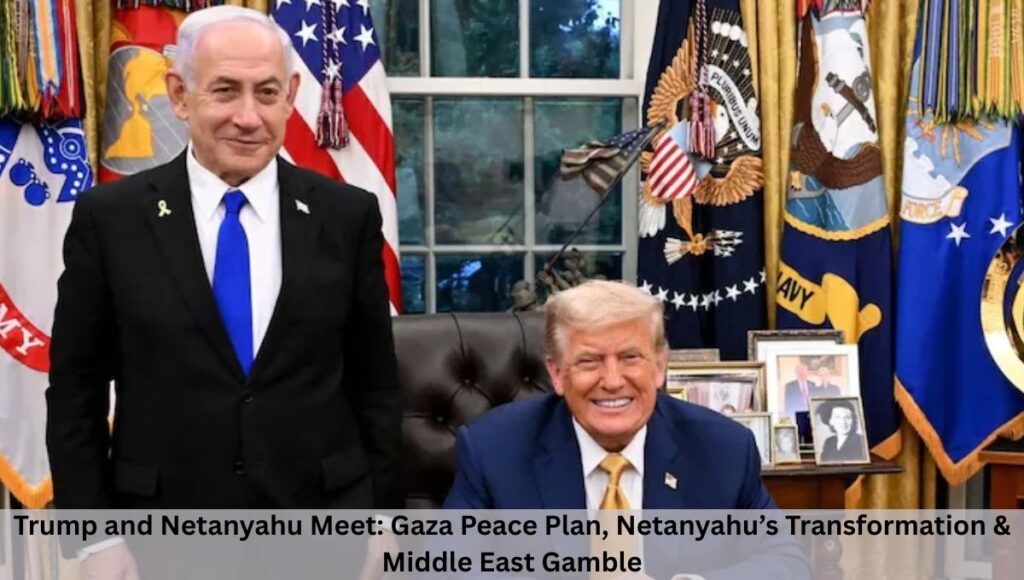
Trump and Netanyahu Meet: Gaza Peace Plan, Netanyahu’s Transformation & Middle East Gamble
Netanyahu’s Transformation Since October 7
From Cautious Operator to Risk-Taker
For most of his political career, Netanyahu earned a reputation for avoiding large-scale wars and preferring limited, calculated conflicts. In 2012, for instance, Operation Pillar of Defense in Gaza lasted just eight days. Rivals often mocked him as a leader of “big words, small actions.”
But the October 7 Hamas-led attack, which left over 1,200 Israelis dead, shattered that playbook. In its aftermath, Netanyahu promised, “We are going to change the Middle East.”
Since then, Israel has pursued daring, prolonged operations not only in Gaza but also against Iran, Hezbollah, the Houthis, and Syrian assets, with Netanyahu boasting at the UN General Assembly that Israel had “devastated Iran’s atomic weapons and missile programs” and “crippled Hezbollah.”
Analysts Weigh In: Changed Man or Cornered Politician?
- Mazal Mualem, author of The Netanyahu Code, argues that the October 7 security collapse was a “wake-up call,” transforming Netanyahu into a leader unafraid of prolonged wars and resistant to security establishment caution.
- Anshel Pfeffer, author of Bibi: The Turbulent Life and Times of Benjamin Netanyahu, disagrees, claiming Netanyahu remains risk-averse but is now addicted to a “status quo of war.”
Both agree that fear remains Netanyahu’s central motivator—whether fear of history’s judgment, of his corruption trial, or of losing his coalition.
The Trump Factor: From Unconditional Backing to Subtle Limits
Trump’s Support for Israel
The Trump administration has been Israel’s most consistent ally throughout the nearly two-year Gaza war, offering diplomatic cover, military support, and regional coordination. Trump has framed his leadership as the key to delivering “greatness in the Middle East.”
At the UNGA, Trump unveiled his 21-point Gaza peace plan, which he claimed could usher in the region’s first real chance at peace.
Trump’s Mercurial Role
But Trump’s support comes with caveats. In June, while backing Israeli strikes on Iran, he abruptly forced Israel to turn back fighter jets mid-operation after declaring the hostilities over.
This unpredictability underscores a critical dynamic: Netanyahu cannot assume Trump’s support is unconditional, particularly as Trump now signals that “the time has come to end the Gaza war.”
The 21-Point Gaza Peace Plan: What’s on the Table?
Core Proposals
Trump’s plan, drafted with Jared Kushner, envoy Steve Witkoff, and former UK Prime Minister Tony Blair, contains the following elements:
- Hostage Release: All 48 remaining captives in Gaza to be freed within 48 hours of a ceasefire.
- Ceasefire & Withdrawal: A permanent ceasefire and gradual Israeli withdrawal from Gaza.
- Palestinian Prisoner Release: Israel to free ~250 prisoners serving life terms and ~2,000 detainees from Gaza.
- New Governance: Establishment of the Gaza International Transitional Authority (GITA), run by an international board with Palestinian technocrats on the ground.
- Security Mechanism: A multinational stabilization force to oversee border crossings, Gaza’s coastline, and security zones.
- Reconstruction Funding: Arab and Muslim countries to finance humanitarian aid and reconstruction.
- Hamas Amnesty or Exile: Fighters can renounce violence and remain in Gaza or leave under amnesty.
- No Annexation: Israel to refrain from annexing Gaza or the West Bank.
- Path to Statehood: A reformed Palestinian Authority may eventually oversee Gaza, with the door left open for future Palestinian statehood.
Why It’s Contentious
Netanyahu’s far-right allies—Itamar Ben Gvir and Bezalel Smotrich—fiercely oppose the plan, particularly its recognition of Palestinian rights and potential for statehood. Both demand the permanent occupation of Gaza and have threatened to topple Netanyahu’s government if he concedes.
Also Read: Trump’s Gaza plan is a significant step – but faces fundamental obstacles
Netanyahu’s Political Tightrope
Fragile Coalition
Netanyahu’s Likud-led government is already in minority territory with 60 of 120 seats. Recent defections by ultra-Orthodox allies over military conscription disputes further weakened him.
Ben Gvir and Smotrich, holding 13 seats combined, wield enormous leverage. They could force early elections, though their own interests in continuing the war make immediate collapse unlikely.
Public Pressure
Initially united behind Netanyahu after October 7, Israeli public opinion has soured. Support for the war has eroded amid rising casualties, economic strain, and diplomatic isolation. International recognition of Palestinian statehood and threats of sanctions have only deepened Israel’s crisis of legitimacy.
Regional and Global Stakes
Arab and Muslim States’ Role
Arab states, including Qatar, Egypt, the UAE, and Saudi Arabia, are deeply involved in the peace process. Their support for Trump’s plan reflects growing fatigue with the Gaza war and concern about regional instability.
International Legitimacy
Israel’s actions in Gaza have triggered widespread condemnation, with over 66,000 Palestinians killed since October 2023, according to Gaza health authorities. Global protests, sanctions discussions, and legal challenges at international courts add pressure on Netanyahu.
U.S.-Israel Alliance
Trump’s plan represents the most serious U.S. effort to end the Gaza war. Whether Netanyahu accepts it may shape not only Israel’s future but also Trump’s legacy in Middle East diplomacy.
The Blair Factor: Gaza’s Transitional Governance
Trump’s plan controversially includes Tony Blair as a potential leader of the Gaza International Transitional Authority. Blair, whose role in the 2003 Iraq War remains polarizing, is seen by some as a credible international mediator and by others as an illegitimate foreign overseer.
The GITA’s proposed structure places international diplomats and businessmen at the top, with Palestinian technocrats implementing policy under their oversight. Critics say this risks reinforcing Gaza’s dependence rather than promoting genuine Palestinian self-governance.
Netanyahu’s Dilemma: Legacy or Survival?
Netanyahu stands at a historic crossroads. On one hand, embracing Trump’s peace plan could secure his partnership with Washington, stabilize Gaza, and potentially open a path to normalization with Arab states. On the other, it risks shattering his coalition, empowering rivals, and exposing him to political downfall.
His gamble—to stake his legacy on military might and then pivot toward peace under Trump’s terms—could either rehabilitate his image as a Churchill-like defender of Israel or cement him as a desperate gambler clinging to power.
Conclusion: What Comes Next?
As Trump and Netanyahu meet in Washington, the contradictions defining this moment are stark:
- Trump promotes peace but remains unpredictable.
- Netanyahu projects strength but is politically vulnerable.
- Israel seeks security but faces eroding legitimacy.
- Palestinians yearn for relief but remain caught in the crossfire of geopolitics.
Whether this meeting produces a breakthrough or simply delays another chapter of conflict depends on how far Netanyahu is willing to bend—and how firm Trump is prepared to be.
For now, the Middle East watches as two leaders, each defined by ambition and survival instincts, test the boundaries of history.
Also Read: France Formally Recognises Palestine, Joins Wave of Western Nations
Related Posts:
- Trump’s 2025 Gaza Peace Plan Signing and Historic…

- Gaza Peace Deal First Phase Achieved: Trump’s Israel…

- 5 Powerful Highlights as Trump Lands Second Nobel…

- Dramatic Moments Behind Trump’s Gaza Peace Push and…

- Israel Awards Highest Honor to Trump in 2025 for…

- 7 Shocking Reasons FIFA’s Peace Prize for Trump…
