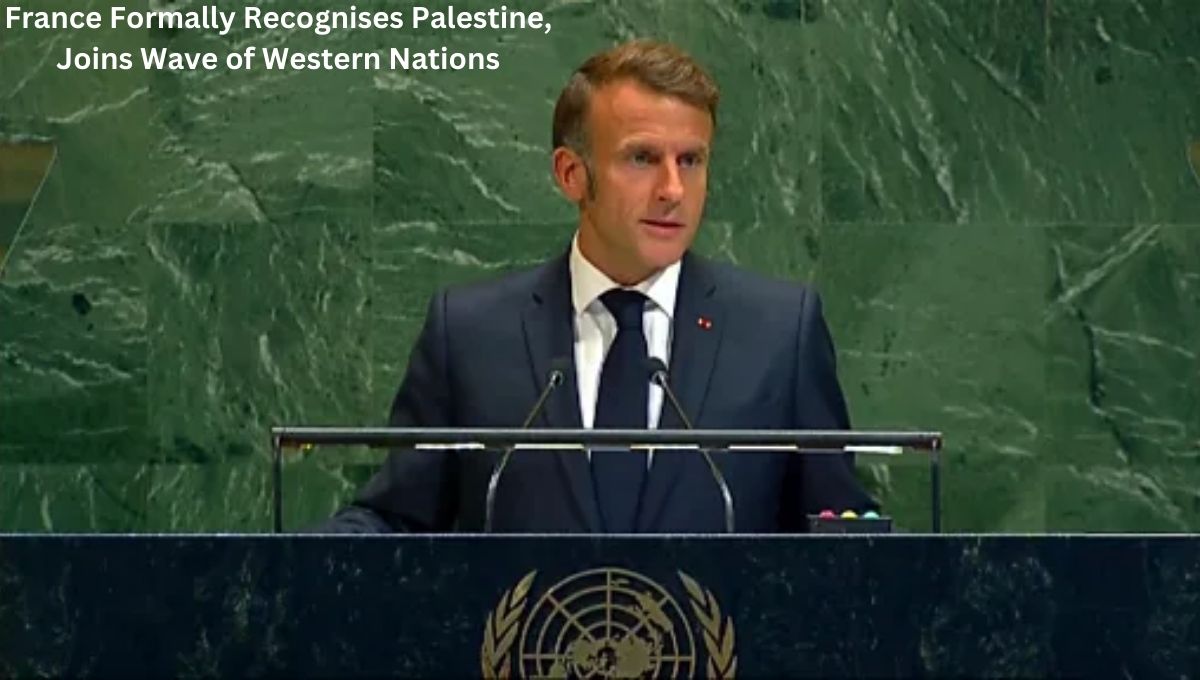
In a landmark diplomatic shift, France Formally Recognises Palestine, Joins Wave of Western Nations. France has formally recognised the State of Palestine, becoming the latest Western nation to break with decades of diplomatic caution and extend official recognition. The announcement was made on Monday at the 80th Session of the United Nations General Assembly in New York, where President Emmanuel Macron declared that “the time for peace has come” and that “nothing justifies the ongoing war in Gaza.”
Speaking before world leaders, Macron framed the decision as both a moral responsibility and a strategic necessity. He said France’s recognition represented a “defeat for Hamas”, making clear that Paris’s intention was not to reward militant violence but to preserve the viability of a two-state solution.
“True to the historic commitment of my country to the Middle East, to peace between the Israelis and the Palestinians, this is why I declare that today, France recognises the state of Palestine,” Macron told the Assembly. The decision aligns France with a growing bloc of Western states, including the United Kingdom, Canada, Australia and Portugal, which announced recognition of Palestinian statehood a day earlier.
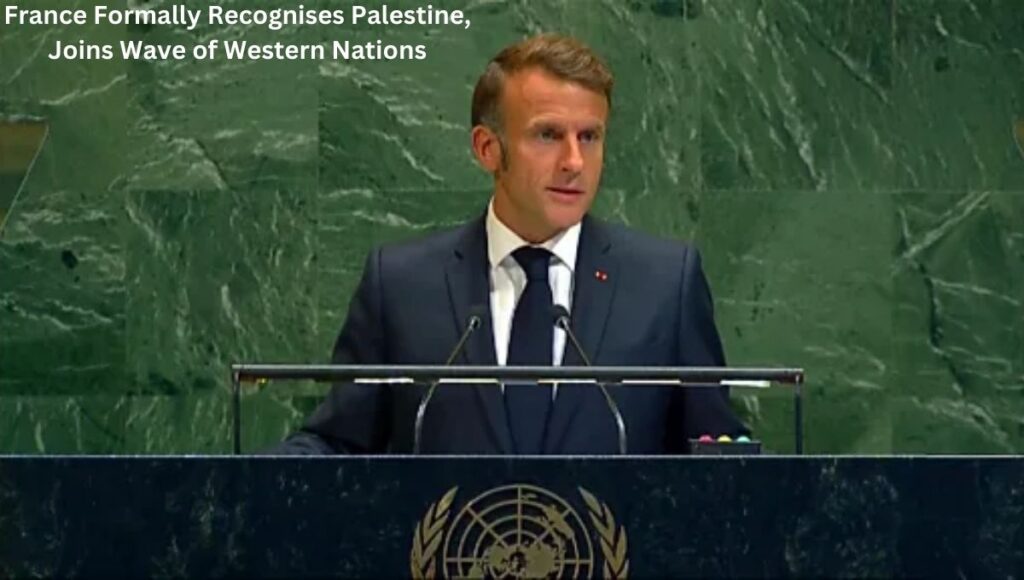
France Formally Recognises Palestine, Joins Wave of Western Nations
A Turning Point in Western Diplomacy
France’s move comes amid mounting international pressure on Israel over its military campaign in Gaza and expanding settlement activity in the West Bank. The humanitarian crisis has reached catastrophic levels, with more than 65,000 Palestinians killed, according to Gaza’s Hamas-run health ministry, and famine confirmed in parts of Gaza City.
Over 140 countries worldwide have already recognised Palestine, but France’s announcement marks a significant moment. As a G7 member and permanent UN Security Council power, Paris’s decision carries substantial weight in international diplomacy.
Belgium, Luxembourg, Malta, Andorra and San Marino are expected to follow in the coming days, accelerating a momentum that analysts say is reshaping Western engagement in the Middle East.
Also Read: What does recognising a Palestinian state mean?
Israel’s Response: Rejection and Defiance
Israeli officials reacted with fury to France’s decision. Ambassador Danny Dannon, speaking in New York just before Macron’s announcement, dismissed the UN discussions as a “charade” and said the idea of a two-state solution had been “taken off the table” after the Hamas attack of October 7, 2023, which left about 1,200 people dead and 251 taken hostage.
Prime Minister Benjamin Netanyahu reiterated his government’s position that “there will be no Palestinian state to the west of the River Jordan.” President Isaac Herzog warned that recognition would “embolden the forces of darkness.”
Some Israeli officials have gone further, suggesting annexation of the occupied West Bank remains a possibility. Last month, Israel approved a controversial new settlement project that critics say could effectively split the West Bank in half, making any future Palestinian state non-contiguous.
Palestinian Authority Welcomes Recognition
Palestinian President Mahmoud Abbas addressed the UN via video link, after the U.S. revoked visas for him and dozens of Palestinian officials. He welcomed France’s announcement, calling for a permanent ceasefire and a future free of Hamas’s control.
“Hamas has no role in governing Gaza,” Abbas said, urging the militant group to surrender its weapons to the Palestinian Authority (PA). “What we want is one unified state without weapons,” he added, while also condemning the October 7 attack.
Abbas framed the recognition drive as a path to peace: “Our future and yours depends on peace. Enough violence and war.”
Also Read: Belgium to Recognise Palestine at UN General Assembly and Imposes 12 Sanctions on Israel
Saudi Arabia and Arab States Push Two-State Solution
Saudi Foreign Minister Faisal bin Farhan Al Saud, speaking on behalf of Crown Prince Mohammed bin Salman, told the UN that a two-state solution was the only viable path to regional peace.
Saudi Arabia, alongside France, has been instrumental in pressing Western nations to recognise Palestine. Riyadh views recognition as a key step that could eventually open the door to its own normalisation of relations with Israel, provided certain conditions are met.
Arab leaders have stressed that Hamas must not be part of any new Palestinian administration. A joint conference hosted by France and Saudi Arabia in New York last month called for Hamas’s disarmament and the deployment of a temporary international stabilisation mission in Gaza.
European Union: Reconstruction and Support
European Commission President Ursula von der Leyen announced the creation of a new Palestine Donor Group aimed at financing Gaza’s reconstruction. “We must all do more,” she said, stressing that recognition must be matched with financial and humanitarian commitments.
Germany has so far resisted immediate recognition. Foreign Minister Johann Wadephul stated that for Berlin, recognition comes “at the end of the process” but admitted that “this process must begin now.”
Italy has also argued recognition could be “counter-productive” in the absence of a viable Palestinian state infrastructure.
UN’s Position: Intolerable Situation in Gaza
UN Secretary-General Antonio Guterres described the Gaza war as “morally, legally and politically intolerable.” He called the two-state solution the “only credible path” forward.
The UN General Assembly recently passed a resolution reviving the two-state framework, endorsed by 142 nations, including India. The resolution came just a day after Netanyahu categorically rejected Palestinian statehood, underlining the deep divide between Israel and much of the international community.
Canada, UK, Australia Join Recognition Wave
On Sunday, Canada became the first among its Western peers to formally recognise Palestine. Prime Minister Mark Carney pledged Ottawa’s “full partnership in building the promise of a peaceful future.”
Australia and the UK soon followed. British Prime Minister Keir Starmer said recognition was consistent with Britain’s historic responsibility in the region, while Australia emphasised its desire to preserve the possibility of peace amid escalating violence.
For these countries, recognition also reflects frustration with Israel’s current government and a desire to distance themselves from the Trump administration’s policy of staunch support for Netanyahu.
Macron’s Path to Recognition: From Frustration to Action
Analysts note that Macron’s shift began after the October 7 Hamas attack. As civilian casualties mounted in Gaza, French officials grew frustrated with Washington’s reluctance to pressure Israel. Macron first hinted at recognition in February 2024 during a visit to Jordan’s King Abdullah II, saying it was “not a taboo for France.”
By December, Macron was coordinating closely with Saudi Arabia’s Crown Prince Mohammed bin Salman, laying groundwork for a recognition campaign. In April, he visited Egypt and met with wounded Palestinians, a trip that reportedly had a deep personal impact.
In July, Macron addressed the British Parliament, warning: “With Gaza in ruins and the West Bank being attacked daily, a Palestinian state has never been put at risk as it is.”
His recognition pledge, sent in a private letter to Mahmoud Abbas in late July, set the stage for this week’s announcement and spurred other Western countries to follow suit.
A Defiance of U.S. Policy
The recognition wave marks a direct challenge to U.S. policy under President Donald Trump, who has opposed Palestinian statehood and strongly backed Israel throughout the Gaza war.
U.S. officials privately warned that recognition could be “the very end of the chance” at a two-state solution, arguing it would embolden Israel to retaliate and reduce incentives for the Palestinian Authority to reform.
Nonetheless, the absence of the U.S. at the France-Saudi hosted peace summit on Monday highlighted Washington’s diplomatic isolation on this issue.
Domestic Reactions in France and Europe
In France, the recognition was met with a mix of celebration and controversy. On Sunday night, both the Palestinian and Israeli flags were projected onto the Eiffel Tower.
Some local town halls flew Palestinian flags, despite a government directive to maintain neutrality.
Across Italy, pro-Palestinian protests erupted in about 80 towns and cities, underscoring the growing mobilisation of European civil society.
Looking Ahead: Uncertain Future
While Macron insisted France would only open an embassy to a Palestinian state once all hostages were released and a ceasefire agreed, questions remain about what recognition means in practical terms.
Israel shows no sign of halting its offensive in Gaza or curbing settlement expansion. Netanyahu’s coalition remains firmly opposed to Palestinian statehood, and any moves toward annexation could trigger new flashpoints across the region.
At the same time, the Palestinian Authority faces credibility challenges, with corruption and weak governance undermining its ability to present itself as a viable alternative to Hamas.
Conclusion: A Diplomatic Gamble
France’s recognition of Palestine is a historic gamble, one that shifts the diplomatic landscape of the Middle East and Europe. By joining the UK, Canada, Australia and others, Macron has placed Paris at the centre of renewed efforts to salvage the two-state solution. Whether this decision sparks progress toward peace—or deepens the impasse—remains uncertain.
But for now, France’s move represents a rare moment of bold Western leadership on one of the world’s most intractable conflicts.