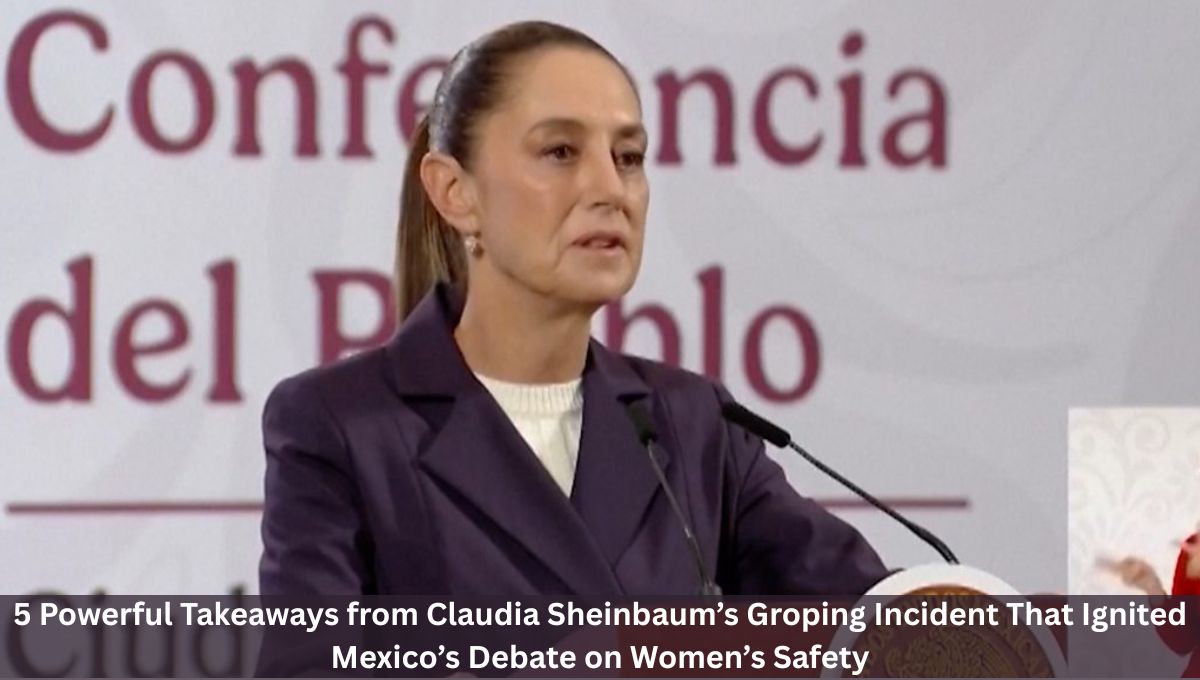
5 Powerful Takeaways from Claudia Sheinbaum’s Groping Incident That Ignited Mexico’s Debate on Women’s Safety, harassment laws, and machismo. In a shocking incident that has stirred both outrage and reflection, Mexico’s President Claudia Sheinbaum announced she is pressing charges against a man who groped her during a public appearance in Mexico City on November 4. The encounter, captured on multiple mobile phones, showed a man approaching the president from behind, touching her body without consent, and attempting to kiss her neck.
The footage, widely circulated online, has sparked a broader national debate — not only about presidential security but also about the entrenched culture of machismo and everyday harassment faced by women across Mexico. Sheinbaum, 63, Mexico’s first female president, moved swiftly to condemn the incident as an assault on all women.
Speaking during her regular morning press briefing the next day, she declared:
“If I don’t file a complaint, what will happen to other Mexican women? If they do this to the president, what will happen to all women in our country?” Her firm decision to take legal action against the man — identified by authorities as Uriel Rivera Martínez — has made the episode not only a personal act of defiance but a symbolic turning point in Mexico’s ongoing battle for women’s safety and dignity.
5 Powerful Takeaways from Claudia Sheinbaum’s Groping Incident That Ignited Mexico’s Debate on Women’s Safety
1. The Incident: A Disturbing Violation in Public View
According to reports, the assault occurred as Sheinbaum was greeting supporters near the National Palace in Mexico City. The man, allegedly under the influence of alcohol, wrapped his arm around her shoulder, touched her chest and hip, and attempted to kiss her.
A member of her team, Juan José Ramírez Mendoza, quickly intervened, and the man was later arrested by the Sex Crimes Investigation Unit.
The viral video, viewed millions of times within hours, triggered widespread anger and concern. Many viewers expressed disbelief that such an act could happen to the head of state in full public view, while others saw it as a chilling reminder of what ordinary women face every day.
Sheinbaum later clarified that she was walking from the National Palace to the Ministry of Education, a short five-minute route, when the incident occurred.
“We thought it would be faster to walk. But this shows that no woman — no matter her position — is safe from harassment,” she said.
Also Read: Mexican women outraged by public sexual assault on their president
2. The Attacker: Who Is Uriel Rivera Martínez?
The suspect, identified as Uriel Rivera Martínez, was detained hours after the incident. Arrest records described him as approximately 1.60 metres tall, of dark complexion, with black hair.
While little is publicly known about his occupation or background, authorities confirmed that he appeared intoxicated and had allegedly harassed two other women earlier that day.
If convicted, Martínez could face up to six years in prison under Mexico City’s sexual assault laws, with potential sentence aggravation due to multiple harassment complaints.
Sheinbaum confirmed that he was “completely drunk” at the time and that “this was not an isolated act.” She stated:
“This individual was harassing other women in the same area. A line must be drawn. Harassment is a crime, and every woman deserves respect.”
3. The National Outcry: ‘If They Can Do This to the President…’
The video quickly dominated Mexican news cycles and social media platforms, trending under hashtags like #NoMasAcoso (No More Harassment) and #ConElla (With Her). Women’s rights activists and feminist groups described the event as a reflection of the deep-rooted machismo that continues to permeate Mexican society.
Many commentators emphasized that the attack demonstrated a grim reality — that even the most powerful woman in the country is not immune to harassment. “If they can do this to the president, imagine what happens to women without power, protection, or witnesses,” wrote one activist on X.
The Secretariat for Women, part of Sheinbaum’s own administration, issued a strong statement condemning the assault:
“No woman is exempt from sexual harassment in our country. These acts are not only violent but criminal. Denouncing them is fundamental to justice and cultural change.”
Women’s rights organizations also called for stronger legal protections and better enforcement, noting that the vast majority of sexual crimes in Mexico go unpunished.
4. Mexico’s Grim Reality: Harassment and Femicide Crisis
The attack on Sheinbaum has reignited public attention toward Mexico’s longstanding gender-based violence crisis. According to the National Institute of Statistics and Geography (INEGI), over 70% of Mexican women aged 15 and above have experienced at least one form of violence — and 49% report having suffered sexual harassment or assault.
The United Nations has also warned that 10 women are murdered every day in Mexico, often in crimes that remain unsolved. Activists argue that these figures represent just the tip of the iceberg, as many cases go unreported or misclassified.
Despite Sheinbaum’s promises during her presidential campaign to tackle femicide and improve justice for victims, progress has been slow. Critics say that while her administration has made strides in areas such as fentanyl trafficking and national security, gender-based violence continues to plague daily life.
Still, her decision to file charges has been hailed by many as a watershed moment — one that could empower more women to come forward. “When the president says, ‘Enough,’ it resonates beyond politics. It’s about changing the national mindset,” said sociologist Ana María López of the National Autonomous University of Mexico (UNAM).
5. A Call for Legal Reform: Making Harassment a Crime Nationwide
One of the most significant outcomes of the incident has been Sheinbaum’s public call for a nationwide review of harassment laws. Currently, Mexico’s 32 states have different legal definitions and punishments for sexual harassment, and not all classify it as a crime.
Mexico City, where the attack occurred, does — but other regions only treat it as a misdemeanor or administrative offense. Sheinbaum said she will work with the Secretariat for Women to push for unified legislation that ensures sexual harassment is punishable by law across all states.
“It should be a criminal offense everywhere. We are going to launch a campaign so that women can report harassment without fear,” she said. “Harassment must not be trivialized — it must be named, punished, and eradicated.”
Her government has already begun consultations with the National Congress to explore amendments to the Federal Criminal Code, which would make sexual harassment a nationally recognized offense.
Security Concerns: Should the President Have More Protection?
The groping incident also reignited debate over presidential security in Mexico. Like her mentor and predecessor Andrés Manuel López Obrador (AMLO), Sheinbaum has chosen not to maintain the Presidential Guard, which was dissolved in 2018 to symbolize closeness to the people.
Security analysts have criticized this decision, warning that the lack of a specialized protection unit creates vulnerabilities.
“After the dissolution of the Presidential Guard, no equivalent professional security system was rebuilt,” said analyst Raúl Benítez-Manaut. “Sheinbaum depends on a small group of aides rather than a trained perimeter defense team.”
The timing of the incident has further heightened concerns, coming just days after the assassination of Carlos Manzo, the mayor of Uruapan in the violent state of Michoacán. Manzo had publicly requested federal support to combat drug cartels before being shot dead during Day of the Dead festivities.
Still, Sheinbaum remains firm in her approach. “We can’t stay far from the people — that would deny who we are,” she told reporters. “Our aides will continue to accompany us, but we must remain close to citizens.”
Media Ethics Debate: ‘Re-victimization’ and Responsible Coverage
The controversy has extended to Mexico’s media after the newspaper Reforma published still images of the assault. Sheinbaum condemned the act, calling it “an act of re-victimization.” “Using those images is also a crime. It crosses an ethical line,” she said, citing Mexico’s digital violence laws.
The Women’s Ministry supported her statement, urging journalists to avoid sharing images that exploit victims or violate privacy. The ministry emphasized that respectful reporting is crucial to fostering a culture of accountability and dignity.
Public Reaction: A Moment of Reckoning
Across Mexico, the public response to Sheinbaum’s decision has been deeply emotional. For some, it symbolized the everyday struggles of Mexican women. For others, it underscored the systemic failures that allow harassment and violence to persist unchecked.
Street protests and solidarity events have been reported in Mexico City, Guadalajara, and Monterrey, with demonstrators chanting, “No means no — even for the president.”
Editorials across major newspapers described the episode as a turning point, suggesting it might push the administration to adopt a national gender safety framework — one that goes beyond symbolism and delivers tangible protections for women.
Claudia Sheinbaum’s Legacy and the Road Ahead
Claudia Sheinbaum’s presidency was already historic — she became Mexico’s first female head of state and one of the few women leaders in Latin America’s history. Yet, this moment has added a new layer of meaning to her leadership.
By choosing to press charges and call for legislative reform, Sheinbaum has transformed a moment of personal violation into a collective statement of resistance. Her message is not just political; it is deeply cultural — a rejection of the normalization of harassment.
“There must be respect for women in every sense,” she said. “Harassment is a crime — and it’s time everyone in this country understands that.” As Mexico continues to grapple with machismo, gender inequality, and violence, Sheinbaum’s response has set a precedent for both justice and leadership.
Whether this incident will lead to concrete change remains to be seen — but it has undoubtedly ignited one of the most important national conversations of her presidency.
Also Read: Thai Monk Scandal: ₹100 Crore Blackmail Rocks Buddhist Clergy