7 Devastating Facts About Typhoon Kalmaegi: Philippines Declares National Calamity After 114 Deaths, 127 Missing. The Philippines is reeling from the devastating aftermath of Typhoon Kalmaegi, which has killed at least 114 people and left 127 missing across the country’s central regions.
President Ferdinand Marcos Jr. has declared a state of calamity, describing the situation as a “national emergency” and warning of another incoming storm that could strike the country within days.
The typhoon, locally known as Tino, is being described as the deadliest natural disaster to hit the Philippines in 2025. It unleashed torrential rain, flash floods, and landslides that destroyed homes, submerged towns, and displaced more than 560,000 residents — many of whom are now sheltering in evacuation centers.
7 Devastating Facts About Typhoon Kalmaegi: Philippines Declares National Calamity After 114 Deaths
Cebu Bears the Brunt of Deadly Flash Floods
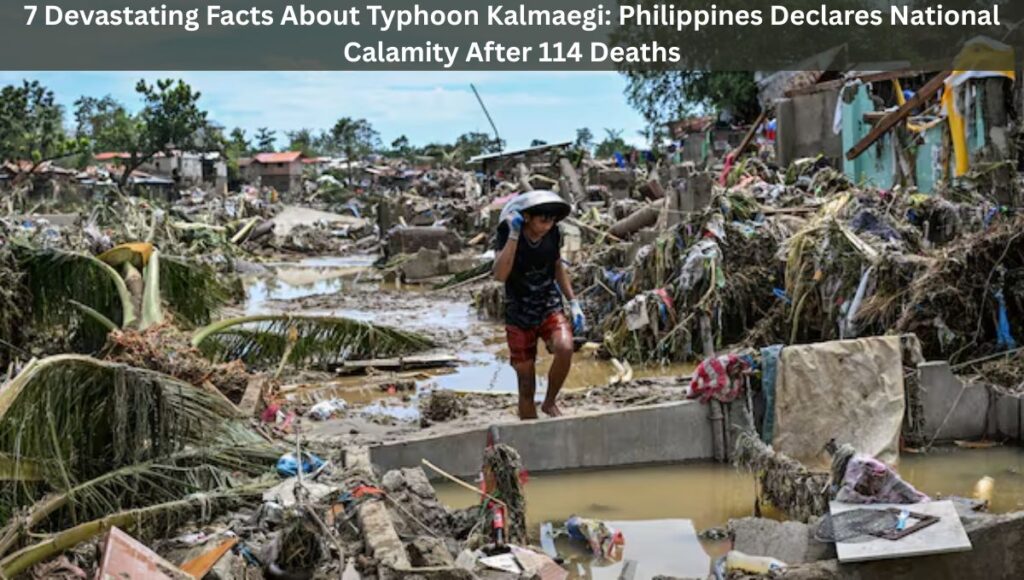
The province of Cebu, one of the country’s most populous islands, was the worst hit. Rivers overflowed and hillsides collapsed, sending torrents of muddy water into residential areas and city centers. Officials confirmed that 71 of the deaths occurred in Cebu alone, with dozens more injured or missing.
“Almost all the rivers here overflowed,” said Carlos Jose Lañas, a 19-year-old volunteer rescuer. “This is the worst flood I’ve ever experienced. Even emergency responders were caught off guard.”
Authorities described the situation as “unprecedented,” noting that even seasoned disaster-response teams were overwhelmed by the volume of emergency calls and rising water levels. Rescue operations stretched into the night as locals were trapped on rooftops, waiting for boats or helicopters to arrive.
President Marcos Declares National Emergency
On Thursday, President Ferdinand Marcos Jr. formally declared a national state of calamity, granting the government power to fast-track the release of emergency funds and control food pricing to prevent hoarding.
“Almost 10 to 12 regions will be affected. With that kind of scope, it’s a national calamity,” Marcos said during a press briefing.
The declaration allows agencies to mobilize resources faster, procure emergency supplies, and coordinate relief efforts across multiple provinces.
Marcos also expressed concern about a new storm forming east of the country — Typhoon Uwan (international name Fung-wong) — which meteorologists warn could strengthen into a super typhoon by the weekend.
“The next storm could be even stronger,” the president warned, urging preparedness among northern and central provinces.
Scenes of Destruction Across the Philippines
Across Cebu, entire neighborhoods were submerged. Streets turned into rivers, cars were overturned, and bridges washed away. Local reports showed residents wading waist-deep through floodwaters carrying only food and clothing.
“Right now, the rain has stopped and the sun is out, but our houses are filled with mud,” said Jel-an Moira Servas, a small business owner in Mandaue City. “We don’t even know where to start cleaning. Everything inside is in shambles.”
According to the Office of Civil Defense, nearly 2 million people have been affected by Typhoon Kalmaegi. Over 450,000 people are being housed in temporary evacuation centers, while others are staying with relatives or in community shelters.
In addition to the civilian casualties, six Philippine Air Force crew members were killed when their helicopter crashed on Mindanao Island while delivering relief supplies.
Debris Clearing and Rescue Efforts Underway
As floodwaters began to recede by Thursday, the scale of devastation became clear.
Raffy Alejandro, a senior civil defence official, said:
“The challenge now is debris clearing. These need to be cleared immediately, not only to account for the missing who may be among the debris or may have reached safe areas but also to allow relief operations to move forward.”
Rescue teams are still searching for dozens of missing people, many believed to be trapped in collapsed homes or buried under landslides. Emergency workers and volunteers are racing against time to restore electricity, water, and communication lines in the affected areas.
Experts Link Flooding to Poor Infrastructure
Experts have pointed out that years of unchecked quarrying and substandard flood control systems may have worsened the damage in Cebu.
Local residents have long complained of incomplete or poorly built flood projects, some of which have been mired in corruption allegations.
Environmental groups are urging the government to prioritize sustainable infrastructure and proper drainage systems, especially in coastal and low-lying areas vulnerable to typhoons.
Kalmaegi Strengthens as It Heads Toward Vietnam
After wreaking havoc in the Philippines, Typhoon Kalmaegi exited the archipelago early Thursday morning and entered the South China Sea, where it began to regain strength.
Meteorologists at the U.S. Joint Typhoon Warning Center (JTWC) upgraded it to a Category 4 storm, warning that it was “barrelling toward the Vietnamese coast” and expected to make landfall near Quy Nhon in central Vietnam.
Vietnamese authorities have already begun evacuating around 350,000 people from high-risk areas in the provinces of Gia Lai and Dak Lak, and mobilizing thousands of soldiers to support relief and rescue efforts.
The storm threatens to bring heavy rains and damaging winds to key coffee-producing regions, potentially disrupting the country’s ongoing harvest.
Also Read: Typhoon Kalmaegi slams into Vietnam after killing 114 people in the Philippines
Regional Impact: Vietnam and Thailand Brace for Storm
Vietnam’s aviation authorities warned that eight airports, including Da Nang International Airport, could suspend operations as the storm approaches. More than 50 flights have been cancelled or rescheduled as a precaution.
In Thailand, officials have issued flood and landslide alerts in northern and central provinces, anticipating the storm’s remnants to cause torrential rainfall and river overflows.
Both countries have learned from past typhoons that early evacuation and coordination can dramatically reduce casualties.
Recurring Disasters and Climate Resilience Challenges
The Philippines faces an average of 20 typhoons each year, making it one of the world’s most disaster-prone countries. Kalmaegi follows a series of calamities, including Super Typhoon Ragasa and Typhoon Bualoi, which struck just weeks earlier, as well as a 6.9 magnitude earthquake that killed over 70 people.
This string of natural disasters has amplified calls for the government to strengthen early-warning systems, modernize rescue infrastructure, and improve urban planning to withstand future climate shocks.
Scientists warn that climate change is intensifying tropical storms in the Pacific, leading to more frequent and destructive typhoons. Warmer ocean temperatures are allowing storms like Kalmaegi to gather strength rapidly, even after passing over land.
Human Stories Amid the Ruin
In the aftermath, stories of survival and community spirit have begun to emerge. Volunteers in Cebu have set up makeshift kitchens and donation drives to feed evacuees.
Local radio stations have been broadcasting rescue hotlines, and social media is filled with calls for missing loved ones.
Despite the trauma, many Filipinos expressed resilience — a familiar, bittersweet theme in a country battered by natural disasters yet renowned for its strength in recovery.
“We lost our home, but not our hope,” said a flood survivor in Consolacion. “We will rebuild again.”
Next Storm Looms: Typhoon Uwan Approaching
Even as Kalmaegi moves toward Vietnam, another storm — Typhoon Uwan (Fung-wong) — is forming east of the Philippines and could make landfall in northern Luzon by the weekend.
The Philippine Atmospheric, Geophysical and Astronomical Services Administration (PAGASA) has issued early warnings, stating that Uwan has “an increasing chance of landfall” and may intensify into a super typhoon.
Officials have urged residents in flood-prone areas to stay alert, stock supplies, and heed evacuation orders if necessary.
Outlook: Long Road to Recovery
The full extent of Typhoon Kalmaegi’s destruction is still being assessed. Damage to infrastructure, agriculture, and housing is expected to cost billions of pesos.
For now, rescue operations and humanitarian relief remain the government’s top priority. As President Marcos put it, “We will rebuild. But we must rebuild smarter — and stronger.”
With another storm already on the horizon, the Philippines’ struggle against the forces of nature continues, underscoring the urgent need for climate resilience and disaster preparedness in one of the world’s most vulnerable nations.
Key Takeaways
- Death toll: 114 confirmed, 127 missing
- Regions affected: Cebu, Negros, Mindanao, Palawan
- People displaced: Over 560,000
- Typhoon category: 4 (regaining strength over South China Sea)
- Next threat: Typhoon Uwan (Fung-wong) approaching Luzon
- Vietnam evacuations: 350,000 people moved to safety
Also Read: At Least 12 Dead, Hundreds of Thousands Evacuated as Typhoon Bualoi Slams Vietnam