9 Explosive Facts Driving Iran’s Deepening Protest Crisis fueled by economic collapse, sanctions, and post-war pressure.Iran is once again confronting widespread street protests as mounting economic hardship, political repression, and geopolitical isolation collide.
Demonstrations that began as a protest against rising living costs have now spread to much of the country, reviving memories of past uprisings and placing renewed pressure on the Islamic Republic’s aging leadership.
The unrest comes at a particularly fragile moment for Tehran. The country is still reeling from a 12-day war with Israel in June that saw U.S. forces bomb Iranian nuclear facilities. Since then, renewed United Nations sanctions, a collapsing currency, and the weakening of Iran’s regional alliances have intensified public anger.
With protests spreading and a growing death toll, U.S. President Donald Trump has issued stark warnings, raising fears that Iran’s internal crisis could once again escalate into a dangerous international confrontation.
Here is what to know about the protests shaking Iran and the challenges now facing its government.
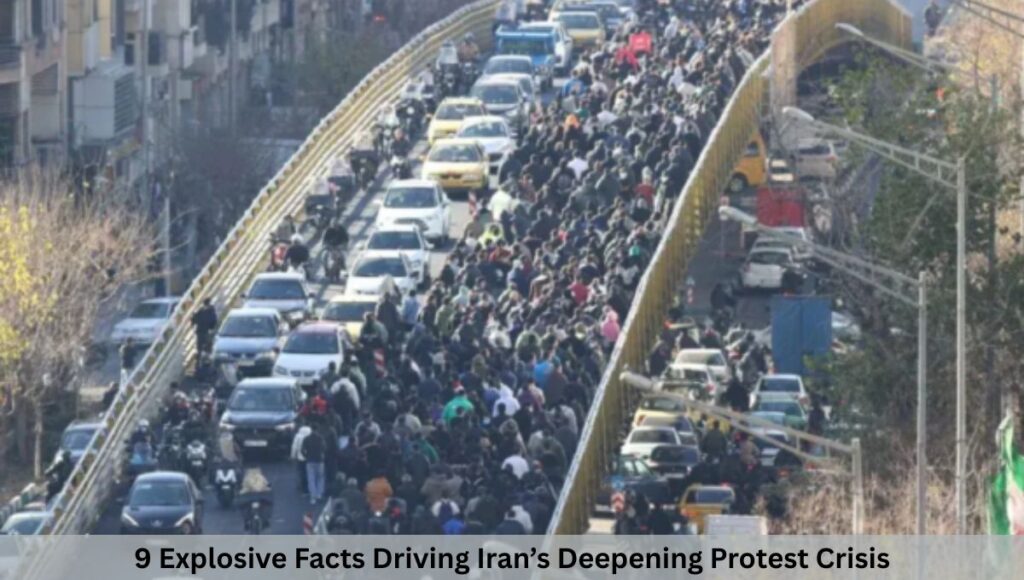
9 Explosive Facts Driving Iran’s Deepening Protest Crisis
How Widespread Are the Protests?
The demonstrations have reached an extraordinary geographic scale.
According to the U.S.-based Human Rights Activists News Agency (HRANA), protests have been reported in more than 220 locations across 26 of Iran’s 31 provinces.
Other tallies suggest the unrest has touched at least 40 cities, most of them small and medium-sized, with concentrations in western regions.
At least 20 to 35 people have been killed, including protesters, children, and members of the security forces, according to rights groups. Arrests exceed 1,200 nationwide, underscoring the scale of the crackdown.
Independent verification remains difficult. Iranian state media has largely downplayed the demonstrations, while journalists inside the country face travel restrictions, surveillance, and the risk of detention.
Online videos—often shaky and brief—provide only fragments of what is unfolding on the ground.
Despite the lack of transparency, one thing is clear: the protests have not subsided, even after Supreme Leader Ayatollah Ali Khamenei warned that “rioters must be put in their place.”
What Sparked the Protests?
A Collapsing Currency and Rising Prices
At the heart of the unrest is Iran’s collapsing economy.
The Iranian rial has plunged into free fall, now trading at roughly 1.4 million rials to one U.S. dollar.
Compared with a year ago, the currency has lost around 80% of its value, wiping out purchasing power for ordinary Iranians.
Annual inflation stands at about 40 to 42%, while food inflation exceeds 70%. Prices of staples such as meat, rice, and cooking oil have surged, placing basic survival out of reach for many families.
Fuel Price Shock
In December, the government introduced a new pricing tier for subsidized gasoline, raising the cost of some of the world’s cheapest fuel.
Officials also announced that fuel prices would now be reviewed every three months—signaling the likelihood of further increases.
The fuel hike proved to be a tipping point.
Protests began with a shopkeepers’ strike in Tehran on December 28, quickly spreading as public frustration boiled over.
From Economic Grievances to Political Anger
Although the protests were initially driven by economic concerns, they soon took on a political character.
Demonstrators began chanting slogans criticizing Iran’s clerical leadership and the broader system of the Islamic Republic.
This shift echoes past protest movements, where economic despair evolved into open opposition to authoritarian rule.
Anger has been simmering for years, particularly since the 2022 death of Mahsa Amini, a 22-year-old woman who died in police custody after being detained for allegedly violating Iran’s strict dress code.
That episode sparked nationwide protests that shook the regime and left deep scars in Iranian society.
Where Are Protests Most Intense?
The unrest has been particularly pronounced in western Iran, including regions with large Kurdish and Lor populations.
Rights groups report that nearly all those killed in recent clashes belong to ethnic minorities, raising concerns about disproportionate use of force.
In Ilam province, reports say Revolutionary Guards opened fire on protesters in Malekshahi county, killing several people and wounding dozens.
Funerals for the dead reportedly turned into fresh protests, with mourners chanting against the government and Ayatollah Khamenei.
Tehran has also seen sporadic demonstrations, with riot police deployed at major intersections and security forces using tear gas to disperse crowds.
The Government’s Response So Far
Security Crackdown
Iranian authorities have relied on familiar tactics: mass arrests, heavy security deployments, and forceful dispersal of protests.
State media has labeled demonstrators as “rioters,” while officials insist that security forces are responding to violence and attempts to storm government buildings.
At the same time, rights groups accuse authorities of raiding hospitals to seize bodies and prevent independent documentation of deaths.
Limited Economic Concessions
Under mounting pressure, the government has offered modest relief.
A government spokesperson announced that citizens would receive a monthly allowance equivalent to about $7 for four months.
Critics argue the measure is symbolic and insufficient given the scale of inflation and currency collapse.
Iran’s Regional Power Is Weakened
The protests are unfolding as Iran’s influence across the Middle East has been significantly reduced.
The ‘Axis of Resistance’ in Retreat
Iran’s self-styled “Axis of Resistance”—a network of allied states and militant groups—has suffered major setbacks:
- Hamas has been devastated by Israel’s war in Gaza.
- Hezbollah has lost key leaders and faces mounting pressure in Lebanon.
- In Syria, Iran’s longtime ally Bashar al-Assad was overthrown in a rapid offensive in late 2024.
- Yemen’s Houthi rebels have been repeatedly struck by Israeli and U.S. airstrikes.
While China continues to buy Iranian oil, it has offered no overt military backing. Russia, despite using Iranian drones in Ukraine, has also avoided direct support.
The Nuclear Issue Looms Large
Iran’s nuclear program remains a central concern for the West.
Before the June war, Iran was enriching uranium to near weapons-grade levels, making it the only non-nuclear-armed state to do so. Tehran also sharply curtailed cooperation with the International Atomic Energy Agency (IAEA).
The IAEA has warned that Iran could theoretically produce enough material for multiple nuclear weapons if it chose to weaponize its program.
Iran recently announced it had halted uranium enrichment at all sites, signaling openness to renewed negotiations.
However, no significant talks have taken place since the June conflict, and skepticism remains high in Washington and Jerusalem.
Why US–Iran Relations Are So Hostile
Relations between Tehran and Washington have been adversarial for decades.
Once a close U.S. ally under Shah Mohammad Reza Pahlavi, Iran’s relationship with America collapsed after the 1979 Islamic Revolution and the subsequent 444-day U.S. Embassy hostage crisis.
During the Iran-Iraq War, the U.S. backed Saddam Hussein and later shot down an Iranian passenger jet.
Although diplomacy briefly improved with the 2015 nuclear deal, President Trump withdrew from the agreement in 2018, reimposing sanctions that crippled Iran’s economy.
Tensions escalated further after Hamas’ October 7, 2023, attack on Israel and the regional conflicts that followed.
Trump’s Warning Raises the Stakes
President Donald Trump has taken an unusually direct stance on the protests.
He has warned that if Iran “violently kills peaceful protesters,” the United States will “come to their rescue.”
Speaking aboard Air Force One, Trump said:
“If they start killing people like they have in the past, I think they’re going to get hit very hard by the United States.”
The warning has taken on added weight after the U.S. military’s recent capture of Venezuelan President Nicolás Maduro, a longtime Iranian ally—demonstrating Washington’s willingness to take dramatic action.
Fear of Escalation
Iranian officials have reacted angrily to Trump’s remarks, warning that any U.S. intervention would put American troops in the Middle East at risk.
Analysts caution that while U.S. intervention is far from certain, Trump’s rhetoric increases the risk of miscalculation at a time when Iran’s leadership is already under severe strain.
Is This Iran’s Biggest Crisis Since 2022?
The current unrest is the most significant since the 2022–2023 protests sparked by Mahsa Amini’s death.
While it has not yet reached the same scale, the context is arguably more dangerous:
a weakened economy, damaged nuclear infrastructure, eroded regional influence, and an elderly supreme leader facing mounting challenges.
Ayatollah Ali Khamenei, now 86 and in power since 1989, has shown little willingness to compromise, insisting that dialogue is useless with what he calls “rioters.”
What Happens Next?
Iran’s leadership faces a narrowing set of options.
A harsher crackdown risks international backlash and possible U.S. intervention. Meaningful economic reform is constrained by sanctions and isolation.
Political reform threatens the foundations of the Islamic Republic itself. For now, protests continue, the economy worsens, and the world watches closely.
Whether the unrest fades, explodes into a broader movement, or triggers external intervention may define Iran’s trajectory for years to come.
Also Read: 11 Explosive Warnings as Trump Vows to ‘Knock the Hell Out’ of Iran
Also Read: Iran unrest deepens as U.S. attack in Venezuela sharpens Trump intervention threat
Related Posts:
- 7 Dead in Explosive Iran Protests as Economic Anger…

- 3 Explosive Conditions Iran Sets to End War with US…
- 7 Heartbreaking Facts About Venezuela's Earthquake Disaster
- 7 Powerful Facts About Ayatollah Ali Khamenei’s…
- 5 Major Takeaways from the US Supreme Court's…

- 9 Explosive Claims as Trump Says US Winning Iran War