7 Explosive Signals in a Brutal Showdown: Trump Demands New Leadership in Iran, calls Khamenei a failed ruler. US President Donald Trump has taken his sharpest step yet in confronting Iran’s leadership, openly calling for an end to Supreme Leader Ayatollah Ali Khamenei’s rule.
Speaking to Politico, Trump declared, “It’s time to look for new leadership in Iran,” marking his most explicit embrace of regime-change rhetoric since protests erupted across the Islamic Republic late last year.
The comments followed a barrage of hostile statements from Khamenei, who accused Trump of fomenting unrest and bloodshed during weeks of nationwide demonstrations.
While protests have largely subsided under a brutal crackdown, the war of words between Washington and Tehran has intensified, raising fears of a wider regional and global crisis.
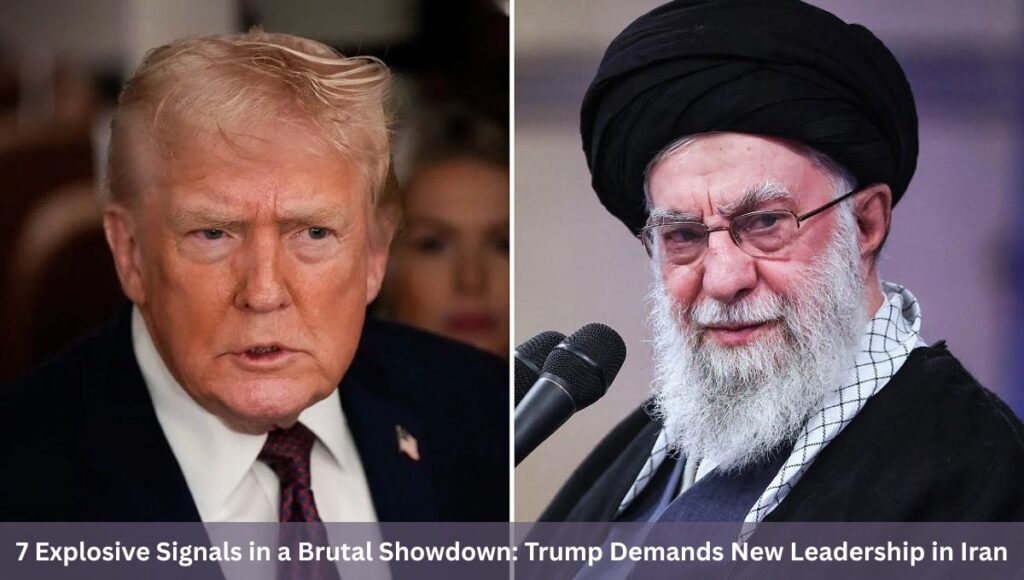
7 Explosive Signals in a Brutal Showdown: Trump Demands New Leadership in Iran
Trump vs Khamenei: A War of Words Turns Personal
Trump’s remarks were unusually personal. He branded Khamenei a “sick man,” accused him of destroying Iran through violence, and argued that leadership based on fear and repression had left the country impoverished and unstable.
“Leadership is about respect, not fear and death,” Trump said, asserting that Iran’s rulers have relied on killing “people by the thousands” to cling to power. He went further, claiming Iran had become “the worst place to live anywhere in the world because of poor leadership.”
Khamenei, in turn, accused Trump of criminal responsibility for the deaths and destruction linked to the protests. In multiple posts on X, the Iranian leader blamed the United States and Israel for orchestrating unrest, describing violent groups as foreign-backed agents bent on chaos.
Protests That Shook the Islamic Republic
The unrest erupted on December 28, 2025, triggered by economic hardship but quickly morphing into calls for the end of clerical rule. Inflation, unemployment, and a collapsing currency pushed citizens onto the streets across all 31 provinces.
Human rights groups estimate that more than 3,000 protesters were killed during the crackdown, with some reports placing the toll far higher. Iran’s leadership has disputed the numbers, blaming “terrorists” and foreign conspirators for the violence.
Despite the bloodshed, demonstrations exposed deep fractures within Iranian society. Young people, women, workers, and middle-class professionals united in rare nationwide defiance, chanting slogans demanding fundamental political change.
Trump’s Threats and Tactical Shifts
Throughout the unrest, Trump issued stark warnings. He threatened “very strong action” if Iran executed protesters and urged demonstrators to “take over institutions,” promising that “help is on the way.”
Yet his tone shifted abruptly when Tehran reportedly called off mass executions. Trump publicly thanked Iran’s leaders, claiming the decision to halt hangings was “the best decision” Khamenei had ever made.
Iranian officials denied there were any plans for executions, underscoring the murky nature of information amid the crisis.
The mixed messaging suggested a tactical recalibration rather than de-escalation. While Trump appeared to step back from immediate military action, his call for new leadership signaled continued pressure on the regime.
Iran’s Leadership Responds: Defiance and Blame
In speeches marking religious observances, Khamenei vowed to “break the back of the seditionists,” warning that both domestic and international “criminals” would face punishment.
Iranian authorities labeled the protests as riots and terrorist operations, insisting they were part of an American plot to dominate Iran.
State media portrayed the crackdown as a necessary defense of national sovereignty, while security forces tightened control through internet shutdowns, mass arrests, and intimidation of journalists and activists.
The Human Cost of Repression
Behind the geopolitical drama lies a human tragedy. Cities from Tehran and Mashhad to Shiraz and Isfahan witnessed cycles of protest and repression. Families mourned lost relatives while thousands were detained under harsh conditions.
The violence has driven fear and uncertainty across Iranian society, deepening resentment toward a leadership seen as disconnected from everyday suffering.
Reza Pahlavi and the Opposition Question
Exiled Crown Prince Reza Pahlavi has sought to position himself as a unifying alternative. He urged Iranians to raise their voices and called on Trump to stand firmly with the Iranian people, warning against repeating past diplomatic engagements with Tehran.
Pahlavi has proposed a transition to a secular democracy through a national referendum. Yet analysts note that Iran’s opposition remains fragmented, lacking a cohesive leadership structure capable of translating street protests into political change.
Iran’s Crisis in Historical Context
Iran’s turmoil reflects a long arc of historical contradictions. Once a civilizational powerhouse, the country experienced rapid modernization under the Pahlavi monarchy before the 1979 Islamic Revolution replaced authoritarian secularism with theocratic rule.
While the revolution promised justice and independence, decades of sanctions, mismanagement, and repression have eroded economic prospects. Despite vast oil reserves, Iran’s GDP remains far below potential, and living standards have steadily declined.
Economic Collapse and Sanctions Pressure
Sanctions have battered Iran’s economy. The rial has plunged to historic lows, inflation hovers around 40 percent, and food prices have soared. Subsidy cuts and fuel price hikes sparked immediate anger, while years of stagnation fueled broader discontent.
Trump has framed sanctions as leverage to force change, warning that countries dealing with Tehran would face penalties. Critics argue the pressure has disproportionately harmed ordinary Iranians while entrenching hardliners.
China, Russia, and the Shifting Global Chessboard
As Washington escalates pressure, Tehran has leaned on Beijing and Moscow. China now buys the bulk of Iran’s crude oil, often through opaque channels, while Russia has provided diplomatic cover at the United Nations.
The alignment has created an alternative economic network that blunts sanctions but deepens global divisions. Analysts warn that Iran’s crisis risks becoming a flashpoint in a broader contest between rival power blocs.
India Caught in the Crossfire
For India, the stakes are acute. New Delhi relies on stability in the Strait of Hormuz, through which a fifth of global oil flows. Any disruption would threaten energy security and economic growth.
India has advised its citizens to leave Iran, cooled enthusiasm for strategic projects like Chabahar port, and carefully balanced ties with the US, Iran, Russia, and China.
Could This Spiral Into Global Conflict?
Experts caution that unchecked escalation could have catastrophic consequences. A military confrontation might trigger oil price shocks, destabilize markets, and draw in multiple powers.
Trump’s rhetoric, while stopping short of immediate force, keeps the threat alive. Iranian leaders, facing internal pressure, may see defiance as essential to survival.
Diplomacy or Disaster?
The Iranian crisis underscores a stark choice for the international community: pursue dialogue and de-escalation, or risk plunging the region into deeper chaos.
As Trump calls for new leadership and Khamenei doubles down on resistance, the world watches anxiously. Iran’s inferno is no longer a domestic issue—it is a warning signal with global implications.
Conclusion: A Turning Point for Iran and the World
Trump’s call for the end of Khamenei’s rule marks a significant escalation in US-Iran tensions. Whether it becomes a catalyst for change or a prelude to wider conflict will depend on choices made in Tehran, Washington, and beyond. What is clear is that Iran stands at a crossroads.
The protests may have subsided, but the underlying grievances remain unresolved. The future of the Islamic Republic—and its impact on global stability—hangs in the balance.
Also Read: 7 Shocking Developments as Iran Moves Toward First Protest Execution
Also Read: Khamenei calls Trump a ‘criminal’ as US president urges ‘new leadership’ in Iran