

11 Explosive Facts About Trump’s Gaza “Board of Peace” and India’s Crucial Invite ignite geopolitical debate. India has received a formal invitation from U.S. President Donald Trump to join the newly formed “Board of Peace”, a controversial international mechanism designed to oversee governance, reconstruction, and security in post-war Gaza — and potentially future global conflicts.
The development, confirmed by U.S. Ambassador to India Sergio Gor, places New Delhi at the heart of one of the most ambitious — and polarising — peace initiatives proposed in recent years.
While Washington frames the Board of Peace as a bold new pathway toward stability, critics warn it could sideline the United Nations, marginalise Palestinians, and transform Gaza into a quasi-international trusteeship driven by geopolitical and commercial interests. India has not yet formally accepted the invitation, but the offer itself is diplomatically significant.
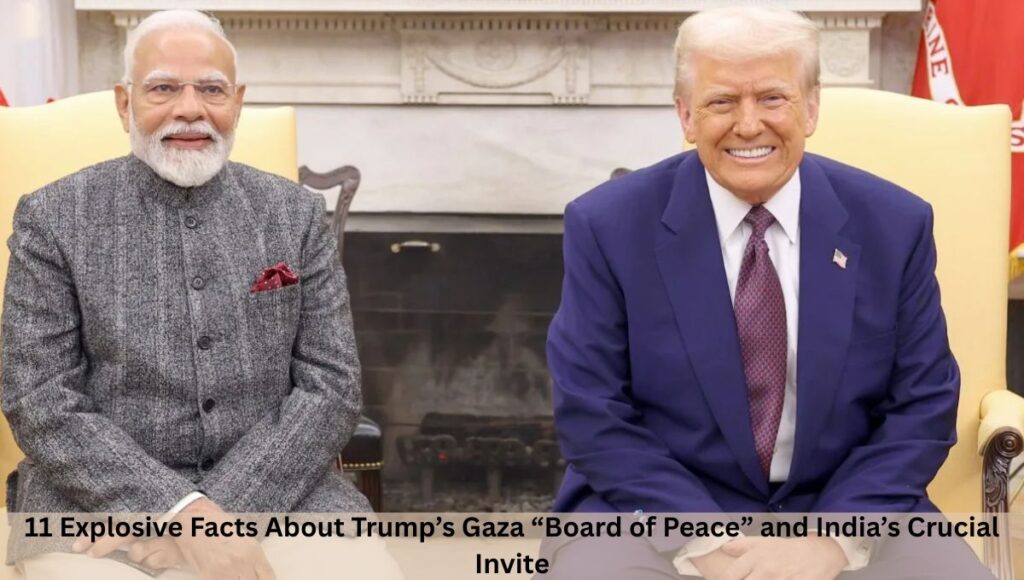
11 Explosive Facts About Trump’s Gaza “Board of Peace” and India’s Crucial Invite
What Is Trump’s ‘Board of Peace’?
The Board of Peace was announced by the White House on January 15 as part of Trump’s 20-point Gaza peace and reconstruction plan, following the October ceasefire that paused Israel’s devastating war on the Palestinian enclave.
According to official U.S. statements, the initiative aims to:
- Oversee post-war governance in Gaza
- Supervise reconstruction funding and implementation
- Support the disarmament of Hamas
- Facilitate the deployment of an international stabilisation force
- Lay groundwork for long-term regional security
What makes the initiative unusual is its three-tier governance structure, with decision-making power concentrated at the top under U.S. leadership.
The Three-Tier Structure Explained
1. The Founding Executive Council (Top Tier)
This is the most powerful body, holding financial authority and strategic control. It is chaired by President Donald Trump, who retains final veto power.
Key members include:
- Marco Rubio, U.S. Secretary of State
- Steve Witkoff, U.S. Middle East Envoy
- Jared Kushner, Trump’s son-in-law
- Marc Rowan, billionaire investor (Apollo Global Management)
- Ajay Banga, President of the World Bank
- Tony Blair, former UK Prime Minister
- Robert Gabriel, U.S. Deputy National Security Adviser
This council effectively sets Gaza’s future direction.
2. Gaza Executive Board (Middle Tier)
This body handles regional coordination and implementation, bringing together Arab states, international officials, and business figures.
Members include:
- Turkey’s Foreign Minister Hakan Fidan
- Representatives from Qatar, Egypt, and the UAE
- Sigrid Kaag, UN Middle East Coordinator
- Israeli-Cypriot billionaire Yakir Gabay
- Nickolay Mladenov, High Representative for Gaza
Israel has publicly objected to this board, citing Turkey and Qatar’s inclusion.
3. National Committee for the Administration of Gaza (Bottom Tier)
This is the only Palestinian-led component, composed of technocrats tasked with managing:
- Health
- Education
- Housing
- Finance
- Telecommunications
- Municipal services
Critics argue Palestinians have been reduced to administrators without political authority, with no say over sovereignty or long-term governance.
Why India’s Invitation Matters
India’s inclusion is not accidental.
New Delhi occupies a rare diplomatic position:
- Strategic partner of Israel
- Historic supporter of Palestine
- Major provider of humanitarian aid to Gaza
- Seen as acceptable to both sides
India was among the first countries to send relief supplies to Gaza through Egypt after the war began.
According to Indian officials and regional analysts, India is viewed as a balancing actor — neither overtly aligned with Israeli hardliners nor hostile to Palestinian aspirations.
Pakistan Is Invited Too — And That Changes the Equation
Trump has also invited Pakistan, India’s neighbour and rival, to join the Board of Peace.
Islamabad has said it will engage in international peace efforts for Gaza.
However, Israel’s envoy to India has previously stated that Pakistan would be unacceptable to Israel in any governance role for Gaza — highlighting the delicate diplomatic minefield India must navigate if it accepts.
The $1 Billion Question
One of the most controversial aspects of the Board of Peace is its funding model.
According to draft charters seen by U.S. media:
- Permanent membership requires a $1 billion contribution
- Three-year non-permanent membership is free
- Funds would be used to rebuild Gaza
Trump reportedly chairs the board for life, with final authority over decisions.
Critics argue this structure risks turning peace into a pay-to-play system.
Global Reaction: Caution, Not Enthusiasm
Despite invitations being sent to around 60 countries, global response has been muted.
- Hungary accepted unequivocally
- Vietnam confirmed acceptance
- Italy and Canada expressed tentative support
- Most countries remain silent or cautious
European diplomats privately warned the initiative could undermine the United Nations, which already suffers from reduced funding and diplomatic paralysis.
Does the Board Undermine the UN?
Many diplomats see the Board of Peace as a de facto rival to the UN Security Council.
Although the Security Council endorsed the Gaza ceasefire plan, critics say:
- The Board bypasses traditional UN mechanisms
- Palestinians lack political representation at the top
- Decision-making is concentrated in Washington
Some analysts describe it as a “commercial trusteeship”, where Gaza is treated as a reconstruction project rather than a political entity.
Israel’s Uneasy Acceptance
Despite being a U.S.-led initiative, Israel has publicly criticised parts of the plan.
Prime Minister Benjamin Netanyahu’s office said the executive board:
“Was not coordinated with Israel and contradicts Israeli policy.”
Right-wing Israeli ministers have called instead for renewed military action or “voluntary migration” from Gaza.
Yet analysts suggest Israel ultimately benefits:
- Security control remains Israeli
- Governance costs are outsourced to donors
- Political responsibility shifts away from Tel Aviv
Palestinian Voices: Hope and Fear
Palestinian reactions are deeply divided.
Supporters say:
- Any functioning administration is better than chaos
- Reconstruction is urgently needed
- Technocrats may restore basic services
Critics warn:
- Palestinians have no sovereignty
- Political aspirations are sidelined
- Aid may be tied to security concessions
As one Gaza analyst put it:
“This is crisis management, not conflict resolution.”
Where Does India Stand Now?
India’s foreign ministry has not yet responded publicly.
Diplomatically, New Delhi faces a strategic dilemma:
Accepting the invitation could:
- Elevate India’s global peacemaking role
- Strengthen ties with Washington
- Allow India to shape Gaza’s reconstruction
Rejecting or delaying could:
- Avoid UN-related backlash
- Prevent entanglement in Gaza’s security mess
- Preserve strategic ambiguity
India’s decision will signal how it sees its role in 21st-century global governance.
The Bigger Picture: A New Global Order?
Trump’s Board of Peace reflects a broader shift:
- Away from multilateral institutions
- Toward ad hoc, leader-driven coalitions
- Blending geopolitics with business logic
Whether it becomes a model for future conflicts — or collapses under its contradictions — remains uncertain.
Conclusion: A Defining Moment for India
India’s invitation to Trump’s Gaza Board of Peace is more than a diplomatic courtesy. It is a test of India’s emerging global identity — as a bridge-builder, a pragmatic power, or a cautious bystander.
The Gaza experiment may redefine not just Palestinian governance, but how the world approaches conflict resolution in an era of fractured multilateralism. For India, the choice will echo far beyond Gaza.
Also Read: 9 Stark Realities Behind Gaza’s Reaction to Trump’s ‘Board of Peace’ Plan
Also Read: Full text: Charter of Trump’s Board of Peace
Related Posts:
- Trump’s 2025 Gaza Peace Plan Signing and Historic…

- Dramatic Moments Behind Trump’s Gaza Peace Push and…

- Trump’s 20-Point Gaza Peace Plan Gains Urgent Global…

- 5 Powerful Highlights as Trump Lands Second Nobel…

- 11 Explosive Revelations From Ted Cruz’s Leaked…

- Can the EU and NATO Impose Tariffs on India and…
