7 Explosive Demands Trump Is Making of Venezuela’s New Leader Delcy Rodríguez following Nicolás Maduro’s capture. Two days after U.S. forces stunned the world by capturing Venezuelan strongman Nicolás Maduro and transporting him to New York to face federal narcotrafficking charges, Washington’s attention has shifted sharply to the woman now running the country:
Thank you for reading this post, don't forget to subscribe!Delcy Rodríguez.
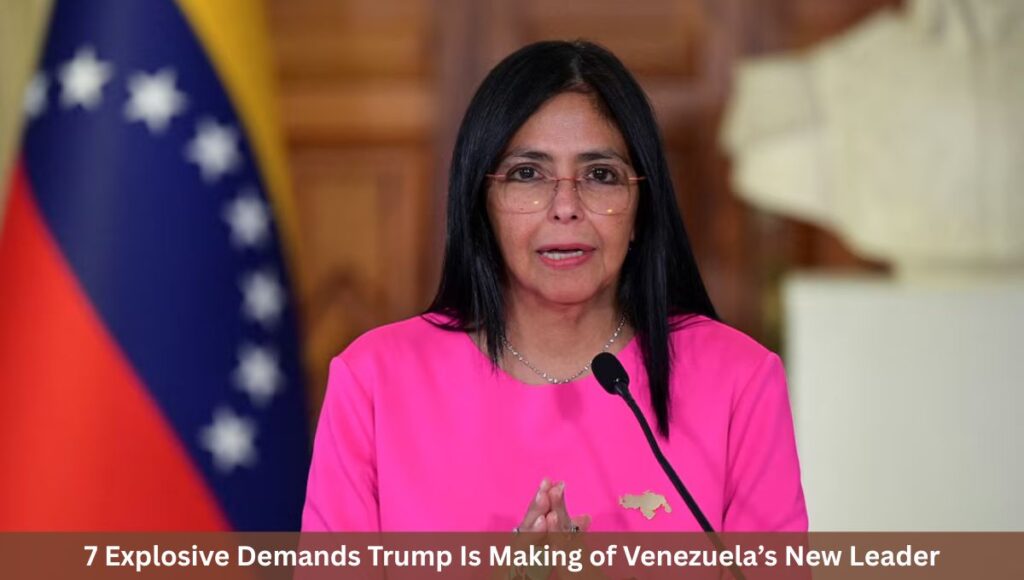
Rodríguez, Venezuela’s longtime vice president and oil czar, was sworn in as acting president amid extraordinary circumstances—U.S. airstrikes, a lightning raid in Caracas, and President Donald Trump openly declaring that the United States would temporarily “run” the oil-rich South American nation.
Behind the scenes, according to U.S. officials and people familiar with internal administration discussions, Trump has already presented Rodríguez with a short, high-stakes list of demands. Compliance could buy her time, sanctions relief, and limited international legitimacy. Defiance, Trump has warned, could result in another U.S. military strike.
At the center of Washington’s emerging Venezuela strategy is a belief—shared by Trump and his senior advisers—that Rodríguez is both powerful enough to deliver and vulnerable enough to coerce.
7 Explosive Demands Trump Is Making of Venezuela’s New Leader
A Defining Moment for U.S.–Venezuela Relations
The Trump administration insists the operation against Maduro was a law enforcement action, not a war or regime-change campaign.
Yet Trump’s own rhetoric—combined with a sustained U.S. military presence in the Caribbean—has blurred that distinction.
Venezuela, already shattered by years of sanctions, hyperinflation, mass migration, and authoritarian rule, now stands at a geopolitical crossroads.
The choices Rodríguez makes in the coming weeks could determine whether the country moves toward a managed transition—or slides into renewed violence and instability.
The Three Core Demands Washington Has Delivered
According to U.S. officials familiar with the discussions, the Trump administration has laid out three immediate non-negotiable demands for Rodríguez.
1. Crack Down on Drug Trafficking Networks
The top priority for Washington is narcotics.
U.S. officials want Rodríguez to dismantle what they describe as Venezuela’s role as a transit hub for cocaine trafficking, particularly routes linked to Colombian cartels, Hezbollah-connected networks, and corrupt Venezuelan military officials.
Secretary of State Marco Rubio framed the issue bluntly in a Sunday interview:
“We no longer want a Venezuela that’s a crossroads for many of our adversaries, no longer sending us drug gangs and drug boats.”
Maduro’s indictment accuses him of using state power to flood North America with cocaine. Trump officials argue that failing to uproot those networks would undermine the legal justification for the U.S. operation itself.
2. Expel Iranian, Cuban, and Hostile Foreign Operatives
The second demand strikes at Venezuela’s geopolitical alliances.
Washington wants Rodríguez to kick out Iranian, Cuban, and other foreign operatives linked to countries or networks hostile to the United States.
This includes intelligence personnel, military advisers, and alleged Hezbollah facilitators.
For years, U.S. intelligence agencies have viewed Venezuela as a strategic foothold for America’s adversaries in the Western Hemisphere.
Trump officials believe removing that presence is essential to regional security—and to restoring U.S. dominance in the Caribbean basin.
3. Halt Oil Sales to U.S. Adversaries
Oil, as always, is central.
The Trump administration is demanding that Venezuela stop selling crude to U.S. adversaries, particularly China and Iran, while reopening the door to American energy companies.
Venezuela holds the largest proven oil reserves in the world, but years of mismanagement and sanctions have crippled production.
Trump has made clear that restoring output—under terms favorable to U.S. firms—is a strategic priority.
Rubio described the ongoing U.S. naval presence as an “oil quarantine,” designed to exert maximum leverage without occupying the country.
Elections—But Not Anytime Soon
Beyond the immediate demands, U.S. officials say they expect Rodríguez to eventually facilitate free elections and then step aside.
However, they stress that no election timetable has been set, and there are no votes imminent.
A senior U.S. official described discussions of elections as “far too premature,” reflecting concerns about instability, armed rival factions, and the absence of a unified opposition.
Trump himself has downplayed urgency, saying Venezuela must be “fixed” before any credible vote can take place.
Why Delcy Rodríguez Is Washington’s Linchpin
Despite her deep roots in chavismo, Trump and his advisers believe Rodríguez is uniquely positioned to deliver results.
She controls the economic apparatus, maintains influence over the military, and has longstanding ties to Venezuela’s oil industry. At the same time, U.S. officials believe she is on a “short leash.”
One person close to the administration described the strategy starkly:
“They’re confident they can whip her in whatever direction they want before they dispose of her and move on.”
Trump himself has echoed that sentiment publicly.
“If they don’t behave, we will do a second strike,” he warned aboard Air Force One.
From Condemnation to Cooperation—A Rapid Shift
Rodríguez’s own rhetoric has evolved rapidly.
Immediately after Maduro’s capture, she condemned the U.S. action as a “barbarity” and a violation of Venezuelan sovereignty. Within days, her tone softened dramatically.
In a public statement, she invited Washington to collaborate on an “agenda of cooperation,” emphasizing peace, dialogue, and respect for international law.
That shift, analysts say, reflects the extraordinary pressure she is under—from Washington abroad and from rival power centers at home.
The Leverage—Sanctions, Assets, and Fear
Beyond military threats, the U.S. wields significant financial leverage over Rodríguez.
According to people familiar with Trump’s Venezuela policy, Rodríguez holds substantial assets abroad—particularly in Qatar and Turkey.
Former U.S. envoy Elliott Abrams said even discussing those assets could be decisive.
“The statement that we’re talking to the Qataris and the Turks about her money would be quite a threat.”
Sanctions relief, by contrast, remains uncertain. Officials say there are no immediate plans to lift sanctions or send major humanitarian aid, despite earlier internal discussions.
A Weak After-Action Plan
One striking revelation from people involved in the discussions is the absence of a comprehensive post-Maduro plan.
“There was no interagency process to develop an after-action plan,” one source said.
Cuts to the State Department and other agencies have limited Washington’s crisis-planning capacity, raising fears that missteps could trigger violence or factional conflict inside Venezuela.
Internal Rivals and a ‘Pit of Vipers’
Rodríguez is not alone at the top.
She must contend with powerful figures such as Interior Minister Diosdado Cabello and Defense Minister Vladimir Padrino López—each with loyalists, armed supporters, and political ambitions.
One U.S. official described the situation bluntly:
“It’s an unstable pit of vipers.”
Balancing U.S. demands while maintaining internal cohesion may prove to be Rodríguez’s greatest challenge.
Who Is Delcy Rodríguez?
At 56, Delcy Rodríguez is one of the most influential figures in modern Venezuelan politics.
Born in Caracas, she studied law at the Central University of Venezuela. Her father, a Marxist revolutionary, died in police custody in 1976 after being arrested in connection with the kidnapping of an American businessman.
Rodríguez rose through the ranks under Hugo Chávez and later Nicolás Maduro, serving as communications minister, foreign minister, president of the Constituent Assembly, vice president, and oil minister.
She has spent more than two decades defending Venezuela’s socialist system against international criticism, often confronting U.S. officials directly at the United Nations.
Hardliner or Caretaker?
Despite Trump’s optimism, many analysts remain skeptical that Rodríguez represents meaningful change.
“She is not a moderate alternative to Maduro,” said one former diplomat. “She has been one of the most powerful hard-liners in the system.”
Others believe her role is temporary—a caretaker chosen to stabilize the country until a managed transition can be arranged.
CNN has reported that U.S. officials view her as capable of ensuring order, protecting energy investments, and preventing immediate collapse.
A Country Watching—and Waiting
Inside Venezuela, lawmakers aligned with the ruling party have worked to project normalcy, re-swearing in the National Assembly and condemning Maduro’s capture.
At the same time, millions of Venezuelans—both at home and in exile—are watching closely, uncertain whether this moment represents the beginning of renewal or another chapter of foreign-imposed upheaval.
What Comes Next
For now, Trump’s strategy appears deliberately ambiguous: maximum pressure, limited promises, and overwhelming leverage.
Rodríguez’s willingness—or refusal—to meet U.S. demands will shape not only her political survival but Venezuela’s future place in the global order.
As Trump himself put it:
“We’re in charge. We’re going to fix it. Elections will come at the right time.”
Whether that promise leads to stability or deeper turmoil remains one of the most consequential unanswered questions in global geopolitics today.
Also Read: 7 Explosive Warnings: Trump Threatens Colombia as Cuba ‘Looks Ready to Fall’
Also Read: Rubio Attempts to Clarify Trump Claim That U.S. Will ‘Run’ Venezuela: What to Know