

12 Killed in Powerful Islamabad Court Blast Amid Rising Pakistan-Afghan Tensions, highlighting deteriorating security situation. A powerful explosion outside Islamabad’s district court on Tuesday killed at least 12 people and injured more than 25 others, in one of the deadliest attacks to hit Pakistan’s capital in years. Most of the casualties were lawyers and staff members working at the court complex, officials said.
According to local media reports, the explosion occurred shortly after 12:30 p.m. near the entrance of the Islamabad judicial complex, sending plumes of black smoke into the sky and triggering panic among those present. Authorities suspect it was a suicide attack carried out from a car parked outside the district court premises.
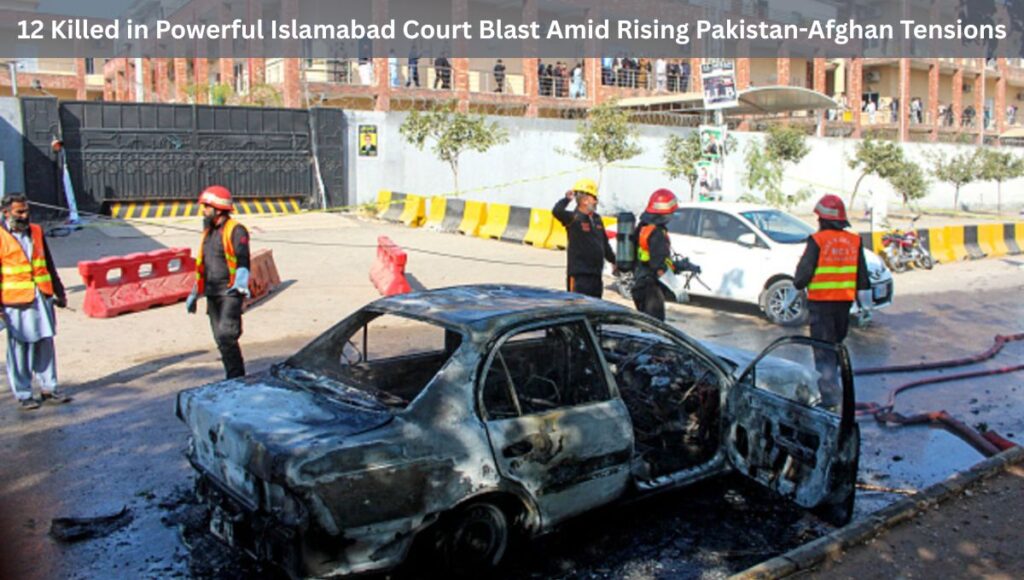
12 Killed in Powerful Islamabad Court Blast Amid Rising Pakistan-Afghan Tensions
Witnesses Describe Chaos
Videos circulating on social media showed flames and thick smoke rising from a charred vehicle as bystanders and security personnel rushed to the scene. Several cars parked nearby were damaged, while the force of the blast shattered windows in nearby offices.
“As I parked my car and entered the complex, I heard a loud bang on the gate,” said lawyer Rustam Malik, who witnessed the explosion. “I saw two dead bodies lying on the gate, and several cars were on fire. It was complete chaos; lawyers and people were running for safety.”
Rescue teams and police swiftly cordoned off the area, while ambulances transported the injured to Pakistan Institute of Medical Sciences Hospital (PIMS). Hospital officials confirmed receiving over two dozen injured individuals, several of them in critical condition.
Officials Confirm Suicide Nature of Blast
Pakistan’s Interior Minister Mohsin Naqvi later confirmed that the explosion was a suicide bombing. The attacker had reportedly tried to enter the court premises but detonated explosives near a police vehicle after being stopped by guards.
“The suicide bomber attempted to enter the judicial complex but failed to get inside. He then targeted a police car near the main gate,” Naqvi told reporters. “We are investigating whether the attacker had accomplices who helped plan this assault.”
No group immediately claimed responsibility for the bombing, but officials said the method bore the hallmarks of attacks previously carried out by Tehreek-e-Taliban Pakistan (TTP), also known as the Pakistani Taliban.
Defence Minister Calls It a ‘Wake-Up Call’
In a strongly worded statement, Pakistan’s Defence Minister Khawaja Asif said the attack should serve as a wake-up call for the nation, warning that the country was “in a state of war.”
“Anyone who believes that the Pakistan Army is only fighting in the border regions should take the Islamabad court attack as a warning,” Asif said on X (formerly Twitter). “This is a war for all of Pakistan, and our armed forces are making daily sacrifices to keep citizens safe.”
He also blamed Afghanistan for allowing militant groups to operate freely across the border, accusing Kabul of harboring TTP leaders involved in cross-border assaults.
President Zardari Condemns ‘Suicide Blast’
President Asif Ali Zardari condemned the attack, calling it a “cowardly act of terror” and extended condolences to the victims’ families. He urged law enforcement agencies to ensure the perpetrators are swiftly brought to justice.
In a statement, Zardari praised the police and rescue teams for their quick response and emphasized the need for greater intelligence coordination to prevent similar incidents. “The sacrifices of our law enforcement agencies will not go in vain,” he said.
Security on High Alert in Capital
Authorities have tightened security in Islamabad, placing government buildings, courts, and foreign missions on high alert. The capital has multiple security zones, and entry requires clearance at several checkpoints.
Despite these measures, Tuesday’s blast has raised questions about lapses in surveillance and intelligence sharing.
Senior police officials said forensic teams were examining the blast site and vehicle fragments to determine the explosive materials used.
Early reports suggest the use of high-grade explosives consistent with previous militant attacks in Pakistan’s urban centers.
Links to Broader Surge in Violence
The explosion comes as Pakistan grapples with an upsurge in militant attacks across its northwestern provinces, particularly in Khyber Pakhtunkhwa and Balochistan, since the Taliban’s return to power in Afghanistan in 2021.
Islamabad has accused the Afghan Taliban of sheltering TTP operatives, who have intensified strikes on Pakistani security forces and civilian targets. Kabul, however, has repeatedly denied such allegations.
Recent months have witnessed a breakdown in diplomatic and military communication between the two neighbors. Skirmishes along the border in October led to the worst exchange of fire between the two countries in years.
Foiled Attack in Wana Hours Before the Blast
Earlier the same day, Pakistani security forces foiled a major attack on Cadet College Wana in South Waziristan, near the Afghan border. Officials said two TTP militants were killed when troops repelled an assault aimed at taking cadets hostage.
According to the Pakistani Army, six attackers, including a suicide bomber, tried to storm the facility overnight. “All cadets, instructors, and staff remained safe,” said local police chief Alamgir Mahsud. “Two militants were killed, while three who entered a building were neutralized by morning.”
The failed assault was reminiscent of the 2014 Peshawar school massacre, in which 154 people—mostly children—were killed by TTP gunmen. Officials said the Wana attackers sought to replicate that tragedy.
TTP Denies Role but Remains Under Suspicion
Although the TTP denied involvement in both the Wana attack and the Islamabad blast, officials remain skeptical. The group has carried out dozens of suicide bombings and attacks against courts, police stations, and military convoys over the past decade.
A security official told local media that “the pattern and target selection indicate TTP or allied splinter groups.” He added that investigators were exploring whether the Islamabad attack was coordinated to divert attention from the failed Wana operation.
Red Fort Explosion in Delhi Adds to Regional Alarm
The Islamabad blast also coincided with an explosion a day earlier in New Delhi, where a car blew up near the Red Fort, killing at least 13 people. Indian authorities have launched a probe under the Unlawful Activities (Prevention) Act (UAPA) and the Explosives Act.
The car, a Hyundai i20, was reportedly driven by a man identified as Umar Un Nabi from Jammu and Kashmir’s Pulwama district. Indian police are investigating possible terror links after recovering 2,900 kilograms of IED-making material from a nearby location.
Though there is no official connection between the Delhi and Islamabad blasts, security analysts say the timing of the two incidents—and their targeting of major public areas—suggests possible coordination among extremist networks in the region.
Regional and International Reactions
Condemnations poured in from across South Asia. The United Nations mission in Pakistan expressed “deep sorrow” over the loss of life, urging stronger counter-terror cooperation between regional governments.
India’s Ministry of External Affairs, while refraining from comment on Pakistan’s internal situation, noted that the “region continues to face grave threats from transnational terrorism.”
Meanwhile, U.S. State Department spokesperson Matthew Miller said Washington was monitoring the situation and stood “in solidarity with the people of Pakistan against all forms of terrorism.”
Islamabad’s Fragile Security Balance
The attack underscores Islamabad’s vulnerability despite years of counter-terror operations. Suicide bombings in the capital have become rare since 2016, following major military campaigns such as Operation Zarb-e-Azb and Radd-ul-Fasaad, which targeted militant strongholds.
However, experts warn that Pakistan’s fragile economic condition, political instability, and strained ties with Afghanistan have emboldened extremist groups to reassert themselves.
Security analyst Ayesha Siddiqa told Dawn News, “The re-emergence of urban terrorism shows that sleeper cells still exist. Islamabad is supposed to be the most secure city in Pakistan, yet this attack exposes systemic weaknesses.”
Investigation Underway
Police said a joint investigation team (JIT) comprising officials from the Counter Terrorism Department (CTD), Federal Investigation Agency (FIA), and military intelligence had been formed to probe the attack.
Preliminary reports suggest the suicide bomber waited for nearly 15 minutes before detonating explosives near the court’s entrance. CCTV footage retrieved from nearby buildings is being analyzed to identify possible accomplices.
Authorities are also investigating whether the vehicle used in the bombing was stolen or had been registered under a fake identity.
Conclusion
The Islamabad court blast marks another grim reminder of Pakistan’s enduring struggle against militancy. Coming amid renewed Pakistan-Afghanistan tensions and just hours after a foiled TTP-linked assault, the attack underscores how regional instability continues to spill into urban centers.
With President Zardari calling for unity and Defence Minister Asif warning of a protracted war, Pakistan once again faces the daunting task of safeguarding its capital against the return of terror.
Also Read: 7 Major Developments as Pakistan-Afghanistan Peace Talks Collapse
Also Read: Iran concerned over rising tensions between Afghanistan, Pakistan: FM Araghchi
Related Posts:
- 5 Major Takeaways from the US Supreme Court's…

- 7 Heartbreaking Facts About Venezuela's Earthquake Disaster

- Afghanistan–Pakistan War 2025: Inside the 48-Hour Ceasefire

- 7 Powerful Facts About Ayatollah Ali Khamenei’s…
- In 8 Moves, EU Targets China-Linked Refineries and…

- 7 Powerful Measures: Trump Sanctions Russian Oil…
