

7 Key Developments as US Senate Passes Deal to End Record Shutdown — Longest in US History. The United States Senate has voted to end the longest government shutdown in the nation’s history, approving a bipartisan deal that temporarily funds the government until January while promising a future vote on the extension of Affordable Care Act tax credits. The legislation marks a major breakthrough after more than six weeks of political stalemate, economic strain, and public frustration.
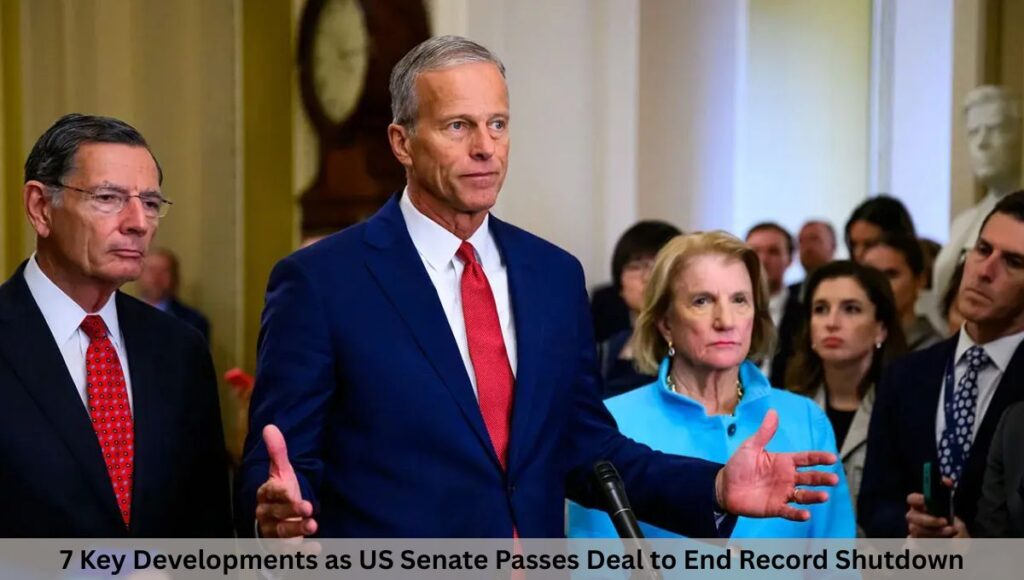
7 Key Developments as US Senate Passes Deal to End Record Shutdown
A Divided Congress Finds Common Ground
After 41 days of government paralysis, the Senate voted 60-40 in favor of the funding bill late Monday. The measure, reached after extensive talks between centrist Democrats and Senate Republican leaders, provides a short-term stopgap to reopen shuttered agencies and restore operations across the federal government.
The bill now heads to the House of Representatives, where Speaker Mike Johnson faces the challenge of guiding the measure through a fractured Republican majority.
President Donald Trump has indicated his support for the legislation, calling it a “good deal” and signaling that he would sign it promptly once passed by the House.
“This agreement moves us closer to ending the pain felt by millions of Americans,” said Senate Majority Leader John Thune. “After almost six weeks, we’re finally able to reopen the government.”
How the Deal Came Together
The final compromise was brokered by a small bipartisan group led by Senators Jeanne Shaheen and Maggie Hassan of New Hampshire and Independent Senator Angus King of Maine—three former governors known for pragmatic dealmaking.
Their plan ties immediate government funding to a future vote on extending the Affordable Care Act’s enhanced subsidies, which are set to expire on January 1.
Democrats did not secure a guarantee that the subsidies will be renewed, but Senate leaders have agreed to schedule a vote by mid-December. “This was the only deal on the table,” said Shaheen, emphasizing that continued inaction would have worsened the economic and social fallout of the shutdown.
Centrist Democrats Drive Compromise
A critical bloc of eight centrist Democrats played a decisive role in advancing the funding measure despite sharp opposition from progressives within their party.
Among those supporting the agreement were Senators Tim Kaine of Virginia, Jeanne Shaheen, Maggie Hassan, John Fetterman, Catherine Cortez Masto, Jacky Rosen, Dick Durbin, and Angus King.
Kaine, whose state is home to thousands of federal workers affected by the shutdown, said the vote reflected “a duty to end the suffering of hardworking families.”
He added that lawmakers know their constituents expect them to act responsibly and that those who fail to do so “could very well be replaced at the ballot box.”
A Deep Divide Within the Democratic Party
While the compromise allows the government to reopen, it has revealed a widening divide among Democrats.
Senate Democratic Leader Chuck Schumer and several liberal members voted against the measure, arguing that the deal failed to deliver concrete results on health care.
Senator Richard Blumenthal of Connecticut called it “no deal without health care,” while Senator Bernie Sanders of Vermont described the decision to compromise as a “horrific mistake.”
Other Democrats, including Senator Chris Murphy of Connecticut, urged their colleagues to hold firm, citing strong voter support for extending health coverage benefits.
House Democrats were equally critical. Minority Leader Hakeem Jeffries condemned the Senate-passed measure, saying it “fails to extend the Affordable Care Act tax credits” and vowed to oppose it when it reaches the House floor.
The Role of the White House and President Trump
The White House played a central role in sealing the agreement. According to aides familiar with the discussions, Trump’s growing resistance to extending the health care subsidies pushed Senate Democrats to accept a temporary compromise rather than risk a prolonged shutdown.
The administration also agreed to reverse the mass firings of federal workers that occurred during the funding lapse and to guarantee back pay for affected employees.
Trump signaled optimism on Monday, saying, “We’re going to be opening up our country very quickly. We have support from enough Democrats, and this deal is very good.”
The president’s comments underscored the urgency of restoring normal operations amid mounting economic costs and public anger over disrupted services.
What the Legislation Includes
The bipartisan package not only funds the government through January but also provides a full-year budget for several key departments. These include military construction and veterans’ affairs, the Department of Agriculture, and the legislative branch.
The legislative branch portion of the bill allocates $203.5 million for enhanced congressional security and $852 million for the U.S. Capitol Police. These provisions were outlined in a summary released by Democratic appropriator Senator Patty Murray.
Importantly, the agreement prohibits further layoffs of federal employees during the fiscal year and ensures that all federal workers receive full back pay for the duration of the shutdown.
Lingering Uncertainty and Procedural Hurdles
Although the Senate’s approval is a major milestone, the path to fully reopening the government remains complex. Several procedural steps must still be completed before federal agencies resume normal operations.
Senate rules allow up to 30 hours of post-cloture debate before the final vote, unless all 100 senators agree to expedite the process.
Lawmakers such as Senator Rand Paul of Kentucky have already indicated plans to introduce amendments, potentially delaying the bill’s final passage.
Paul emphasized that he was not attempting to obstruct the reopening but wanted to address unrelated provisions affecting his state’s hemp industry. “Standing up for Kentucky jobs is part of my job,” he said.
The House Returns From Recess
The next critical step lies with the House of Representatives, which has been in recess since mid-September.
Speaker Mike Johnson has instructed members to return to Washington “immediately” but indicated that the earliest possible vote would be Wednesday afternoon due to travel delays.
Under House rules, the bill will require a simple majority—218 votes—to pass. Given the narrow Republican majority, Johnson may need support from a small number of Democrats to secure passage.
Democratic opposition, however, remains strong, with Jeffries warning that his caucus will “fight the GOP bill in the House of Representatives.”
Republicans are optimistic that enough moderate Democrats will cross party lines to end the shutdown.
Some Democrats, including Representatives Jared Golden of Maine and Henry Cuellar of Texas, have signaled openness to supporting the measure. “It’s past time to put country over party,” Cuellar said in a social media post.
Shutdown Fallout and Public Impact
The shutdown, which began on October 1, has had wide-reaching consequences across the country. Federal workers missed multiple paychecks, air travel was disrupted by staffing shortages, and vital programs such as food assistance and childcare support were curtailed.
Economic analysts estimate that the six-week closure cost billions of dollars in lost productivity and consumer confidence.
With agencies preparing to resume operations, experts caution that the recovery will take time.
“Reopening the government is like turning an aircraft carrier—it happens slowly,” said one former federal budget official. “It may take a week or more before normal services are restored.”
Liberal Pushback and Calls for Leadership Change
Progressive frustration has spilled over into public calls for leadership changes within the Democratic Party.
Representative Ro Khanna of California urged Senate Democrats to replace Schumer, arguing that he failed to protect working-class Americans from rising health care costs.
“If you can’t lead the fight to stop healthcare premiums from skyrocketing, what will you fight for?” Khanna wrote on social media.
Despite internal dissent, centrist Democrats insist that the deal represents a necessary first step toward broader reform.
“There’s no perfect solution,” said Senator John Hickenlooper, who voted against the deal but acknowledged his colleagues’ intentions. “Some of them believe they’re helping the most people possible.”
Trump’s Calculus and the Road Ahead
The shutdown marked one of the most challenging standoffs of Trump’s presidency. His insistence on separating healthcare negotiations from government funding forced Democrats to weigh political strategy against the human cost of the shutdown.
While Trump is celebrating the agreement as a victory, Democrats believe the upcoming healthcare vote will highlight Republican opposition to extending Affordable Care Act benefits, providing them with a potent campaign issue heading into the next election cycle.
“The contrast between the parties on health care is clear,” said one Democratic aide. “Even if this bill doesn’t pass, voters will see who stood for affordable coverage.”
Next Steps: House Vote and Implementation Timeline
If the House passes the Senate’s continuing resolution by midweek, the bill will move quickly to the president’s desk. Trump has pledged to sign it “immediately.” Once enacted, federal agencies will begin recalling employees and processing back pay.
Officials estimate it could take until the end of the week for critical services to fully resume. Some functions, such as federal benefits distribution and air traffic management, may take several more days to return to pre-shutdown capacity.
Speaker Johnson expressed optimism about the timeline, telling reporters, “It appears our long national nightmare is finally coming to an end.”
What Happens in January
The current deal extends government funding only through January 30, setting the stage for another potential showdown early next year. If Congress fails to pass a comprehensive funding package or agree on health care legislation, the government could face another partial shutdown.
Senator Shaheen said Democrats would “certainly consider” withholding votes on future funding measures if the promised healthcare vote fails to materialize. “Waiting another week or month wouldn’t deliver a better outcome,” she said, emphasizing the importance of maintaining momentum.
Economic and Political Implications
Economists warn that repeated shutdowns undermine public trust and economic stability. The six-week closure disrupted billions in contracts, delayed loan processing, and slowed federal research projects. With consumer sentiment still fragile, further uncertainty could dampen growth heading into 2026.
Politically, the outcome has reshaped fault lines within both parties. Republicans, eager to project unity, have praised the Senate deal as a responsible step forward. Democrats, however, face the challenge of reconciling their centrist and progressive wings ahead of next year’s elections.
Conclusion: A Fragile Truce
The Senate’s passage of the funding measure marks a turning point in the historic shutdown, but it is far from the end of Washington’s budget battles. With a temporary reprieve secured, lawmakers now face the larger task of negotiating durable solutions on healthcare, spending, and federal workforce stability.
As federal workers prepare to return to their jobs and agencies begin restoring operations, the coming weeks will test Congress’s ability to sustain cooperation beyond crisis management. For now, Americans can expect a gradual return to normalcy—and a cautious hope that this time, the government stays open.
Also Read: Millions of Americans become pawns in the worst shutdown on record
Also Read: 7 Key Developments as US Senate Approves Deal to End Record Shutdown
Related Posts:
- 7 Key Developments as US Senate Approves Deal to End…

- 5 Key Takeaways as Democrats Offer Bold Deal to End…

- 5 Key Takeaways as Trump–Democrats Standoff Drives…

- 7 Key Takeaways from Trump’s Decision to End the…

- U.S. Government Shutdown 2025: 10 Alarming Impacts…

- US Government Shutdown 2025: 5 Key Impacts Shaking…
