

5 Key Takeaways as Democrats Offer Bold Deal to End US Shutdown — and Republicans swiftly reject it. The United States government shutdown — now stretching into its 38th day, the longest in modern history — continues to test the patience of millions of Americans. With airports in disarray, federal workers unpaid, and vital programs halted, Senate Democrats have stepped forward with a new proposal they say could reopen the government immediately. But there’s a catch — and Republicans aren’t happy about it.
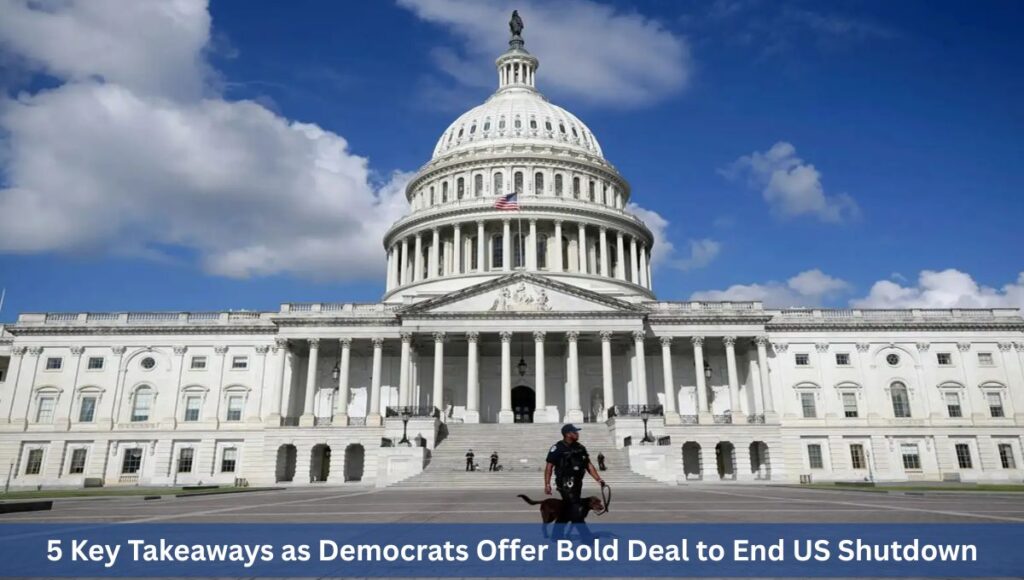
5 Key Takeaways as Democrats Offer Bold Deal to End US Shutdown
Democrats Propose a One-Year Extension of Obamacare Tax Credits
Senate Minority Leader Chuck Schumer on Friday unveiled the Democrats’ proposal to end the shutdown: reopen the government in exchange for a one-year extension of expiring Affordable Care Act (ACA) tax credits, which are central to Obamacare.
“All Republicans have to do is say yes,” Schumer declared on the Senate floor, underscoring the urgency of the situation as federal services continue to suffer.
The ACA tax credits, which help millions of Americans afford health insurance, are set to expire at the end of the year. Democrats argue that extending them for one year would prevent sudden premium hikes for roughly 20 million Americans currently depending on these subsidies.
“This proposal reopens the government and ensures working families get certainty and financial relief while open enrollment has begun,” Schumer said.
What the Democrats Are Demanding
Under Schumer’s plan, Democrats would vote to pass a short-term GOP funding bill — reopening the government — if Republicans agree to a separate one-year ACA extension. The deal also includes a bipartisan committee to discuss long-term health care reforms.
Senator Gary Peters (D-Mich.) is spearheading the initiative. His proposal would link the ACA tax credit extension with a short-term funding bill and a package of appropriations measures, ensuring that essential departments are funded while a larger compromise is negotiated.
This marks a strategic shift for Democrats, who have spent nearly six weeks holding firm on including the ACA subsidy extension within the same government funding package. By separating the issues but demanding parallel votes, they aim to balance immediate relief with long-term reform discussions.
“Let’s find a path to honor both positions,” Schumer said. “We reopen the government and give families stability in their health coverage.”
Republicans Call It “Hostage Politics”
The Republican response was swift — and scathing. Senator Lindsey Graham (R-S.C.) blasted the proposal, calling it “ridiculous” and “equivalent to political hostage-taking.”
“We should not continue flooding health insurance companies with taxpayer dollars under Obamacare as the price to open up the government,” Graham said.
Similarly, Senate Majority Leader John Thune (R-S.D.) dismissed the plan as a “non-starter.” “They know their proposal is unserious and unrealistic,” Thune told reporters. “It’s nowhere close to what we need to do here.”
The Republican leadership, which holds 53 Senate seats, insists that Democrats must first vote to reopen the government unconditionally, before discussing health care or any other policy demands. GOP senators argue that Democrats are leveraging the shutdown to preserve what they call “failing Obamacare subsidies.”
A White House official echoed that view, accusing Democrats of “holding the American people hostage for political spending priorities.” “This is a huge climbdown from their initial position,” the official told CNBC, calling it evidence that Democrats are feeling internal pressure after recent state election defeats for Republicans.
White House and Trump’s Reaction: “End the Hostage Game”
The Trump administration has also rejected Schumer’s offer outright. Former President Donald Trump, who remains a powerful voice within the GOP, urged Senate Republicans to “stay in Washington until a deal is reached” or eliminate the filibuster to pass a clean funding bill without Democratic support.
“If they can’t reach a deal, Republicans should terminate the filibuster immediately and take care of our Great American Workers!” Trump wrote on Truth Social.
The White House, meanwhile, described the Democratic proposal as “a stunt,” suggesting it was a sign that Democrats were desperate to end the shutdown they “started.”
Officials accused Schumer and House Minority Leader Hakeem Jeffries (D-N.Y.) of playing politics while “millions of Americans are suffering.”
Despite the harsh tone, some moderate Republicans privately acknowledge that pressure is mounting to find a way out. As polling shows, a majority of Americans blame Republicans and Trump for the ongoing shutdown.
Democrats Defend Their Proposal as a “Good Faith Compromise”
Hakeem Jeffries, leading House Democrats, praised Schumer’s plan as a “good faith proposal” that balances both reopening the government and addressing healthcare affordability.
“The initiative put forth by Leader Schumer is reasonable and in good faith. It reopens the government and addresses an important part of the Republican healthcare crisis,” Jeffries said in a statement.
Jeffries also took aim at House Speaker Mike Johnson (R-La.), accusing Republicans of abandoning their responsibilities.
“House Republicans need to get back to work and return from their outrageous six-week taxpayer-funded vacation. Enough,” Jeffries added.
Jeffries’ remarks highlight a broader frustration within the Democratic caucus. While Democrats have shown willingness to negotiate, they argue that Republicans — following Trump’s cues — are prioritizing political optics over governance.
Inside the Political Calculus: Pressure Mounts on Both Parties
The shutdown has stretched into its sixth week, and the political cost is mounting. Recent polls show that more Americans blame Republicans (57%) than Democrats (33%) for the gridlock, with independent voters increasingly frustrated by Washington’s dysfunction.
Three days before Schumer’s proposal, Democratic candidates swept key state races in New York City, New Jersey, and Virginia — a development that Trump himself admitted was “a bad sign” for the GOP.
“The shutdown was seen as a big factor — negative for the Republicans,” Trump told reporters.
The economic impact of the shutdown has been severe. Federal workers have missed two paychecks, small businesses reliant on government contracts are struggling, and air travel delays have worsened as airport staff work without pay.
“This is no longer about politics — it’s about people’s lives,” said Senator Peters, defending the Democratic strategy. “Our proposal gets people back to work and ensures millions keep their health coverage.”
What’s at Stake: ACA Subsidies and the 2026 Premium Surge
At the heart of this standoff is the fate of Affordable Care Act premium tax credits — subsidies that make insurance affordable for low- and middle-income Americans.
If Congress fails to extend these credits, premiums for 2026 coverage could spike dramatically. Insurers have already begun warning that without renewal, they will have to raise rates for millions of policyholders.
The enhanced ACA subsidies, introduced under the American Rescue Plan during the pandemic, currently benefit over 20 million Americans. They are set to expire at the end of December unless extended.
Democrats see this as a crucial issue of economic security for working families, while Republicans view it as an unsustainable subsidy that inflates government spending.
Republicans Plan a Countermove
Sources in the GOP say Republican senators are preparing to unveil a new bipartisan funding package, potentially including limited healthcare discussions but without any conditions tied to reopening the government.
A test vote on the measure could happen soon — possibly within days — forcing Democrats to make a crucial decision: whether to compromise or risk prolonging the shutdown even further.
Senate Majority Leader John Thune has indicated he might keep the Senate in session over the weekend, the first time since the shutdown began, to push the negotiations forward.
This follows Trump’s private urging to Republican lawmakers to “end the shutdown quickly” after the party’s poor performance in state elections.
Bipartisan Committee: A Path Forward or a Political Mirage?
The proposed bipartisan healthcare committee, part of Schumer’s deal, could serve as a framework for future negotiations on health reform — but skepticism remains high.
Republicans doubt the committee would produce meaningful results, while Democrats see it as a way to keep discussions alive while protecting ACA subsidies in the short term.
“This is about giving families certainty,” Schumer emphasized. “They’re shopping for coverage right now, and they deserve to know what they’ll pay.”
Yet, with Republicans labeling the plan “political theater” and Democrats refusing to back down, the path to compromise looks narrow.
Public Frustration Grows
Across the country, frustration is palpable. Thousands of TSA agents, air traffic controllers, and federal workers have protested outside airports and government offices, demanding that Congress end the standoff.
Nonprofit organizations warn that food aid programs could soon face severe shortages, while federal housing assistance has already been delayed in several states.
“People’s lives are on hold,” said one furloughed worker in Maryland. “We’re not pawns in a political game.”
The Road Ahead: Uncertainty and Political Stakes
The coming days will be decisive. If no deal is reached soon, federal courts, transportation safety systems, and food inspection programs could grind to a halt, further escalating the crisis.
Analysts warn that prolonged shutdowns historically damage the ruling party more. However, in this divided environment, both parties face political risks.
For Democrats, the challenge is to maintain unity behind Schumer’s healthcare-linked strategy. For Republicans, the risk lies in appearing indifferent to workers and families caught in the crossfire.
As of Friday night, talks remain deadlocked, and the government shutdown enters its 39th day with no clear resolution in sight.
Key Takeaway
Schumer’s proposal to extend ACA tax credits and reopen the government marks a significant, though controversial, move by Democrats. Republicans’ swift rejection underscores how deep the partisan divide has become — even as millions of Americans bear the cost.
Unless a breakthrough emerges soon, Washington appears headed for an even longer and costlier standoff.
Also Read: US Government Shutdown 2025: 5 Key Impacts Shaking Washington and Global Markets
Also Read: Democrats consider prolonging the shutdown as Republicans prepare new bills without health care fix
Related Posts:
- 7 Key Takeaways from Trump’s Decision to End the…

- 5 Major Takeaways from the US Supreme Court's…

- 7 Key Developments as US Senate Approves Deal to End…

- 7 Heartbreaking Facts About Venezuela's Earthquake Disaster

- 5 Key Takeaways as Trump–Democrats Standoff Drives…

- 7 Key Developments as US Senate Passes Deal to End…
