

U.S. Government Shutdown 2025: 10 Alarming Impacts Hitting the Economy Hard, costing $15 billion a week. The ongoing U.S. government shutdown is sending shockwaves through the economy, with small businesses, federal workers, and local communities bearing the brunt of a deepening political impasse. Now entering its third week, the shutdown has frozen key federal operations, delayed paychecks, and disrupted essential services, prompting Treasury officials to warn that it could cost the economy up to $15 billion per week in lost output.
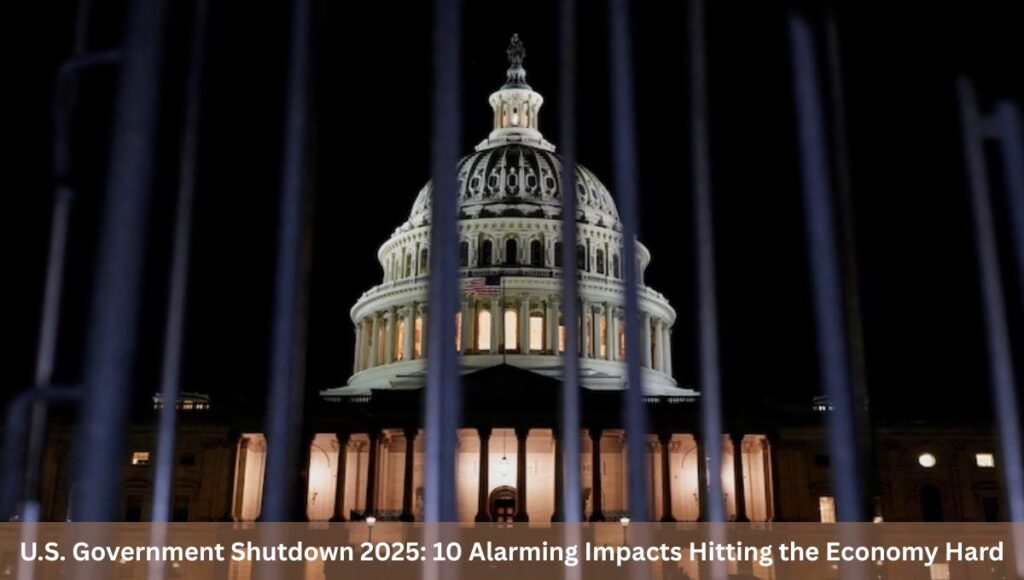
U.S. Government Shutdown 2025: 10 Alarming Impacts Hitting the Economy Hard
1. Small Businesses Struggle as Federal Services Halt
“The shutdown is stifling our ability to grow,” said Grant Richardson, founder of the Austin-based wine import company Pangea Selections.
Richardson’s business, like thousands of others, is caught in bureaucratic limbo. He cannot finalize a six-figure Small Business Administration (SBA) loan while the government remains closed. At the same time, he continues to pay nearly $20,000 in tariffs this month and is still waiting for $10,000 in business tax credits.
Even a deal with a California winemaker to launch a new product line has been shelved because federal agencies aren’t approving new bottle labels.
“The government is still taking money from us, but it’s not paying out what it owes,” Richardson said.
The shutdown has effectively frozen vital government functions such as loan approvals, tax credit processing, and regulatory certifications — leaving entrepreneurs stranded.
2. Federal Workers Miss First Full Paychecks
According to the Bipartisan Policy Center (BPC), around 658,000 federal civilian employees across departments such as Defense, Health and Human Services, and Veterans Affairs missed their first full paycheck on Friday.
It marks the first complete pay lapse since the shutdown began, with more than 1.4 million total employees either furloughed or working without pay.
- About 670,000 are furloughed without pay.
- Another 730,000 are performing essential duties unpaid.
If no continuing resolution (CR) is passed by the end of the month, the total number of withheld paychecks could surge to 1.8 million, potentially exceeding 4.5 million by December.
The White House has urged Congress to pass a clean CR — a stopgap bill to sustain government operations — but Democrats have refused to support it unless it includes additional funding for Affordable Care Act (ACA) subsidies and expanded Medicaid.
3. Restaurants and Cafeterias in Washington, DC Hit Hard
At Market to Market, a cafeteria inside Washington’s Ronald Reagan Building, chef manager Sean Han said foot traffic has plunged 20%–30% since the shutdown began.
“We’ve been around for about 20 years, so we’ve seen this before,” Han said. “But it took us nine months to recover after the pandemic, and we’ll have to rebuild again once this ends.”
Restaurant reservations in Washington are down 9% compared to the same week last year, according to data from OpenTable.
With thousands of federal workers staying home and tightening their budgets, downtown eateries and cafes are reporting sharp revenue drops, forcing owners to consider layoffs.
4. Shutdown Freezes Local Tourism and National Park Businesses
In North Carolina’s Outer Banks, Pam Anderson, owner of Ocean Sands K-9 Resort, said her kennel bookings have plummeted as national parks remain closed.
The nearby Wright Brothers National Memorial — a major tourist draw — has shut its doors, slashing tourism-dependent revenue.
Reservations are down 40% for October and 60% for November, forcing Anderson and her husband to cut personal spending and reconsider charitable donations.
“I told my husband the other day, ‘Don’t spend any money,’” she said.
Similar stories are emerging around the Grand Canyon, Yellowstone, and other parks where local economies depend heavily on tourism.
5. Military Towns Like Huntsville Feel the Strain
In Huntsville, Alabama, a city whose lifeline is military and aerospace work, the shutdown has taken a serious toll.
Restaurateur Fran Bolden, who opened Arsenal Eats at the Redstone Arsenal Army base earlier this year, said her cafeteria is now shuttered.
“We usually serve around 150 people a day for breakfast and lunch,” she said. “Now we’re seeing only 25 to 30.”
Small businesses around the base are also feeling the hit, she added. “The local economy depends on people spending. With people not out, not sure what to do — we can’t sustain ourselves.”
6. Shutdown Hits Fitness and Childcare Centers
In Washington, Bernard Jackson, who runs a swim and wellness center, has seen attendance plummet.
“Since people are not getting paid, they aren’t coming to their lessons,” Jackson said.
He estimates a 40% drop in revenue as federal employees cancel classes for their children and seniors.
Still, Jackson continues to send clients at-home exercises and swim tips. “The pool is still open,” he said, “but we’re barely keeping it that way.”
7. Democrats and Republicans Trade Blame Over ACA Funding
The shutdown stems from a bitter standoff over the continuing resolution (CR) — a temporary funding bill.
Democrats are demanding provisions that extend Affordable Care Act tax credits and Medicaid matching rates, arguing that failure to renew them will spike insurance premiums for millions.
Republicans insist these measures are unrelated to government funding and should be debated later.
President Donald Trump’s administration supports a clean CR without additional riders, accusing Democrats of “playing politics with paychecks.”
8. Treasury Warns of $15 Billion Weekly Losses
In a press briefing, Treasury Secretary Scott Bessent initially misstated that the shutdown could cost $15 billion per day, later correcting it to $15 billion per week.
Still, the figure represents a serious threat to the post-pandemic recovery.
Bessent said the shutdown was “starting to cut into muscle” and could derail Trump-era economic gains.
“There is pent-up demand, but this shutdown is increasingly an impediment,” Bessent said.
He added that while investments in artificial intelligence and manufacturing remain strong, the federal freeze threatens key growth channels like infrastructure and small business lending.
9. Deficit Shrinks, but Shutdown Slows Progress
Bessent also noted that the U.S. deficit for the 2025 fiscal year was smaller than the previous year’s $1.833 trillion, attributing the decline to increased customs revenue from Trump’s tariffs and restrained federal spending.
He projected the deficit-to-GDP ratio could fall into the 3% range, provided the government reopens soon.
“The deficit-to-GDP now has a five in front of it,” Bessent said. “We can get it lower if we grow more and spend less.”
However, economists warn that the shutdown itself may erode fiscal progress by reducing tax revenue and stalling growth in consumer spending.
10. Growing Economic Fallout Across America
The Century Foundation reported 20,000 unemployment insurance claims from federal workers in the past three weeks.
Financial institutions like JPMorgan Chase are offering interest-free bridge loans and fee waivers to impacted clients.
Meanwhile, military families have been temporarily shielded from missed paychecks through $8 billion in reallocated funds and a $130 million private donation accepted by the Pentagon.
But that relief may be temporary. If the shutdown continues into late October, members of every branch of the U.S. military could miss their next paycheck — a first in American history.
Political Fallout: The Battle of Narratives
Both parties are attempting to frame the shutdown on their terms.
Republicans accuse Democrats of holding government funding hostage for ideological goals, while Democrats say Republicans are prioritizing politics over people.
Public sentiment, meanwhile, appears to be turning toward frustration and fatigue, with polls showing a majority of Americans blaming both parties equally for the gridlock.
The Broader Picture: Governance in Gridlock
This shutdown highlights a recurring flaw in the U.S. political system — the reliance on stopgap measures and partisan brinkmanship instead of long-term fiscal planning.
The consequences extend beyond immediate disruptions:
- Credit rating agencies have warned that prolonged inaction could harm U.S. credibility.
- Federal infrastructure projects and research grants are paused.
- Households in government-heavy regions face rising debt and missed rent or mortgage payments.
Economists warn that even if the shutdown ends soon, the damage to confidence and output could linger for months.
The Path Forward
Possible solutions include:
- A short-term CR to reopen government operations while negotiations continue.
- A comprehensive bipartisan deal addressing both funding and healthcare provisions.
However, as the impasse drags on, neither side appears ready to yield. Congressional aides suggest the earliest reopening could come after the next payroll cycle, leaving millions of workers in limbo.
Conclusion: A Nation on Pause
The 2025 U.S. government shutdown has become more than a political stalemate — it’s an economic emergency that’s testing resilience across industries and communities.
From small-town entrepreneurs to federal employees and service industry workers, the impact is spreading fast and deep.
Unless Congress finds a way forward, the shutdown could mark one of the costliest political standoffs in U.S. history, draining billions weekly from an economy already balancing growth and uncertainty.
Also Read: Inside Donald Trump’s 2025 US government shutdown: What’s different this time?
Also Read: US Government Shutdown 2025: 5 Key Impacts Shaking Washington and Global Markets
Related Posts:
- US Government Shutdown 2025: 5 Key Impacts Shaking…

- 5 Key Takeaways as Trump–Democrats Standoff Drives…

- 7 Heartbreaking Facts About Venezuela's Earthquake Disaster

- 7 Key Takeaways from Trump’s Decision to End the…

- US Government Shutdown 2025: Why It Happened, Costs,…

- 7 Powerful Measures: Trump Sanctions Russian Oil…
