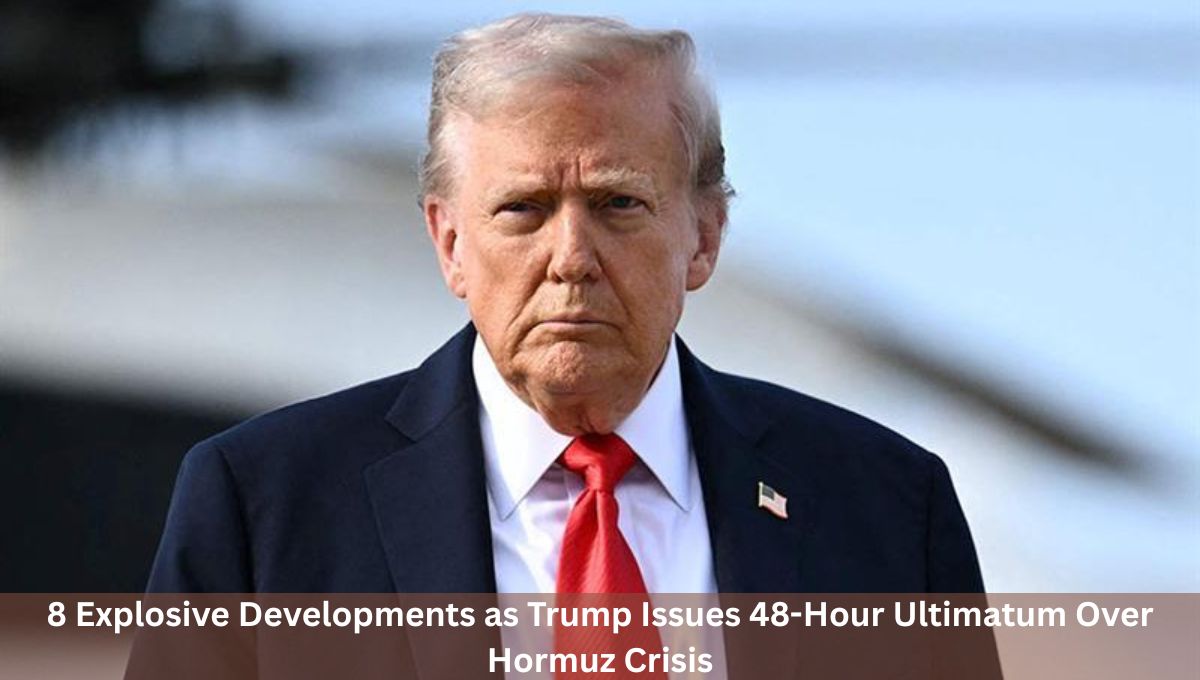
8 Explosive Developments as Trump Issues 48-Hour Ultimatum Over Hormuz Crisis amid global energy market turmoil. The ongoing conflict in the Middle East has taken a dramatic and potentially dangerous turn after U.S. President Donald Trump issued a stark 48-hour ultimatum to Iran.
The warning:
reopen the Strait of Hormuz or face devastating strikes on critical energy infrastructure.
This development marks a sharp escalation in a war already entering its fourth week, with rising casualties, expanding battle zones, and mounting global economic consequences.
The Strait of Hormuz—one of the world’s most critical energy chokepoints—has now become the center of a geopolitical showdown with far-reaching implications.
As tensions rise, global markets tremble, governments scramble, and military forces prepare for what could be a decisive phase in the conflict.
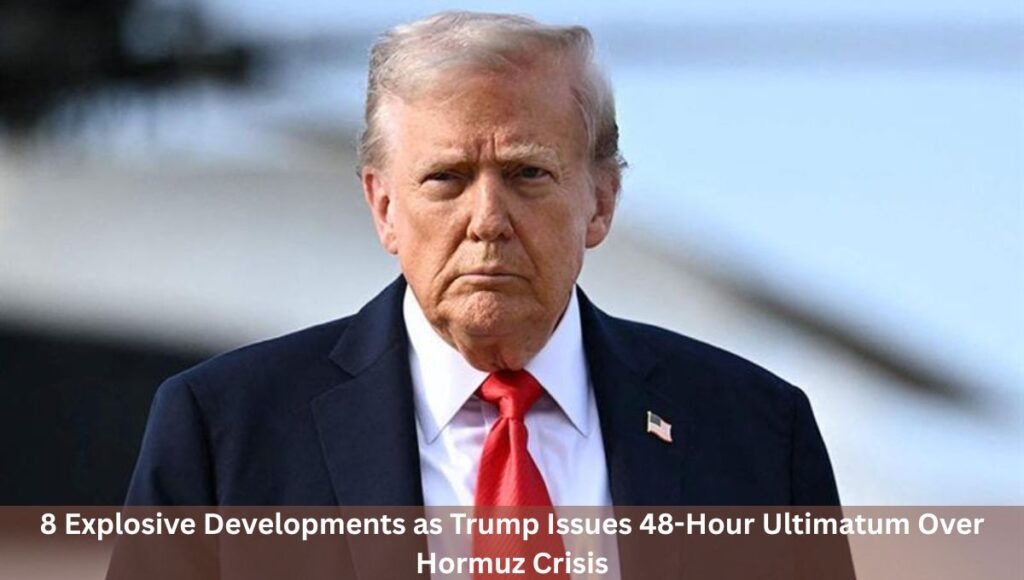
8 Explosive Developments as Trump Issues 48-Hour Ultimatum Over Hormuz Crisis
Trump’s 48-Hour Ultimatum: What Was Said
A Direct and Unprecedented Warning
In a strongly worded social media post, President Trump issued a clear ultimatum to Iran:
- Reopen the Strait of Hormuz within 48 hours
- Ensure it is fully open “without threat”
- Or face U.S. military strikes on power infrastructure
He warned that the United States would “hit and obliterate” Iranian power plants, beginning with the largest facilities.
This statement represents one of the most direct threats against Iran’s civilian infrastructure since the conflict began.
Shift From De-escalation to Aggression
What makes this development even more striking is its timing. Just a day earlier, Trump had hinted at “winding down” military operations, suggesting that U.S. objectives were nearly achieved.
The sudden pivot from potential de-escalation to an aggressive ultimatum underscores the fluid and unpredictable nature of the conflict.
Iran’s Response: Retaliation Threatens Expansion
Military Warning From Tehran
Iran responded swiftly and firmly. Its military command warned that any attack on Iranian infrastructure would trigger wide-ranging retaliation.
According to official statements:
- U.S. energy infrastructure in the region would be targeted
- Information technology systems could be attacked
- Desalination facilities, vital for water supply in Gulf nations, could also be hit
A Strategy of Deterrence
Iran’s response reflects a broader strategy aimed at deterring further attacks by raising the cost of escalation.
By threatening critical infrastructure, Tehran is signaling that the consequences of U.S. action would extend far beyond military targets.
The Strait of Hormuz: Why It Matters
A Vital Global Energy Lifeline
The Strait of Hormuz is one of the most strategically important waterways in the world.
It connects the Persian Gulf to global markets and serves as a conduit for:
- Around 20% of global oil supply
- Significant volumes of liquefied natural gas (LNG)
Any disruption to this route has immediate and severe consequences for global energy markets.
Current Situation: A De Facto Blockade
Since the escalation of the conflict:
- Shipping traffic has drastically reduced
- Tankers face threats from missiles, drones, and mines
- Several countries have halted or rerouted shipments
Iran has effectively imposed restrictions on vessels linked to the U.S. and its allies, creating what many describe as a “de facto blockade.”
Global Oil Shock and Economic Fallout
Rising Energy Prices
The impact on global energy markets has been immediate and severe:
- Oil prices have surged to multi-year highs
- Natural gas prices have spiked in Europe
- Shipping insurance costs have skyrocketed
These developments are fueling inflation worldwide, affecting both developed and emerging economies.
Economic Ripple Effects
The consequences extend far beyond energy markets:
- Increased transportation costs
- Supply chain disruptions
- Rising consumer prices
For many countries, especially energy importers, the crisis is translating into economic instability.
Military Escalation Across the Region
Expanding Conflict Zones
The war is no longer confined to Iran and Israel.
It now spans multiple regions:
- Gulf nations facing drone and missile attacks
- Maritime routes under constant threat
- Military bases targeted across the region
Long-Range Capabilities Raise Concerns
Recent developments suggest that Iran has deployed long-range missile systems capable of reaching far beyond the Middle East.
This expansion:
- Raises concerns for Europe and Asia
- Signals a shift in military strategy
- Increases the likelihood of broader international involvement
Nuclear Tensions Add to the Risk
Strikes Near Nuclear Facilities
Recent exchanges have included strikes near sensitive nuclear sites:
- Iran’s Natanz enrichment facility has been targeted
- Israeli towns near nuclear infrastructure have been hit
While no radiation leaks have been reported, the risk of a nuclear-related incident remains a major global concern.
International Warnings
Global nuclear watchdogs have urged:
- Maximum restraint
- Avoidance of attacks near nuclear sites
- Immediate de-escalation
The stakes are significantly higher when nuclear infrastructure is involved.
Global Diplomatic Response
Calls for Restraint
World leaders and international organizations have called for:
- Immediate reopening of the Strait
- Protection of civilian infrastructure
- Diplomatic negotiations
Coalition Pressure Builds
More than 20 countries have:
- Condemned the disruption of shipping
- Expressed readiness to ensure safe passage
- Urged Iran to restore normal operations
However, consensus on military intervention remains elusive.
Trump’s Strategic Calculus
Domestic and Global Pressures
Trump’s ultimatum comes amid:
- Rising oil prices affecting U.S. consumers
- Political pressure ahead of elections
- Concerns over prolonged military engagement
Mixed Messaging
Throughout the conflict, the U.S. administration has sent mixed signals:
- Suggesting withdrawal at times
- Escalating threats at others
This inconsistency has created uncertainty among allies and adversaries alike.
Iran’s Leverage: Energy and Geography
Control Over a Critical Chokepoint
Iran’s geographic position gives it significant leverage:
- Ability to disrupt global energy flows
- Strategic control over maritime routes
- Influence over regional stability
Selective Restrictions
Iran has indicated that:
- Some countries may be allowed passage
- Others could face restrictions
- Decisions may be based on political alignment
This selective approach adds complexity to the crisis.
Human and Regional Impact
Civilian Risk Increases
As the conflict escalates:
- Civilian infrastructure is increasingly at risk
- Urban areas are affected by strikes
- Humanitarian concerns are growing
Regional Instability
Neighboring countries are facing:
- Security threats
- Economic disruptions
- Political uncertainty
The ripple effects are being felt across the Middle East and beyond.
Potential Scenarios: What Comes Next
Scenario 1: Escalation Into Wider War
If the ultimatum is not met and strikes occur:
- Iran could retaliate across multiple fronts
- Regional conflict could intensify
- Global powers may be drawn in
Scenario 2: Diplomatic Breakthrough
Under international pressure:
- Iran may partially reopen the Strait
- Negotiations could begin
- Tensions may stabilize temporarily
Scenario 3: Prolonged Standoff
A middle-ground scenario where:
- Limited restrictions continue
- Sporadic attacks persist
- Economic pressure builds over time
Global Energy Security at Risk
Strategic Importance of Stability
The Strait of Hormuz crisis highlights:
- Vulnerability of global energy supply chains
- Dependence on a few critical routes
- Need for diversified energy sources
Long-Term Implications
Even if the crisis is resolved:
- Markets may remain volatile
- Energy policies may shift
- Geopolitical alliances could change
Conclusion: A Defining Moment in Global Politics
Trump’s 48-hour ultimatum to Iran represents a defining moment in the ongoing conflict. It underscores the high stakes involved—not just for the Middle East, but for the entire world.
With global energy supplies under threat, military tensions rising, and diplomatic solutions uncertain, the situation remains highly volatile.
The next 48 hours could prove —determining whether the crisis escalates into a broader war or moves toward a fragile de-escalation.
For now, the world watches closely, aware that the consequences of this confrontation will be felt far beyond the waters of the Strait of Hormuz.
Also Read: 10 Explosive Strikes That Forced Trump to Rethink Iran War Strategy
Also Read: Iran Claims It Shot Down ‘Enemy’ F-15 Near Hormuz Hours After Trump’s ’48 Hour’ Ultimatum