
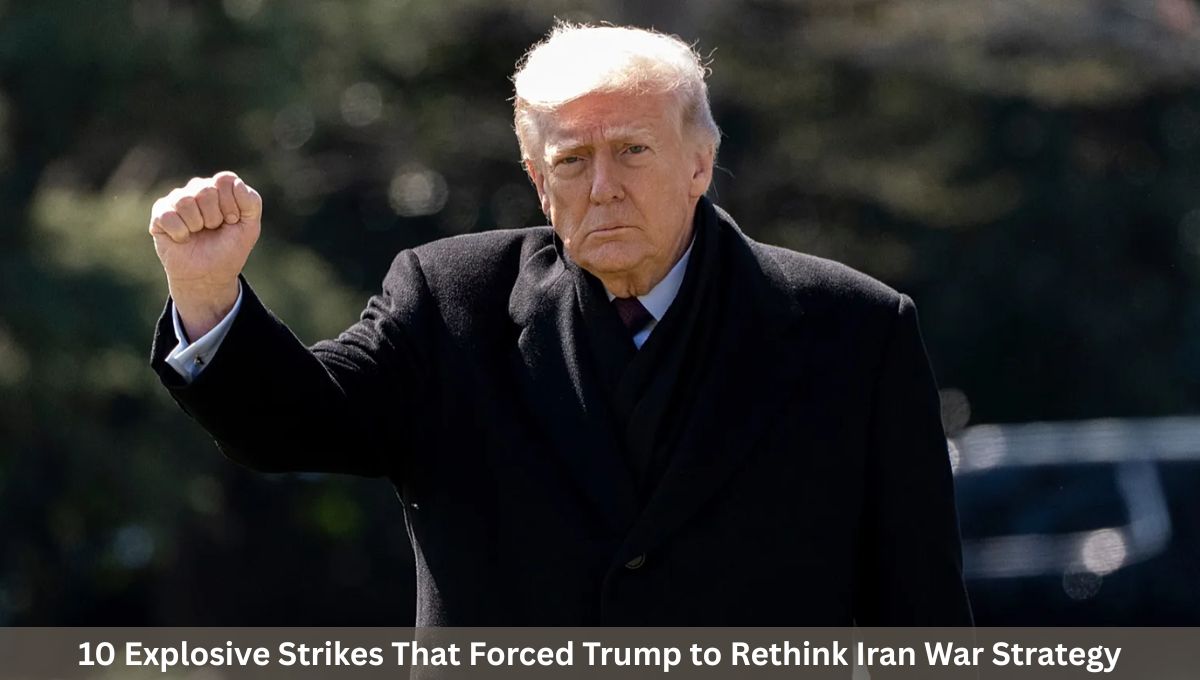
10 Explosive Strikes That Forced Trump to Rethink Iran War Strategy amid a rapidly escalating conflict. The ongoing conflict between Iran and the United States, backed by Israel, has taken a dramatic turn. What began as a high-intensity military campaign on February 28 has now evolved into a complex geopolitical crisis with global implications.
This past week, however, may prove to be a turning point.
A series of high-impact retaliatory actions by Iran—ranging from strikes on critical energy infrastructure to claims of damaging one of America’s most advanced fighter jets—have altered the strategic landscape.
These developments appear to have influenced US President Donald Trump, who has now hinted at “winding down” military operations.
The question now is:
Did Iran’s recent moves force Washington to rethink its strategy?
10 Explosive Strikes That Forced Trump to Rethink Iran War Strategy
The Trigger: South Pars Gas Field Strike
The escalation can be traced back to a major Israeli strike on Iran’s energy infrastructure.
What Happened?
On March 18, Israeli forces targeted the South Pars gas field, a vital energy asset shared between Iran and Qatar.
Known as the North Field on the Qatari side, this region is the largest natural gas reserve in the world.
Why It Matters
- Iran depends heavily on South Pars for domestic energy
- Qatar relies on the same field for global LNG exports
- Any disruption impacts global energy markets immediately
The strike triggered an immediate and forceful response from Tehran.
Iran’s First Major Response: LNG Shockwave
Iran’s retaliation came swiftly—and strategically.
Target: Ras Laffan LNG Facility
Ras Laffan Industrial City—the world’s largest liquefied natural gas processing facility—was hit in a missile strike.
Impact of the Strike:
- Fires and infrastructure damage reported
- Threatened nearly 20% of global LNG supply
- Sent energy markets into panic
Global Fallout
The attack transformed a regional conflict into a global economic crisis:
- Gas prices surged worldwide
- Europe and Asia faced supply fears
- Markets reacted with volatility
This was the moment when the war’s economic consequences became impossible to ignore.
Trump Responds: A Sudden Strategic Pause
Shortly after the LNG strike, Donald Trump made a notable shift in tone.
Key Statements:
- Indicated Israel would pause further strikes on gas infrastructure
- Warned Iran against further escalation
- Later hinted at “winding down” military operations
Why This Matters
This marked the first clear sign that:
- The US was reassessing the cost of escalation
- Economic risks were influencing military decisions
- A prolonged conflict might not be sustainable
The F-35 Incident: A Shock to US Military Prestige
Perhaps the most surprising development was Iran’s claim of hitting a US stealth fighter.
About the Aircraft
F-35 Lightning II is widely considered one of the most advanced combat aircraft in the world.
Iran’s Claim:
- The jet was struck by IRGC air defence systems
- Forced into an emergency landing
- Pilot reportedly survived
US Response:
- Confirmed emergency landing
- Did not confirm missile hit
Why This Matters
Even partial damage to an F-35 carries huge implications:
- Challenges the perception of US technological superiority
- Suggests Iran’s air defence systems remain operational
- Raises doubts about air dominance
From a strategic standpoint, this was a psychological and symbolic win for Iran.
Diego Garcia Strike: Expanding the Battlefield
The most alarming development came next.
The Target
Diego Garcia, a remote US-UK military base in the Indian Ocean.
What Happened:
- Iran reportedly launched two ballistic missiles
- One failed mid-flight
- Another was intercepted (uncertain outcome)
Why It’s Significant:
- Distance: Nearly 4,000 km from Iran
- Suggests long-range missile capability
- Expands conflict beyond the Middle East
This was not just an attack—it was a strategic message:
No US asset is out of reach.
Missile Range Shock: A New Strategic Reality
Iran has long maintained that its missile range is limited to 2,000 km.
The Implication:
- Diego Garcia lies twice that distance
- Indicates undeclared capabilities
- Forces global reassessment of threat levels
Possible System:
- Khorramshahr-class IRBM
- Capable of heavy payloads and extended range
If confirmed, this could:
- Put parts of Europe within range
- Shift NATO’s defence priorities
- Increase missile defence spending globally
Strait of Hormuz: The Economic Pressure Point
Strait of Hormuz has become a central battlefield.
Current Situation:
- Iran has effectively disrupted shipping
- Attacks on vessels have increased
- Oil flow significantly reduced
Global Impact:
- Oil prices surged above $110 per barrel
- Shipping costs skyrocketed
- Inflation pressures increased worldwide
Strategic Importance:
- Handles 20% of global oil supply
- Critical for Asia and Europe
Control of Hormuz gives Iran a powerful leverage tool.
Rising Pressure on Washington
The cumulative effect of Iran’s actions created mounting pressure on the US.
Key Challenges:
- Economic Fallout
- Rising fuel prices
- Market instability
- Military Risks
- Expanding conflict zones
- Threats to overseas bases
- Political Costs
- Domestic pressure
- Global criticism
These factors likely contributed to Trump’s shift in messaging.
Trump’s “Winding Down” Signal: What It Means
Donald Trump has now suggested the US is:
- “Very close” to achieving objectives
- Considering winding down operations
- Not interested in a formal ceasefire
Contradictions:
- Continued troop deployments
- Requests for additional war funding
- Ongoing strikes
Interpretation:
This suggests a strategy of:
- Declaring victory early
- Reducing direct involvement
- Maintaining strategic pressure
US Military Build-Up Continues
Despite talk of winding down, the US is increasing its presence.
Key Developments:
- Deployment of 2,500 Marines
- Additional naval assets sent to region
- Reinforcement of air operations
Total Presence:
- Over 50,000 US troops in the region
This indicates preparation for:
- Extended conflict
- Rapid response scenarios
Iran’s Broader Strategy: Calculated Escalation
Iran’s actions appear deliberate and multi-layered.
Objectives May Include:
- Demonstrating military capability
- Expanding conflict geography
- Increasing economic pressure
- Forcing diplomatic reconsideration
Key Strategy:
Escalate just enough to raise costs—but avoid full-scale war.
Regional Tensions Rise: UAE Warning
Iran has also issued warnings to regional players.
Key Flashpoints:
- Abu Musa island
- Greater Tunb island
Warning to UAE:
- Threat of direct strikes if territory used for attacks
This adds another layer of regional instability.
Human and Economic Cost of War
The conflict has already taken a heavy toll.
Casualties:
- Over 1,400 deaths in Iran
- More than 1,000 in Lebanon
- Casualties reported in Israel and among US forces
Economic Impact:
- Energy prices soaring
- Stock markets declining
- Global recession risks increasing
Global Implications: Beyond the Middle East
This conflict is no longer regional.
Affected Areas:
- Europe (energy dependence)
- Asia (oil imports)
- Global shipping routes
Key Risks:
- Prolonged energy crisis
- Supply chain disruptions
- Military escalation involving more countries
What Happens Next?
The future remains uncertain.
Possible Scenarios:
1. De-escalation
- Diplomatic negotiations
- Gradual military withdrawal
2. Prolonged Conflict
- Continued strikes
- Economic instability
3. Wider War
- More countries involved
- Expansion into new regions
Conclusion: A Strategic Inflection Point
Iran’s high-impact retaliations over the past week have reshaped the dynamics of the conflict.
From:
- Striking global energy infrastructure
- Claiming damage to advanced US aircraft
- Targeting distant military bases
Tehran has demonstrated both capability and intent.
For Donald Trump, the decision to consider winding down operations reflects the complex reality of modern warfare—where economic, political, and military factors are deeply intertwined.
This is no longer just a war of weapons. It is a battle of strategy, perception, and global consequences.
And as events continue to unfold, the world watches closely—because the next move could redefine the balance of power.
Also Read: 8 Explosive Takeaways as Netanyahu Says No One Can Control Trump Amid Iran War
Also Read: Diego Garcia, F-35: Iran’s high-impact hits this week that made Trump speak of ‘winding down’
Related Posts:
- 12 Explosive Claims as Donald Trump Says Iran War…
- 10 Explosive Warnings as Donald Trump Calls Iran…
- 10 Explosive Signals Trump Says Iran War Could End…
- 3 Explosive Conditions Iran Sets to End War with US…

- 10 Explosive Signals: Trump Rates Iran War “15/10”…
- 11 Explosive Warnings as Trump Vows to ‘Knock the…
