
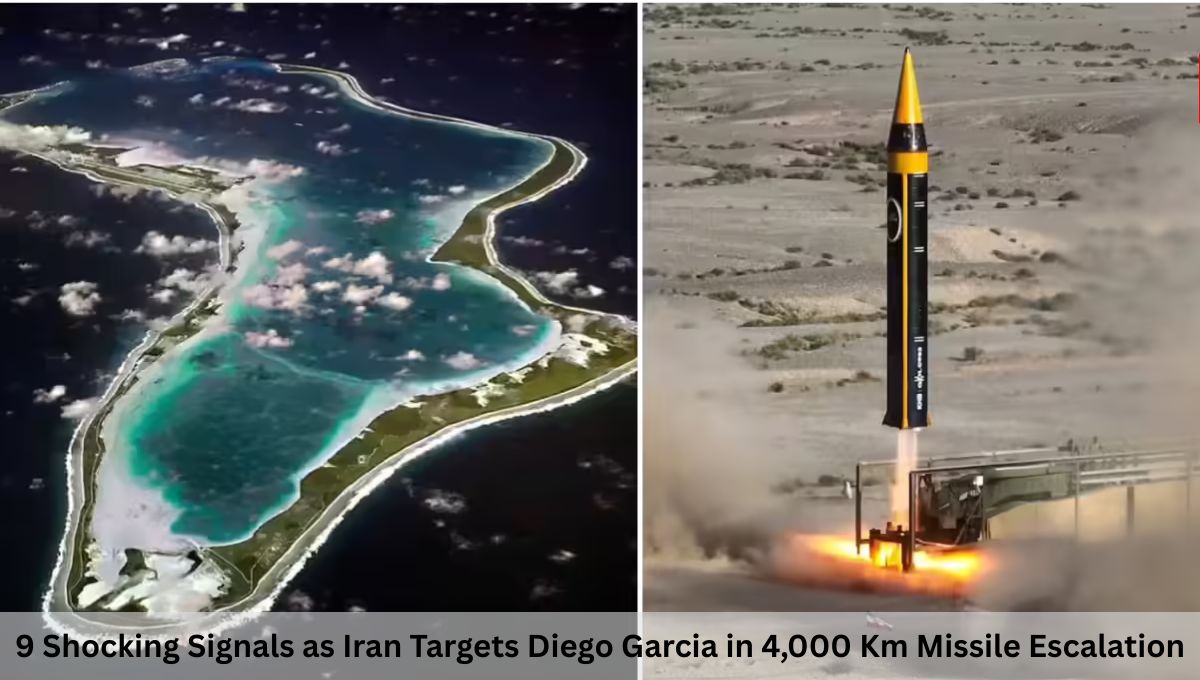
9 Shocking Signals as Iran Targets Diego Garcia in 4,000 Km Missile Escalation, raising concerns over long-range capabilities. The ongoing conflict involving Iran, the United States, and its allies has entered a far more dangerous and unpredictable phase.
In a move that has raised alarm across global capitals, Iran reportedly launched two intermediate-range ballistic missiles toward the US-UK military base at Diego Garcia in the Indian Ocean.
Although neither missile struck the target—one reportedly failed mid-flight while the other was engaged by a US interceptor—the significance of the attempt goes far beyond its immediate outcome.
The strike signals a potential expansion of the conflict’s geographical scope and raises serious questions about Iran’s true military capabilities.
At nearly 4,000 kilometres from Iranian territory, Diego Garcia was long considered a secure and distant stronghold. That assumption is now being challenged.
9 Shocking Signals as Iran Targets Diego Garcia in 4,000 Km Missile Escalation
What Happened: The Missile Attempt Explained
According to reports citing US officials, Iran fired two ballistic missiles toward Diego Garcia:
- One missile broke apart during flight
- The second was targeted by an SM-3 interceptor launched from a US warship
- It remains unclear whether the interception was successful
While no damage was reported, the attempted strike itself marks a critical escalation.
Why This Matters
In military strategy, intent can be just as significant as impact.
Even an unsuccessful strike can:
- Demonstrate capability
- Send strategic signals
- Force adversaries to reassess defenses
In this case, Iran has done all three.
Diego Garcia: Why This Base Is So Important
Diego Garcia is not just another military outpost—it is one of the most strategically important bases in the world.
Key Features of Diego Garcia:
- Jointly operated by the US and the UK
- Located in the central Indian Ocean
- Supports operations across Asia, the Middle East, and Africa
- Hosts long-range bombers, submarines, and surveillance systems
- Serves as a logistics and supply hub
Historical Importance
The base has played a crucial role in:
- US operations in Iraq
- The war in Afghanistan
- Surveillance missions across the Indo-Pacific
Its remote location has long been considered a major advantage—making Iran’s attempt to target it particularly significant.
A 4,000 Km Strike: Breaking Declared Limits?
One of the most alarming aspects of this development is the distance involved.
Iran has historically claimed that its missile range is capped at 2,000 kilometres. However, Diego Garcia lies nearly 4,000 kilometres away.
What This Suggests:
- Iran may possess undeclared long-range missile capabilities
- The strike could involve advanced IRBMs (Intermediate-Range Ballistic Missiles)
- Strategic ambiguity may be intentional
Possible Missile Used
Analysts suspect the involvement of systems like the Khorramshahr-4, believed to have:
- Range exceeding 4,000 km
- Heavy payload capacity
- Potential maneuverable re-entry capabilities
If confirmed, this would represent a major shift in global threat assessments.
Strategic Signaling: More Than Just a Strike
Even without hitting its target, Iran’s move carries powerful strategic messaging.
Key Signals Sent:
- No location is beyond reach
- The conflict is no longer confined to the Middle East
- US and UK overseas bases are now potential targets
- Iran is willing to escalate geographically
Political Impact
Military analysts suggest that:
- Iran has effectively expanded the theatre of conflict
- The psychological impact may outweigh the physical outcome
- Allies may need to reconsider deployment strategies
US Military Response and Reinforcements
The United States is not taking this lightly.
Key Developments:
- Deployment of additional Marines and naval forces
- Movement of amphibious assault ships including
USS Boxer - Increased aerial and naval patrols
Force Expansion:
- Around 50,000 US troops already in the region
- Additional Marine Expeditionary Units (MEUs) being deployed
- Enhanced missile defence operations
This buildup suggests preparation for a prolonged and possibly wider conflict.
Strait of Hormuz: The Global Energy Flashpoint
Strait of Hormuz remains central to the crisis.
Why It Matters:
- Handles nearly 20% of global oil supply
- Critical for global energy markets
- Any disruption affects worldwide economies
Current Situation:
- Shipping activity severely reduced
- Increased attacks on vessels
- US forces actively securing sea lanes
Iran’s actions in the region have already caused:
- Rising oil prices
- Increased shipping costs
- Supply chain disruptions
Expanding Threats: Beyond Military Targets
The situation has become even more concerning due to Iran’s broader warnings.
Reported Threats Include:
- Tourist locations
- Recreational spaces
- Civilian-linked areas globally
Such statements indicate a potential shift toward:
- Asymmetric warfare
- Psychological pressure tactics
- Globalized threat perception
This raises serious concerns for international security and travel.
Missile Defence: Can It Keep Up?
The reported use of the SM-3 interceptor highlights the importance—and limits—of missile defence systems.
About SM-3:
- Designed to intercept ballistic missiles mid-flight
- Uses kinetic “hit-to-kill” technology
- Deployed on US Navy warships
Challenges:
- Increasing missile range and maneuverability
- Multiple simultaneous threats
- Cost asymmetry (interceptors are expensive)
Even successful interceptions come at a strategic cost.
War Expands Into the Indian Ocean
Until now, the conflict had largely been confined to the Middle East.
This Strike Changes That:
- Brings the Indian Ocean into active conflict geography
- Expands risk to new regions
- Forces redistribution of military resources
This could:
- Stretch US and allied defence systems
- Increase global military tensions
- Trigger new alliances and responses
India and Regional Implications
For countries like India, this development is particularly significant.
Why India Should Be Concerned:
- Proximity to Indian Ocean operations
- Dependence on Middle Eastern oil
- Strategic maritime routes at risk
Potential Impacts:
- Increased defence vigilance
- Economic ripple effects
- Diplomatic balancing challenges
Energy Markets and Economic Fallout
The missile strike attempt comes amid already volatile energy markets.
Current Trends:
- Oil prices surging
- Supply disruptions worsening
- Inflationary pressures rising globally
Key Risks:
- Prolonged supply shortages
- Economic slowdown
- Increased geopolitical uncertainty
The longer the conflict continues, the greater the global economic impact.
US Strategy: Containment or Escalation?
The US appears to be balancing between:
- Escalating military pressure
- Preventing full-scale regional war
Possible Strategies:
- Strengthening defence and deterrence
- Securing key supply routes
- Limiting direct engagement inside Iran
However, Iran’s actions may force a recalibration.
The Bigger Question: What Does Iran Want?
Iran’s actions suggest a multi-layered strategy.
Possible Objectives:
- Demonstrate extended strike capability
- Deter further US and Israeli attacks
- Expand conflict pressure points
- Gain leverage in negotiations
By targeting a distant base like Diego Garcia, Iran is signaling that:
the cost of conflict could rise significantly for its adversaries.
What Happens Next?
The situation remains highly fluid.
Possible Scenarios:
- Further Escalation
- More long-range strikes
- Broader targeting
- Stabilization Efforts
- Diplomatic intervention
- De-escalation agreements
- Prolonged Conflict
- Continued regional instability
- Persistent global economic impact
Conclusion: A Turning Point in Modern Warfare
Iran’s attempted strike on Diego Garcia may not have caused physical damage, but it has already reshaped the strategic landscape.
It challenges assumptions about:
- Distance as a form of security
- The limits of missile capabilities
- The containment of regional conflicts
Most importantly, it signals that modern warfare is no longer confined by geography.
As global powers reassess their strategies, one thing is clear:
The conflict has entered a new and far more dangerous phase—one where no location may be truly out of reach.
Also Read: 11 Stark Warnings: Why the US Could Run Low on Missiles if the Iran War Continues
Also Read: No US base out of reach? What Iran’s 4,000 km Diego Garcia strike bid means
Related Posts:
- 7 Stunning Strikes: Iran Claims Destruction of US…
- 3 Explosive Conditions Iran Sets to End War with US…

- 7 Powerful Facts About Ayatollah Ali Khamenei’s…

- 10 Explosive Warnings as Donald Trump Calls Iran…

- 9 Explosive Claims as Trump Says US Winning Iran War

- 10 Explosive Strikes: Israel Bombs Tehran Oil Depots…
