
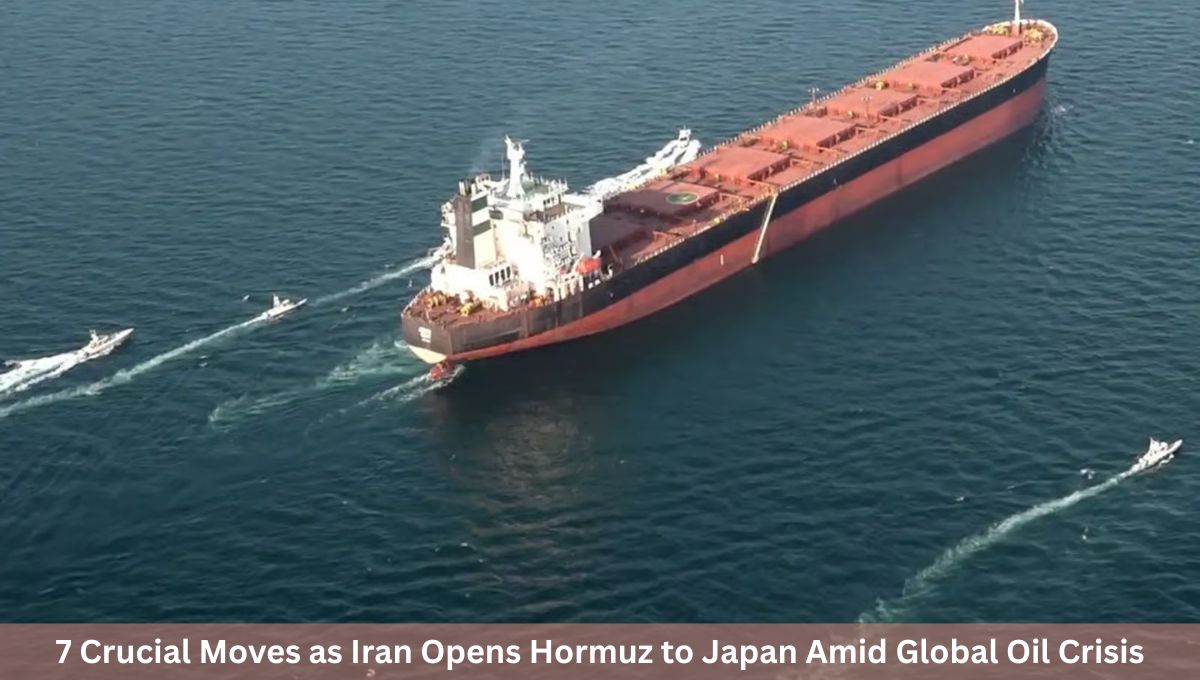
7 Crucial Moves as Iran Opens Hormuz to Japan Amid Global Oil Crisis, signaling a selective blockade strategy. In a major geopolitical development that could reshape global energy flows, Iran has signaled its willingness to allow Japanese-linked vessels to pass through the strategically vital Strait of Hormuz.
The move, reported by Japanese media and attributed to Iran’s Foreign Minister Abbas Araqchi, suggests a shift from a blanket blockade to a more selective maritime strategy amid escalating tensions in the Middle East.
At a time when global oil markets are under immense pressure due to ongoing conflict, this development introduces a new layer of strategic complexity—one that blends diplomacy, energy security, and military signaling.
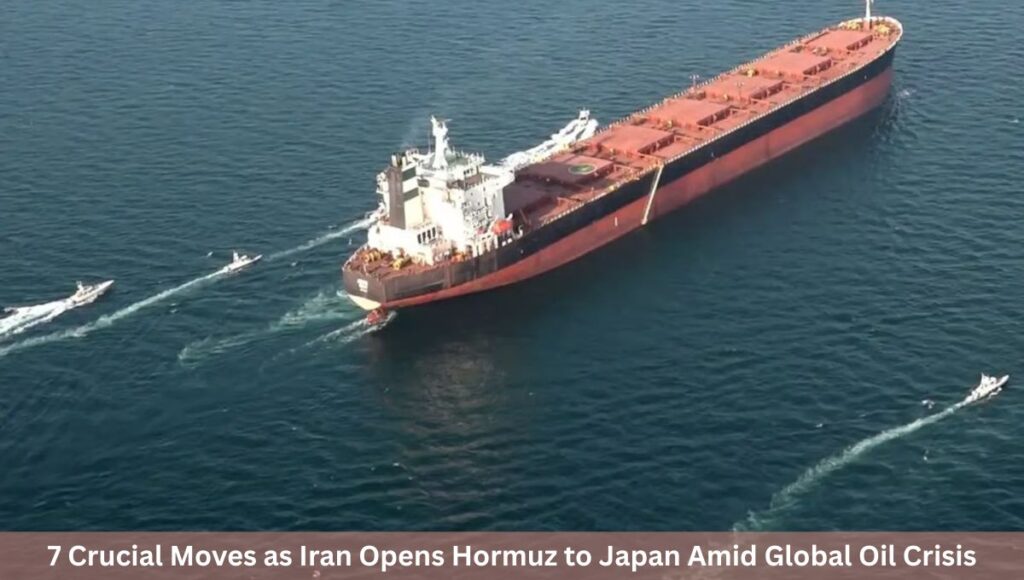
7 Crucial Moves as Iran Opens Hormuz to Japan Amid Global Oil Crisis
A Strategic Shift in Iran’s Hormuz Policy
Iran’s statement that it is “ready to support” Japanese vessels marks a notable departure from its earlier posture.
Since the escalation of the US-Israeli conflict with Iran, the Strait of Hormuz has effectively been under a de facto blockade, severely restricting global shipping.
However, Tehran now appears to be adopting a selective approach—allowing passage for certain nations while restricting others, particularly those seen as adversaries.
Araqchi emphasized that the strait is not entirely closed but is instead “restricted” for countries involved in military actions against Iran.
This nuanced stance allows Iran to maintain pressure on its opponents while avoiding a complete shutdown that could trigger uncontrollable global economic fallout.
Why Japan Matters in This Equation
Japan’s role in this development is far from incidental. The country relies on the Middle East for over 90% of its oil imports, with the majority transiting through the Strait of Hormuz.
Prime Minister Sanae Takaichi recently engaged in high-level discussions with US President Donald Trump, where energy security and maritime access were central topics.
Japan’s diplomatic positioning—maintaining relatively balanced relations with both the US and Iran—makes it uniquely suited to act as an intermediary.
Araqchi himself acknowledged this dynamic, expressing hope that Tokyo could play a constructive role in ending what Iran describes as an “unjustifiable” conflict.
Ongoing Diplomatic Engagements
Iran and Japan are already engaged in active discussions.
Araqchi confirmed talks with Japanese Foreign Minister Toshimitsu Motegi, focusing on mechanisms to ensure safe passage for Japanese vessels.
These talks are significant for several reasons:
- They indicate Iran’s openness to bilateral arrangements rather than multilateral enforcement.
- They highlight a shift toward controlled maritime access rather than total disruption.
- They reflect Iran’s broader strategy of leveraging diplomacy alongside military pressure.
Japan, meanwhile, is proceeding cautiously.
Its postwar pacifist constitution limits military involvement overseas, although recent security legislation allows for defensive actions under specific circumstances.
Selective Blockade: A New Maritime Strategy
Iran’s evolving approach can best be described as a “selective blockade.”
Instead of shutting down the Strait of Hormuz entirely, Tehran appears to be:
- Allowing passage to neutral or friendly nations
- Restricting access to adversarial countries
- Creating controlled maritime corridors along its coastline
Reports indicate that some vessels have already navigated the strait by hugging Iranian territorial waters—a route now informally considered a “safe corridor.”
This strategy serves multiple purposes:
- Economic Leverage: Maintaining some level of oil flow prevents a complete market collapse.
- Political Signaling: Demonstrates control without provoking full-scale international intervention.
- Military Flexibility: Keeps pressure on adversaries while avoiding escalation into total naval conflict.
Impact on Global Oil Markets
The Strait of Hormuz handles nearly 20% of the world’s oil supply. Any disruption—partial or total—has immediate and far-reaching consequences.
Since the conflict began:
- Oil prices have surged dramatically
- Shipping insurance costs have skyrocketed
- Global supply chains have been disrupted
Japan’s potential access to the strait could help stabilize part of the market, but the broader uncertainty remains.
Even limited access does not fully offset the reduced traffic volume, which has dropped sharply due to security concerns.
Global Response and Rising Pressure
Several countries are now engaging with Iran to secure safe passage for their vessels.
These include:
- India
- China
- Pakistan
- Turkey
European nations such as France, Germany, and Italy have also expressed willingness to participate in ensuring maritime security—but only after a ceasefire.
Meanwhile, the United States has been urging allies to contribute militarily to reopening the strait.
However, this call has largely gone unanswered, reflecting the high-risk nature of operating in the region.
The US Position and Strategic Calculations
The United States, under Donald Trump, has taken a firm stance on maintaining freedom of navigation but has faced challenges in mobilizing international support.
Trump has publicly called on allies to “step up” and share the burden of securing the strait.
However, many nations remain hesitant to deploy naval assets into what is effectively a conflict zone.
This hesitation underscores a broader reality:
the Strait of Hormuz is no longer just a shipping route—it is now a contested geopolitical arena.
Shipping Crisis: A Human and Economic Toll
Beyond geopolitics and oil prices, the crisis has significant human and logistical implications.
- Thousands of seafarers remain stranded
- Hundreds of vessels are delayed or rerouted
- Supply chains for critical goods are under strain
According to maritime data, thousands of ships have been affected, with many awaiting clearance or safe passage agreements.
This disruption is not just an economic issue—it is a global humanitarian concern affecting workers and industries worldwide.
Iran’s Broader Strategic Messaging
Iran’s decision to allow Japanese vessels is not just about energy—it is also about signaling.
By selectively opening the strait:
- Iran demonstrates control over a critical global chokepoint
- It positions itself as both a disruptor and a gatekeeper
- It reinforces its leverage in ongoing geopolitical negotiations
At the same time, Tehran continues to insist that it seeks a complete end to hostilities—not merely a temporary ceasefire.
Araqchi made it clear that Iran wants guarantees against future attacks, indicating that maritime policy is closely tied to broader diplomatic objectives.
What This Means for the Future
The situation in the Strait of Hormuz remains fluid and highly volatile.
However, several trends are emerging:
1. Fragmented Global Response
Countries are pursuing individual agreements rather than a unified strategy.
2. Rising Importance of Bilateral Diplomacy
Direct talks, like those between Iran and Japan, are becoming key to resolving immediate challenges.
3. Persistent Energy Market Volatility
Even partial disruptions continue to drive uncertainty in global markets.
4. Expanding Geopolitical Risk
The conflict’s impact is no longer confined to the Middle East—it is affecting global trade and security.
Conclusion
Iran’s willingness to allow Japanese vessels through the Strait of Hormuz marks a pivotal moment in an already complex geopolitical crisis.
It reflects a calculated strategy—one that balances pressure with pragmatism.
For Japan, it offers a potential lifeline for energy security. For global markets, it provides limited relief amid ongoing uncertainty.
And for the broader international community, it underscores the urgent need for coordinated diplomatic solutions.
As the conflict continues to evolve, the Strait of Hormuz will remain at the center of global attention—not just as a vital energy corridor, but as a symbol of shifting power dynamics in an increasingly uncertain world.
Also Read: 10 Explosive Signals as Donald Trump Urges Nations to Secure Strait of Hormuz Amid Iran War
Also Read: Iran says it will allow Japanese ships to transit the Strait of Hormuz
Related Posts:
- 7 Critical Ways Iran’s Yuan Oil Plan Could Shake the…
- 7 Powerful Reasons the U.S. Is Letting Countries Buy…
- 12 Powerful Updates as Iran Opens Hormuz Route for…
- 10 Powerful Revelations from the Trump–Putin Call on…

- 7 Critical Reasons Kharg Island Is Iran’s Oil “Crown…

- 10 Critical Risks if the Strait of Hormuz Closes…
