In a dramatic turn of events, “India-Pakistan Ceasefire After Intense Cross-Border Clashes: Jaishankar Reiterates ‘Uncompromising Stance on Terrorism.’ Today India and Pakistan announced a “full and immediate ceasefire” following day of heavy missile, drone, and artillery exchange across their tense border.
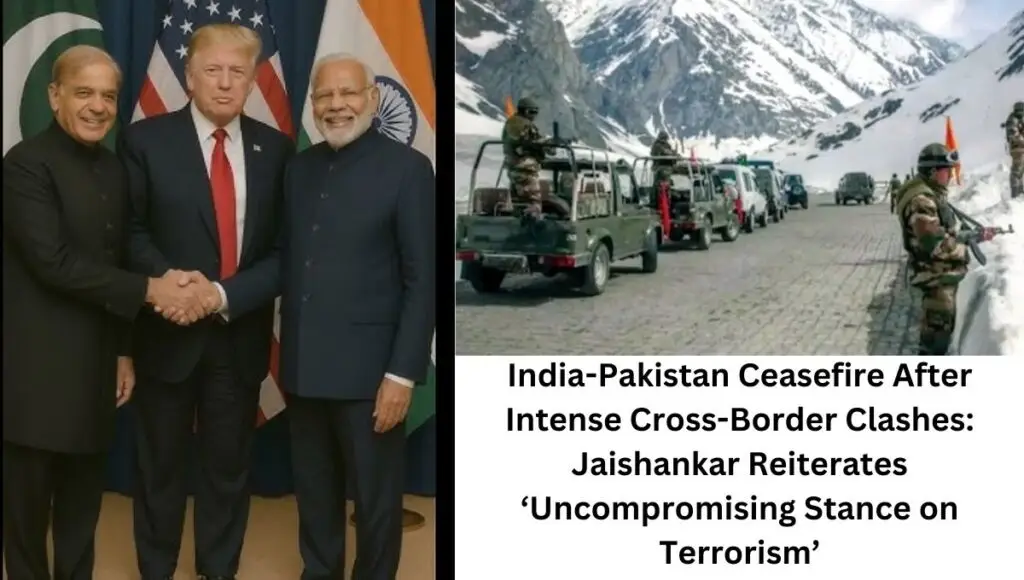
India-Pakistan Ceasefire After Intense Cross-Border Clashes: Jaishankar Reiterates ‘Uncompromising Stance on Terrorism’
India and Pakistan Agree to Ceasefire After Deadly Cross-Border Escalation
The announcement came after a series of high-level military and diplomatic conversations, including a call between the Director Generals of Military Operations (DGMOs) of both countries. Indian Foreign Minister S Jaishankar, in a post on X (formerly Twitter), confirmed the agreement and reiterated India’s unwavering commitment to fighting terrorism.
“India has consistently maintained a firm and uncompromising stance against terrorism in all its forms and manifestations. It will continue to do so,” Jaishankar stated.
Background: What Triggered the Conflict
The recent surge in Indo-Pak tensions began with a deadly terrorist attack in Pahalgam, Jammu and Kashmir, where 26 tourists were killed. India identified the attackers as Pakistan-linked terrorists, prompting a sharp military response.
Under Operation Sindoor, the Indian Armed Forces launched precision cruise missile strikes on terror infrastructure in Pakistan and Pakistan-Occupied Jammu and Kashmir (PoJK).
Targets included command and control centers, radar installations, and ammunition depots in strategic locations such as Chaklala, Rahim Yar Khan, Sukkur, Sialkot, and Rafiqui.
In retaliation, Pakistan escalated by deploying Operation Bunyan-al-Marsoos, targeting 26 Indian sites in Jammu and Kashmir, Punjab, Rajasthan, and Gujarat with drones and missiles.
While India’s air defense systems intercepted most of the attacks, the confrontation pushed both nations to the brink of a broader war.
Ceasefire Negotiated Amid High Tensions
At 3:30 PM, the DGMOs of both countries held a decisive phone call, agreeing to halt all firing and military action across land, air, and sea from 5 PM onwards. The Indian Foreign Secretary Vikram Misri confirmed that the DGMOs will reconvene for further talks on May 12.
Misri clarified that the ceasefire was directly negotiated between India and Pakistan, subtly refuting U.S. President Donald Trump’s claim that the United States had brokered the deal.
Trump had earlier posted on Truth Social celebrating the ceasefire and congratulating both nations for “common sense and great intelligence”.
US Role: Claimed Mediation or Diplomatic Encouragement?
The American position appeared divided. While President Trump and Secretary of State Marco Rubio both credited U.S. diplomacy for de-escalating tensions, Vice President JD Vance had just a day prior taken a non-interventionist stance.
“We’re not going to get involved in the middle of a war that’s fundamentally none of our business,” Vance had said, highlighting America’s strategy of diplomatic engagement without direct interference.
Still, Rubio revealed that he and Vance had spoken with key Indian and Pakistani leaders, including PM Narendra Modi, PM Shehbaz Sharif, EAM S Jaishankar, and top military officials. He praised both leaders for “choosing the path of peace”.
India’s Message: Ceasefire Not a Compromise on Security
Despite agreeing to a ceasefire, India has issued a stern warning to Pakistan. The government stated that any future terror attacks linked to Pakistan would be considered an act of war, and India would respond accordingly.
This declaration comes in the wake of repeated drone strikes and missile attacks by Pakistan on Indian military and civilian infrastructure.
S Jaishankar’s message made it clear: the ceasefire does not imply any dilution of India’s anti-terror policy. The Indian Army’s recent strikes—part of Operation Sindoor—eliminated over 100 terrorists and dismantled several terror camps associated with Jaish-e-Mohammad (JeM) and Lashkar-e-Taiba (LeT).
Upcoming Talks and Road Ahead
As per official statements, the next round of India-Pakistan DGMO-level talks will be held on May 12, focusing on maintaining the ceasefire and reducing further hostilities. However, India has strongly denied U.S. suggestions that broader bilateral talks on other issues are planned at a “neutral site.”
While Pakistan’s Foreign Minister Ishaq Dar tweeted that Islamabad supports peace in the region, India’s position remains clear: peace is welcome, but sovereignty and national security are non-negotiable.
Conclusion: Ceasefire as a Tactical Pause, Not a Permanent Solution
The current India-Pakistan ceasefire brings a much-needed pause to an otherwise escalating situation. However, with deep-rooted mistrust and unresolved issues—particularly cross-border terrorism—the path to lasting peace remains fraught.
As both sides prepare for military talks on May 12, global observers and citizens of both nations hope that diplomacy will prevent another spiral into armed conflict.
Also Read: Pakistan Brings Kashmir and Water Dispute to the Forefront at UN
Also Read: What did India and Pakistan gain – and lose – in their military standoff?
Related Posts:
- Afghanistan–Pakistan War 2025: Inside the 48-Hour Ceasefire

- 5 Major Takeaways from the US Supreme Court's…

- 7 Heartbreaking Facts About Venezuela's Earthquake Disaster

- 7 Powerful Measures: Trump Sanctions Russian Oil…

- 3 Explosive Conditions Iran Sets to End War with US…
- 7 Powerful Facts About Ayatollah Ali Khamenei’s…