
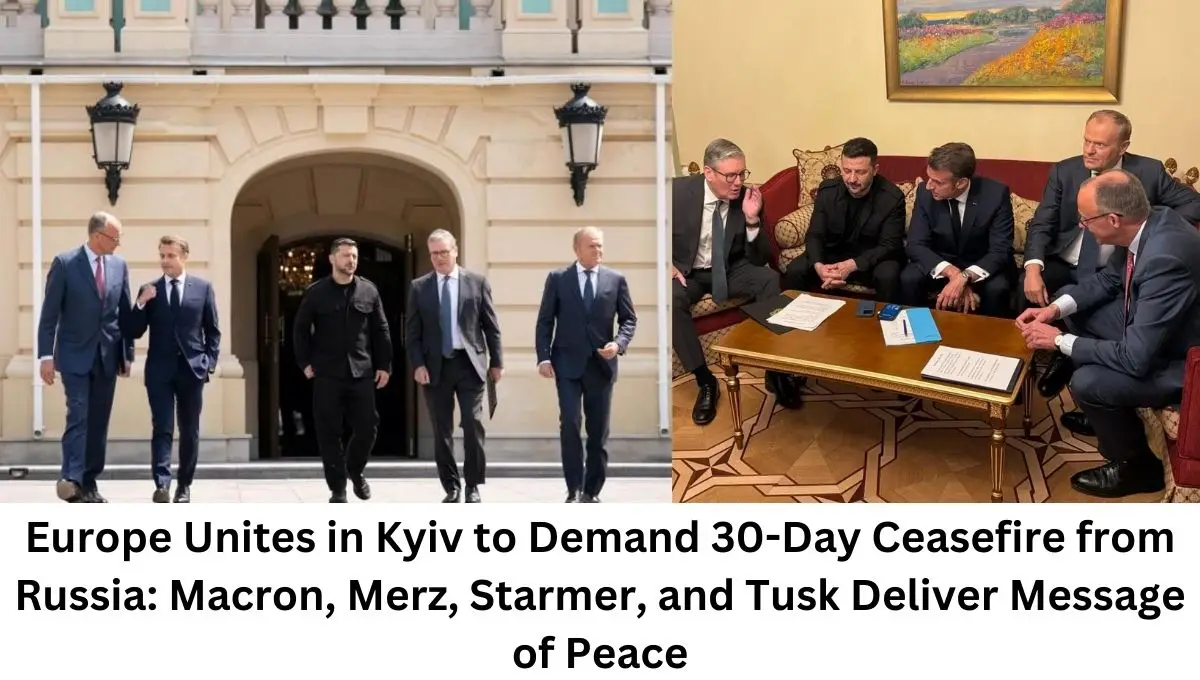
In a bold and unprecedented show of unity, Europe Unites in Kyiv to Demand 30-Day Ceasefire from Russia: Macron, Merz, Starmer, and Tusk Deliver Message of Peace. The leaders of France, Germany, the United Kingdom, and Poland arrived in Kyiv on Saturday, May 10, to demand a 30-day unconditional ceasefire from Russia.
The visit by French President Emmanuel Macron, newly appointed German Chancellor Friedrich Merz, British Prime Minister Keir Starmer, and Polish Prime Minister Donald Tusk marks the first joint mission of this magnitude since Russia’s full-scale invasion of Ukraine began in 2022.
Their arrival signals a powerful message to both the Kremlin and the international community: Europe stands firmly with Ukraine, and the time for peace is now.
Europe Unites in Kyiv to Demand 30-Day Ceasefire from Russia: Macron, Merz, Starmer, and Tusk Deliver Message of Peace
Symbolism and Timing: Responding to Moscow’s Parade with Diplomacy
The timing of the visit could not be more symbolic. Just a day earlier, Russian President Vladimir Putin presided over a lavish military parade in Moscow marking the 80th anniversary of victory in World War II.
In contrast, the European leaders’ arrival in Kyiv signaled a rejection of militaristic displays and an embrace of diplomacy.
A French official described the visit as “Europe’s unity, strength, and responsiveness” mirroring Putin’s show of force but with a message of peace.
This visit comes mere days after Friedrich Merz took office, underscoring how urgent and unified the European response has become.
Backing the Trump-Led Peace Initiative
The visit also follows the proposal by U.S. President Donald Trump of a full and unconditional 30-day ceasefire starting Monday, May 12. Ukraine and its Western allies have endorsed the proposal, urging Russia to seize the opportunity for de-escalation.
In a joint statement, the European leaders declared:
“We are clear the bloodshed must end. Russia must stop its illegal invasion, and Ukraine must be able to prosper as a safe, secure and sovereign nation within its internationally recognized borders for generations to come.”
Zelensky and European Leaders Stand United
President Volodymyr Zelensky met the leaders in Kyiv, welcoming their solidarity and joint effort to push for peace. The delegation first paid respects at Independence Square before heading into extended talks at the Mariinsky Palace.
Ukraine’s Foreign Minister Andrii Sybiha confirmed that Ukraine and its allies are ready for a ceasefire “on land, air, and sea” starting May 12. In his statement on X, Sybiha said:
“If Russia agrees and effective monitoring is ensured, a durable ceasefire and confidence-building measures can pave the way to peace negotiations.”
The leaders later held a phone call with President Trump to coordinate the diplomatic push. While the White House has yet to comment, Sybiha described the call as “fruitful.”
Russia’s Response: Hesitation and Conditions
Despite international pressure, Russia has so far refrained from committing to the 30-day truce. Kremlin spokesman Dmitry Peskov, speaking to ABC News and CNN, reiterated that Russia is open to a ceasefire “in principle,” but cited several “nuances” that remain unresolved.
One of Russia’s main demands is a halt to arms deliveries to Ukraine. Peskov warned that any truce would give Ukraine a strategic advantage if Western military support continues. “Europe is confronting us very openly,” Peskov said. “At this stage, it’s quite useless to try to press on us.”
Sanctions Loom if Russia Refuses Ceasefire
The European leaders warned that failure to comply would result in severe new sanctions. Macron emphasized the need for a “massive sanctions package,” coordinated with Washington, that would target Russia’s banking and energy sectors.
European Commission President Ursula von der Leyen also endorsed the ceasefire proposal, stating on X:
“It must be implemented without preconditions to pave the way for meaningful peace negotiations. We stand ready to impose further biting sanctions in the event of a breach.”
Kyiv Plans for a Post-War Future
Beyond the ceasefire, European leaders discussed the formation of a European defense force to support Ukraine’s long-term security and military regeneration.
According to a joint communique, such a force would “help regenerate Ukraine’s armed forces after any peace deal and strengthen confidence in any future peace.”
This long-term vision further underscores Europe’s commitment to Ukraine’s sovereignty and resilience—far beyond the immediate war zone.
A Critical Juncture for Peace
With less than 36 hours left before the proposed ceasefire deadline, all eyes are now on Moscow. The proposal for a full and unconditional truce represents the most significant peace initiative in months, one that could potentially end Europe’s most devastating conflict since World War II.
Putin’s response will determine the next chapter. Will Russia join the world in choosing diplomacy—or face deeper isolation?
Conclusion: A Defining Moment for Europe and Russia
The unified visit of four major European leaders to Kyiv is not just a diplomatic gesture—it is a firm call for action. As Ukraine, the U.S., and the EU rally around a 30-day ceasefire, the pressure is now squarely on Russia.
The world waits for Moscow’s answer, while Kyiv, bolstered by its allies, continues to hold the moral and political high ground.
Also Read: European leaders tell Putin to agree to Ukraine ceasefire or face new sanctions
Related Posts:
- Poland Invokes NATO Article 4 After Russian Drone…
- 5 Major Takeaways from the US Supreme Court's…

- In 8 Moves, EU Targets China-Linked Refineries and…

- 7 Heartbreaking Facts About Venezuela's Earthquake Disaster
- 7 Powerful Measures: Trump Sanctions Russian Oil…

- 7 Big Takeaways: Macron’s High-Stakes China Visit…
