

In a historic and dramatic turn of events Bangladesh Bans Sheikh Hasina’s Awami League Under Anti-Terrorism Act Amid War Crimes Trial. In Bangladeshi politics, the interim government led by Nobel Peace Prize laureate Muhammad Yunus has banned the Awami League, the political party of former Prime Minister Sheikh Hasina, under the country’s Anti-Terrorism Act. The ban, announced on Saturday, May 10, 2025, comes amid mounting pressure from protesters and a pending war crimes trial against the party’s top leadership. This move marks the first time in Bangladesh’s post-independence history that a ruling party has been officially suspended pending judicial proceedings.
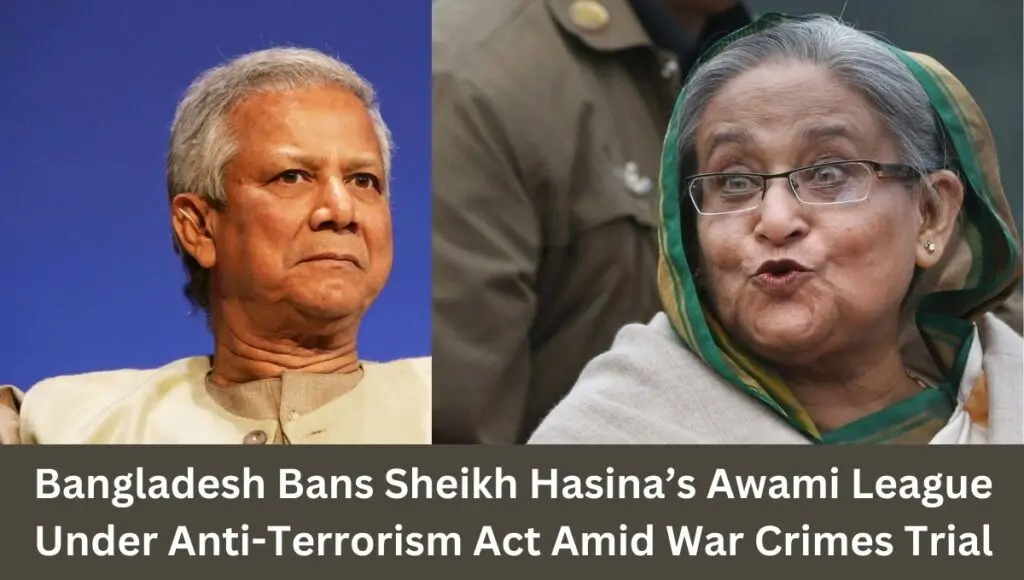
Bangladesh Bans Sheikh Hasina’s Awami League Under Anti-Terrorism Act Amid War Crimes Trial
War Crimes Allegations and Mass Protests Prompt Ban
The decision follows the aftermath of the July 2024 mass protests, during which the Hasina government allegedly carried out a brutal crackdown on demonstrators.
According to the United Nations Human Rights Office, up to 1,400 people were killed over a three-week period as authorities tried to silence a rapidly expanding opposition movement.
The violence sparked widespread condemnation and eventually led to Hasina’s ouster on August 5, 2024, after protesters stormed her official residence.
Since then, she has lived in self-imposed exile in India, defying an arrest warrant issued by the International Crimes Tribunal (ICT) in Dhaka.
Government Statement and Legal Amendments
Asif Nazrul, the law affairs adviser to the interim cabinet, told reporters that the ban was aimed at protecting “national security and sovereignty,” and ensuring the safety of plaintiffs and witnesses involved in the tribunal proceedings.
To strengthen its legal foundation, the Advisory Council also amended the International Crimes Tribunal Act, now enabling the ICT to prosecute not just individuals but also political parties and their affiliated organizations.
“The ban on the Awami League will remain in effect until the conclusion of the tribunal’s trial,” Yunus’s office confirmed in a statement. An official gazette notification is expected on the next working day.
Rise of the National Citizen Party (NCP)
The decision comes amid growing street pressure from a newly formed, student-led party — the National Citizen Party (NCP) — which emerged from last year’s student movement.
Formerly part of Students Against Discrimination (SAD), the NCP played a pivotal role in the July uprising that brought down Hasina’s 16-year rule.
Since Thursday, NCP supporters have staged massive rallies and blockades across Dhaka, demanding the immediate ban of the Awami League. The tension escalated further when thousands marched toward Yunus’s residence and issued an ultimatum for government action.
Several Islamist and right-wing groups, including members of the Jamaat-e-Islami’s student wing, joined the protests, intensifying public pressure on the interim administration.
Reactions from Political Stakeholders
The Awami League has called the ban “illegitimate” and politically motivated, though no formal statement has been issued by Sheikh Hasina herself. Many of her senior colleagues are either in custody or have fled abroad, including former president Abdul Hamid, who successfully left the country just one day before the ban was announced.
In response, three airport police officers were dismissed for negligence related to Hamid’s departure.
The Bangladesh Nationalist Party (BNP), the Awami League’s main rival, has distanced itself from the decision. A BNP spokesperson stated, “We do not support the banning of any political party.” The party maintains that legal accountability should occur without undermining political pluralism.
Historic Party Faces a Historic Setback
Founded in 1949, the Awami League is credited with leading Bangladesh’s 1971 Liberation War and has been a dominant force in the country’s politics ever since. The ban marks a historic turning point, reflecting the ongoing shift in public sentiment and generational politics.
The July Declaration, a pending official summary of the 2024 uprising and its political outcomes, is expected to be published within the next 30 days, as per the resolution adopted during the special meeting of the interim cabinet.
What’s Next for Bangladesh?
With the ICT trials underway, and a rising tide of youth-led political activism, Bangladesh enters a critical juncture. The Yunus administration insists that its actions are designed to ensure justice and national security.
However, critics fear that banning political parties could set a dangerous precedent for democratic suppression.
The road ahead remains uncertain, with public opinion deeply divided, and the fate of the Awami League hanging in the balance as one of South Asia’s most turbulent political trials unfolds.
Also Read: Bangladesh’s Muhammad Yunus Decides to Stay Amid Political Turmoil and Calls for Reform
Also Read: Bangladesh’s interim government bans Awami League from contesting next general elections
Related Posts:
- Bangladeshi Diaspora Protests Yunus Govt at UN,…
- 5 Key Shifts in Bangladesh–Pakistan Relations as…

- Bangladesh’s Muhammad Yunus Decides to Stay Amid…
- 7 Alarming Twists in the Sheikh Hasina–Tulip Siddiq…
- 7 Shocking Reasons Why Bangladesh’s Yunus Govt Bowed…
- Trump’s 2025 Nobel Peace Prize Snub: Politics Over…
