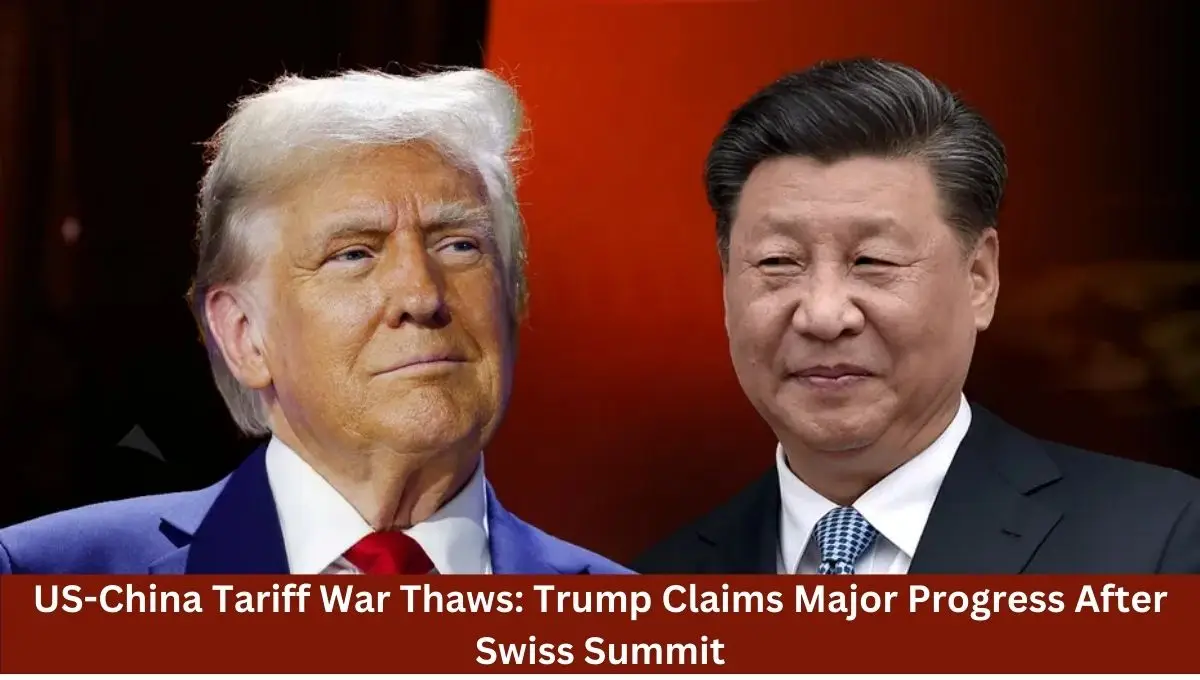
In a surprising diplomatic breakthrough US-China Tariff War Thaws: Trump Claims Major Progress After Swiss Summit. Former President Donald Trump announced on Sunday that the United States and China had negotiated a “total reset” in their strained trade relationship after marathon talks held in Geneva, Switzerland.
US-China Tariff War Thaws: Trump Claims Major Progress After Swiss Summit
Geneva Talks Signal Potential Turning Point in US-China Trade War
The high-level, closed-door discussions, which took place at the residence of the Swiss ambassador to the United Nations, aimed to de-escalate tensions from an escalating US-China trade war that has gripped global markets.
“A very good meeting today with China, in Switzerland. Many things discussed, much agreed to. A total reset negotiated in a friendly, but constructive, manner. We want to see, for the good of both China and the U.S., an opening up of China to American business. GREAT PROGRESS MADE!!!” Trump posted on Truth Social, his social media platform.
Backdrop: Rising Tariffs and Economic Fallout
Trump’s tariff blitz, launched in February, saw the U.S. impose up to 145% levies on Chinese imports, with some products facing tariffs exceeding 245%. China swiftly retaliated with 125% tariffs on American goods.
The fallout has rattled supply chains, impacted consumer prices, and sparked global economic concerns.
The talks in Geneva, which began Saturday and were expected to continue through the weekend, are the first face-to-face negotiations since Trump reignited the tariff war last month.
US Treasury Secretary Scott Bessent and Trade Representative Jamieson Greer met with Chinese Vice Premier He Lifeng in an eight-hour session that sources described as tense but productive.
Despite no formal statement on concessions or tariff rollback, both sides expressed a willingness to continue dialogue — a notable shift from recent months.
Behind Closed Doors in Geneva
The undisclosed venue, later revealed to be a discreet villa near Lake Geneva, provided a neutral and private setting for the discussions. Witnesses saw both delegations return after a lunch break to the gated estate, where the Swiss diplomatic mission helped broker the meeting.
While details remain tightly held, Swiss Economy Minister Guy Parmelin called the meeting’s occurrence itself “a success.” He added, “If a roadmap can emerge and they decide to continue discussions, that will lower the tensions.”
Core Disputes: Trade Deficit, Rare Earths, and Fentanyl
At the heart of Washington’s demands is the desire to shrink its $295 billion goods trade deficit with China and push Beijing toward structural reforms that reduce export dependency and open its markets to U.S. businesses.
Trump’s administration is also pressing China to curb fentanyl exports and ease restrictions on rare earth minerals, which are crucial to manufacturing and national defense.
In contrast, Beijing wants the U.S. to roll back tariffs, clarify what products it expects China to purchase, and acknowledge China as an equal on the world stage.
A commentary by Xinhua, China’s state news agency, warned of the dangers of continued tariff escalation but welcomed the Geneva meeting as “a positive and necessary step.”
Uncertain Path Ahead Despite Optimism
Although President Trump spoke enthusiastically of “great progress,” his administration sent mixed signals on the potential for immediate relief.
Commerce Secretary Howard Lutnick told Fox News that tariffs would not be paused outright, saying, “There’s no chance of zeroing them out. The president will keep significant tariffs on trade with China.”
On Friday, Trump floated the idea of an 80% tariff on Chinese imports — a reduction from the current 145%, but still extreme by historical standards.
His press secretary, Karoline Leavitt, clarified that the U.S. would not reduce tariffs unilaterally and expected concrete concessions from China in return.
Impact on Global Markets and Outlook
The World Trade Organization (WTO) and the International Monetary Fund (IMF) have both slashed global trade forecasts, citing rising uncertainty from the US-China trade war.
Geneva-based WTO Director-General Ngozi Okonjo-Iweala, scheduled to meet with China’s He Lifeng, praised the talks as a “constructive step toward de-escalation.”
As trade between the two giants — worth nearly $700 billion annually — slows to a trickle, the global economy has started feeling the strain. U.S. consumers are facing higher prices, empty shelves, and looming job losses in logistics and retail.
Meanwhile, China’s exports to the U.S. have plunged by 21%, even as shipments to the European Union rise.
Conclusion: A Cautious but Critical Reset
While it’s too early to celebrate a formal trade agreement, the Geneva talks mark a turning point in a conflict that has destabilized global trade and investor confidence.
Trump’s declaration of a “total reset” suggests a shift in tone and strategy, even if tangible outcomes remain elusive.
As negotiations continue, both Washington and Beijing must balance domestic political pressures with the urgent need to stabilize the global economy. Whether the “reset” Trump hailed becomes a lasting resolution or another temporary truce will depend on the next few rounds of high-stakes diplomacy.
Also Read: Renewed US-China Trade War: Trump Accuses China of Breaking Tariff Truce
Also Read: Trump’s China trade breakthrough might be enough to avoid self-inflicted recession
Related Posts:
- 10 Powerful Revelations from the Trump–Putin Call on…

- What’s Next for Donald Trump After Court Rules His…
- 12 Explosive Claims as Donald Trump Says Iran War…
- 10 Explosive Signals: Trump Rates Iran War “15/10”…

- 11 Explosive Warnings as Trump Vows to ‘Knock the…

- 5 Key Breakthroughs as Trump and Xi Seal Major…