US Revokes Visas of Palestinian Officials Ahead of UN General Assembly, Citing Terror Links, raising tensions over Palestinian representation at the UN. In a dramatic escalation of tensions just weeks before the United Nations General Assembly (UNGA) in New York, the United States announced it is revoking and denying visas for officials from the Palestinian Authority (PA) and the Palestine Liberation Organization (PLO).
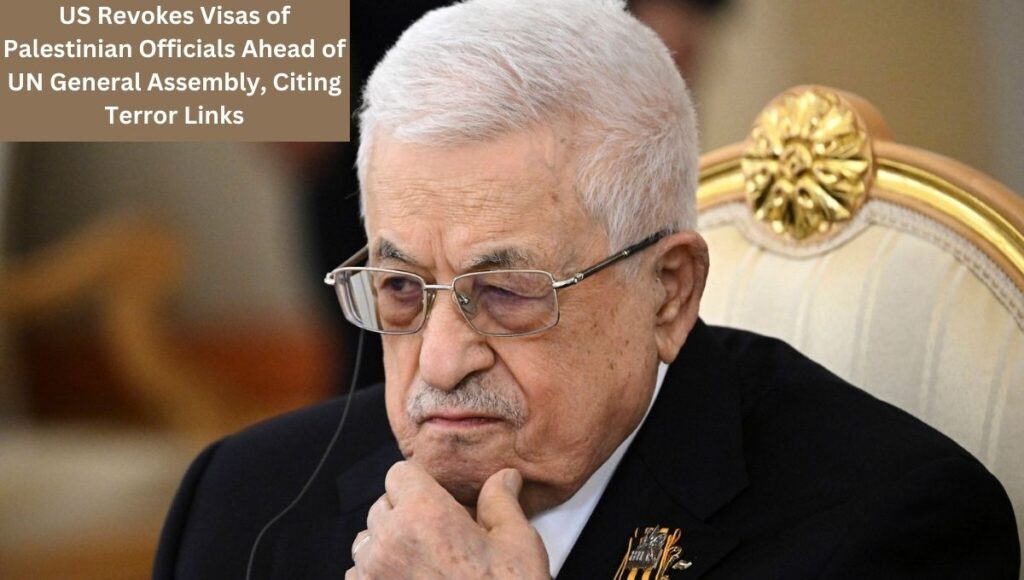
The move, unveiled on Friday by the US State Department, has cast uncertainty over the participation of Palestinian leaders, including President Mahmoud Abbas, at the UN summit. The State Department said the decision was made in line with US law, accusing Palestinian leaders of undermining peace efforts, pursuing unilateral statehood recognition, and supporting terrorism.
The announcement comes amid a global push led by France, Canada, Britain, and Australia to recognize Palestine as a state at the UN gathering in September. While Israel welcomed Washington’s step, Palestinians expressed “astonishment and deep regret,” warning that the move violates the 1947 UN Headquarters Agreement, which obligates the US to facilitate access for foreign diplomats to attend UN meetings.
US Revokes Visas of Palestinian Officials Ahead of UN General Assembly, Citing Terror Links
US State Department’s Announcement
The announcement was first made on X (formerly Twitter) by State Department Deputy Spokesperson Tommy Pigott, who stated:
“Today the Trump Administration is announcing it will deny and revoke visas from members of the Palestine Liberation Organization (PLO) and the Palestinian Authority (PA) ahead of the upcoming UN General Assembly per U.S. law. Before we take them seriously as partners in peace, the PA and PLO must completely reject terrorism and stop counter productively pursuing the unilateral recognition of a hypothetical state.”
Secretary of State Marco Rubio later confirmed that the ban would affect about 80 Palestinian officials, including President Mahmoud Abbas, who had planned to deliver a speech at the UNGA.
The decision aligns with the administration’s previous sanctions against Palestinian officials, announced in July, and follows accusations that the PA and PLO “materially contributed” to Hamas’s refusal to release hostages after the October 7, 2023, attack on Israel.
Who Is Affected?
The US State Department has not released a detailed list of Palestinian officials targeted by the restrictions. However, officials confirmed that Mahmoud Abbas, 89, is among those barred.
This is a particularly significant move, as Abbas has traditionally represented Palestinians at high-level UN gatherings.
The Palestinian UN ambassador, Riyad Mansour, said his delegation was still “checking exactly what the US move means and how it applies to any of our delegation.”
He added that Abbas had planned to attend and speak during a high-level session on Palestinian rights scheduled for September 22.
A State Department official clarified that the Palestinian Mission to the UN in New York would be granted waivers in compliance with the UN Headquarters Agreement, but senior leaders such as Abbas and other PA ministers would not be allowed entry.
Why the US Took This Step
The US cited several reasons for its unprecedented visa denial:
1. Alleged Links to Terrorism
Officials said the PA and PLO have not sufficiently repudiated terrorism, accusing them of continuing incitement in schools and political institutions.
The October 7 Hamas-led attack on Israel, which killed around 1,200 people and led to 251 hostages being taken, was specifically referenced.
2. Unilateral Statehood Recognition Efforts
The State Department condemned Palestinian diplomatic campaigns to seek recognition of statehood outside of negotiations with Israel, labeling them “counterproductive.”
3. International Lawfare Against Israel
The US criticized Palestinians for appealing to the International Criminal Court (ICC) and the International Court of Justice (ICJ) to investigate Israeli actions in Gaza and the West Bank. Washington described these steps as “lawfare” designed to bypass peace talks.
4. National Security Interests
In its official statement, the State Department declared:
“It is in our national security interests to hold the PLO and PA accountable for not complying with their commitments, and for undermining the prospects for peace.”
Palestinian Response
Palestinian leaders strongly condemned the move, calling it discriminatory and a violation of international agreements.
A statement from Abbas’s office said the decision:
- “Stands in clear contradiction to international law and the UN Headquarters Agreement.”
- “Undermines Palestine’s right to representation as a non-member observer state of the United Nations.”
- “Signals a dangerous precedent of politicizing access to the UN.”
The Organisation of Islamic Cooperation (OIC), representing 57 Muslim-majority nations, also denounced the US action, urging Washington to reverse it and respect its obligations as UN host.
Mansour, speaking to reporters, said:
“We will see exactly what it means and how it applies to any of our delegation, and we will respond accordingly.”
Israel’s Reaction
Israel quickly welcomed the US move, with Foreign Minister Gideon Saar calling it a “bold step.” Israeli leaders argue that the PA’s diplomatic efforts to gain recognition of statehood reward Hamas and undermine negotiations.
Prime Minister Benjamin Netanyahu reiterated his rejection of a two-state solution, declaring that recognition of a Palestinian state would amount to rewarding “Hamas’s monstrous terrorism.”
Israel has consistently opposed Palestinian membership or observer roles in international bodies, including the ICC, ICJ, and the UN.
Global Reaction
The US decision comes as France, Canada, Britain, and Australia are preparing to recognize Palestine as a state at the UNGA. More than 147 of the UN’s 193 member states already recognize Palestine.
- France’s President Emmanuel Macron has argued that recognition cannot be delayed, especially amid Israel’s ongoing offensive in Gaza.
- Britain has suggested it will recognize Palestine unless Israel agrees to a ceasefire.
- Canada and Australia have shifted their positions in recent weeks toward supporting recognition.
This growing international consensus is sharply at odds with the US and Israel’s positions.
Also Read: US decision to revoke Palestinian officials’ visas sparks global condemnation
The UN Headquarters Agreement Debate
A key controversy is whether the US decision violates the 1947 UN Headquarters Agreement, which obligates Washington to allow representatives of UN members and observers to attend official meetings in New York.
UN spokesperson Stephane Dujarric said the organization was in talks with the State Department, emphasizing that:
“It is important that all member states and observers be represented, especially in this case with the upcoming two-state solution meeting hosted by France and Saudi Arabia.”
This is not the first time the US has denied entry to officials. In 1988, the US barred PLO leader Yasser Arafat, forcing the UN to move its session to Geneva.
More recently, in 2013, Sudanese President Omar al-Bashir was denied entry due to an ICC arrest warrant.
Critics argue, however, that Abbas and the PA do not face such legal barriers and that the denial reflects political alignment with Israel rather than legitimate security concerns.
Context: The Gaza War and Palestinian Politics
The visa denial also comes amid ongoing conflict in Gaza. Since Israel’s military campaign began following the October 7 Hamas attack, the Hamas-run health ministry claims more than 63,000 people have been killed.
The war has devastated Gaza, displaced millions, and fueled international calls for a ceasefire and recognition of Palestinian statehood.
Meanwhile, the PA, based in the West Bank, has struggled to maintain legitimacy, facing criticism for corruption, inefficiency, and lack of control over Gaza.
Rivalry between Fatah (which dominates the PA) and Hamas has further complicated Palestinian politics.
Despite this, the PLO remains the internationally recognized representative of the Palestinian people and has held observer status at the UN since 1974.
Expert Analysis
Political analysts say the US decision to bar Abbas and other Palestinian officials could have serious diplomatic consequences:
- Diplomatic Fallout: Denying access to UNGA weakens Palestinian representation at a critical moment when momentum is building for recognition of statehood.
- UN Legitimacy Questioned: The move raises concerns about whether the UN can function independently if the host nation selectively restricts participation.
- Impact on Ceasefire Talks: Experts warn the decision may derail international efforts to broker a Gaza ceasefire.
Al Jazeera’s Washington correspondent Alan Fisher noted:
“When the UN was founded, it was agreed that US immigration policies would not interfere with official business. This is going to be controversial.”
Conclusion
The US decision to revoke visas for Palestinian officials ahead of the UN General Assembly is one of the most controversial foreign policy steps in recent years. While Washington argues it is holding the PA and PLO accountable for alleged ties to terrorism and unilateral diplomacy, critics see it as a violation of international law and a dangerous precedent.
As the UNGA approaches, the world will watch closely whether the US stands firm or bows to mounting pressure from the UN, international allies, and global public opinion.
For Palestinians, the visa ban represents not only a political blow but also a symbolic denial of their place at the world’s most important diplomatic forum.
Also Read: Trump Administration is Scrutinizing 55 million US Visa Holders for Deportation Violations