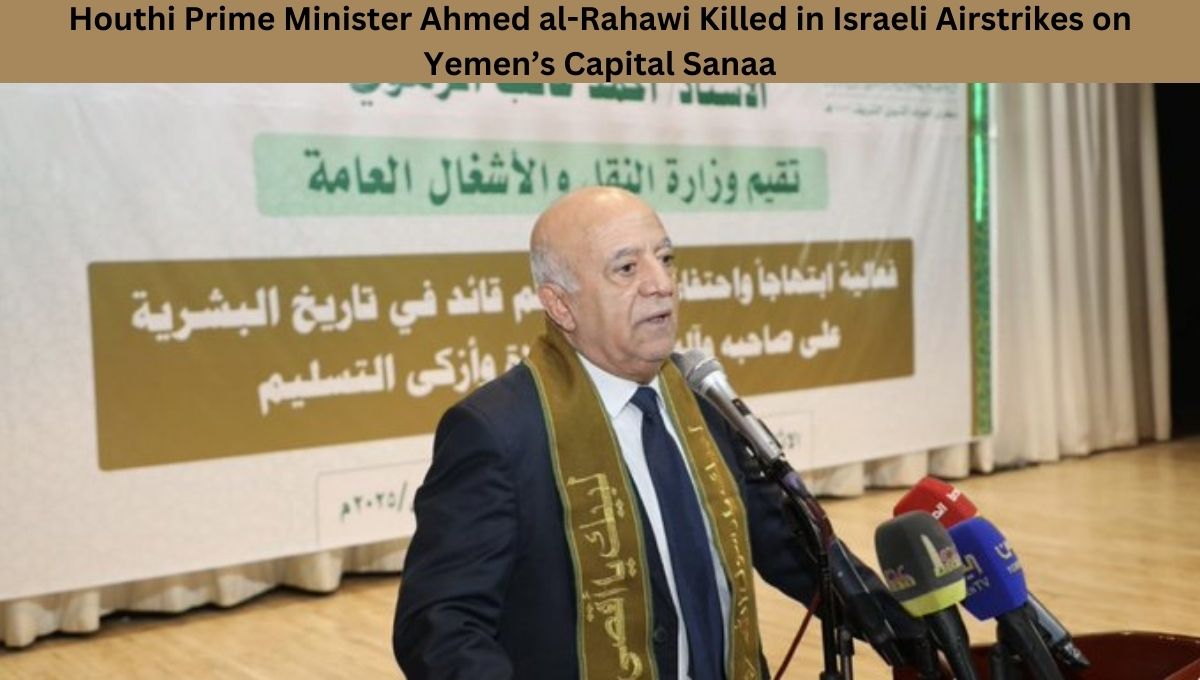
According to Yemeni media and Israeli officials, Houthi Prime Minister Ahmed al-Rahawi Killed in Israeli Airstrikes on Yemen’s Capital Sanaa. The conflict in the Middle East escalated further this week after Israeli airstrikes on the Yemeni capital Sanaa reportedly killed Houthi Prime Minister Ahmed al-Rahawi, along with other senior leaders of the Iran-backed group.
The strikes, carried out late Thursday, targeted multiple locations in and around Sanaa where top Houthi officials had gathered, according to Yemeni media, Reuters, and Israeli officials.
The Israel Defense Forces (IDF) confirmed it struck “a Houthi terrorist regime military target” in Sanaa, calling the operation a calculated and precise attack. Reports suggest that Houthi Defence Minister Mohamed al-Atifi and Chief of Staff Muhammad Abd Al-Karim al-Ghamari may also have been killed.

Houthi Prime Minister Ahmed al-Rahawi Killed in Israeli Airstrikes on Yemen’s Capital Sanaa
Reports of Prime Minister’s Death
According to Yemeni outlets Al-Jumhuriya and Aden Al-Ghad, Ahmed al-Rahawi died inside his Sanaa apartment during the strikes. Several of his close associates were also reportedly killed in the same attack.
The airstrikes appear to have coincided with a gathering of senior Houthi leaders who were preparing to watch a televised speech by the group’s leader Abdul Malik al-Houthi.
Israeli officials said they had taken advantage of an “intelligence window of opportunity” to strike while many top officials were assembled in one location.
While some Houthi sources have denied the deaths, Israeli and Yemeni reports suggest that an entire cabinet meeting was hit, potentially killing a large portion of the Houthi leadership.
Israeli Justification for the Strikes
Israeli Defence Minister Israel Katz, who approved the strikes alongside Prime Minister Benjamin Netanyahu and IDF Chief of Staff General Eyal Zamir, issued a stark warning:
“As we warned the Houthis in Yemen, after the Plague of Darkness comes the Plague of the Firstborn. Whoever raises a hand against Israel his hand will be cut off.”
The IDF said the Houthis have been acting under Iranian direction and funding to harm Israel and its allies, disrupt shipping routes in the Red Sea and Gulf of Aden, and undermine regional stability.
A senior Israeli military official described the operation as a “complex intelligence-driven strike”, adding that the military “acted with precision and speed at the right moment.”
Defence Minister and Military Chief Reportedly Targeted
Beyond the prime minister, Israeli officials believe the airstrikes may have killed:
- Defence Minister Mohamed al-Atifi, who oversaw Houthi military operations.
- Chief of Staff Muhammad Abd Al-Karim al-Ghamari, previously wounded in an earlier Israeli strike.
- Asaad al-Sharqabi, a top official connected with the Defence Ministry, according to Yemeni government sources cited by Reuters.
Channel 12 in Israel reported that the IDF currently assesses that the entire Houthi cabinet, including 12 ministers, was likely killed in Thursday’s operation.
However, it cautioned that the assessment is not definitive and investigations are ongoing.
The Houthis’ Role in Regional Conflict
The Houthis, officially known as Ansar Allah, are an Iran-aligned movement that has controlled large swathes of Yemen, including Sanaa, since 2014.
They are a central part of Iran’s so-called “Axis of Resistance”, which includes Hezbollah in Lebanon and militias in Iraq and Syria.
Since the start of the Gaza war in October 2023, the Houthis have escalated their military activities against Israel:
- Launching missiles and drones toward Israeli cities (most intercepted).
- Attacking commercial vessels in the Red Sea and Gulf of Aden, claiming they were connected to Israel.
- Disrupting global shipping routes, forcing major companies to reroute vessels away from the region.
Israel has responded with multiple rounds of airstrikes on Houthi-controlled areas, including Hodeidah port and military sites in Sanaa.
Previous Strikes and Rising Tensions
Thursday’s attack comes just four days after a previous round of Israeli bombings against Houthi targets, in which at least 10 people were killed and 90 wounded according to Sanaa authorities.
Israeli officials say these strikes are part of a broader campaign to degrade Houthi military capabilities and deter future attacks.
The military stressed that the Houthis had been “given repeated warnings” before Israel decided to escalate its response.
Conflicting Reports from Houthi Media
Despite widespread reports of high-level casualties, the Houthi Ministry of Defence quickly denied that its leaders had been killed in the Sanaa strikes.
The group’s state-run news agency dismissed claims of leadership losses as Israeli propaganda.
As of Friday, no public appearance or statement has been made by Prime Minister Ahmed al-Rahawi, further fueling speculation that he was killed.
Similarly, the status of Defence Minister al-Atifi and Chief of Staff al-Ghamari remains unclear.
Global and Regional Implications
Israel’s Message to Iran and Allies
By striking the Houthis’ top leadership, Israel is sending a clear signal to Iran and its regional allies that attacks on Israel will be met with overwhelming force.
The strikes highlight the widening scope of the Gaza war, which has drawn in actors across the Middle East.
Impact on Yemen
Yemen has been locked in civil war since 2014, with the Houthis fighting the internationally recognized Yemeni government and a Saudi-led coalition.
The Israeli strikes add another layer of complexity to an already devastating conflict, where millions face hunger and humanitarian crises.
Risk of Escalation
Analysts warn that killing senior Houthi leaders could trigger retaliation not only against Israel but also against international shipping.
The Red Sea and Bab el-Mandeb Strait are vital global trade routes, and further disruption could have worldwide economic consequences.
Historical Precedent of Striking Leaders
Israel has a long history of targeted killings against leaders of groups it considers terrorist organizations.
From Hamas leaders in Gaza to Hezbollah commanders in Lebanon, these operations are often justified as deterrence but have sometimes sparked further escalation.
If confirmed, the killing of Ahmed al-Rahawi would mark one of the most significant blows to the Houthis since they rose to power in Yemen more than a decade ago.
Conclusion
The reported killing of Houthi Prime Minister Ahmed al-Rahawi in Israeli airstrikes on Sanaa represents a major escalation in the already volatile Middle East. While Israel claims the strikes were necessary to curb Houthi aggression and protect its national security, the move risks widening the conflict and destabilizing an already fragile Yemen.
As the world awaits confirmation of the full impact of the strikes particularly whether the entire Houthi cabinet was killed the situation underscores how the war in Gaza continues to reverberate far beyond Israel and Palestine, drawing in regional powers and reshaping the dynamics of conflict across the Middle East.
Also Read: Ahmed al-Rahawi killed — Inside the life and legacy of the Yemen Houthi PM
Related Posts:
- Yemen War 2025: Israeli Strike Kills Houthi Military…

- 5 Major Takeaways from the US Supreme Court's…

- 5 Key Developments as Israel Confirms Hamas Handed…

- Afghanistan–Pakistan War 2025: Inside the 48-Hour Ceasefire

- Israel–Hamas Ceasefire Under Strain: 4 More Hostage…

- 7 Heartbreaking Facts About Venezuela's Earthquake Disaster