Amid the Gaza war, Recognition of Palestine by Western Powers: Symbolism or a Diplomatic Shift? On 21 September 2025, the international stage witnessed a seismic diplomatic shift. The United Kingdom, Canada, and Australia — all close allies of the United States — formally recognized Palestine as a sovereign state. Within hours, Portugal joined the move, intensifying Israel’s diplomatic isolation.
The announcements came as the Gaza war entered its second year, marked by mass displacement, starvation, and bombardments. Just days earlier, a United Nations inquiry accused Israel of committing genocide against Palestinians, adding urgency to calls for accountability.
For decades, Western powers had resisted recognition, arguing Palestinian statehood must emerge from negotiations with Israel. But now, recognition by major democracies signals a break from Washington’s line, raising the question:
Does recognition change life on the ground for Palestinians — or is it largely symbolic, a diplomatic gesture without enforcement?
This in-depth analysis unpacks the developments, reactions, historical context, international law, and implications of this watershed moment.
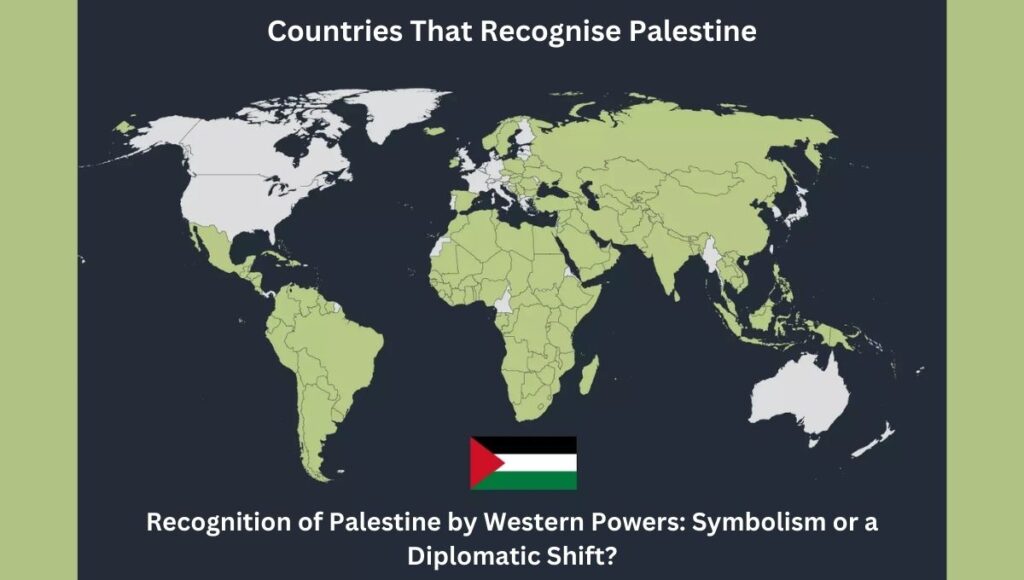
Recognition of Palestine by Western Powers: Symbolism or a Diplomatic Shift?
Why Did the UK, Canada, and Australia Recognize Palestine Now?
A Historic Break with the Past
British Prime Minister Keir Starmer framed recognition as a pledge to “revive the hope of peace” and keep the two-state solution alive.
Canadian Prime Minister Mark Carney described it as a step toward “a peaceful future for both the State of Palestine and the State of Israel.”
Australian Prime Minister Anthony Albanese emphasized it as part of a coordinated global push for peace negotiations.
The timing was deliberate: recognition came on the eve of the UN General Assembly, ensuring maximum international impact.
Outrage Over Gaza and Settlements
The humanitarian catastrophe in Gaza — with nearly 65,000 Palestinians killed since 2023, according to UN figures — has horrified global audiences. Allegations of genocide, famine, and war crimes pressured Western governments to act.
At the same time, Israel’s settlement expansion in the West Bank, deemed illegal under international law, eroded confidence in Israel’s commitment to peace.
Recognition thus became a way to signal moral outrage and push back against Israeli policies.
Israel’s Response: “It Will Not Happen”
Prime Minister Benjamin Netanyahu responded with defiance:
“A Palestinian state will not be established west of the Jordan River.”
He accused London, Ottawa, and Canberra of “rewarding terrorism”, arguing recognition empowers Hamas.
Far-right ministers Bezalel Smotrich and Itamar Ben Gvir escalated demands for annexation of the West Bank and even the dismantling of the Palestinian Authority (PA).
Israel’s Foreign Ministry declared recognition “meaningless on the ground”, since Israel controls borders, resources, and military occupation.
Also Read: Pro-Palestine Protests Erupt in Italy After Meloni Rejects Statehood
The United States: Isolated from Its Allies
Perhaps the most striking development is how the move isolates Washington.
- The U.S. position remains unchanged: Palestinian statehood must emerge from direct negotiations with Israel.
- Under Donald Trump, U.S. policy tilted heavily toward Israel — moving the embassy to Jerusalem, recognizing Golan Heights sovereignty, and endorsing settlement policies.
- Now, with UK and France (expected soon) recognizing Palestine, Washington risks becoming a minority of one among democracies.
This puts the U.S. at odds not only with the Global South but also with its closest allies.
Symbolism vs Reality: Does Recognition Matter?
Symbolism as a Game Changer
International law expert Philippe Sands argues recognition is not symbolic but a “game changer.” It places Palestine and Israel on equal footing in diplomacy, enabling treaties, embassies, and international litigation.
But Reality Unchanged
Yet, Palestinians remain under Israeli military occupation:
- Borders controlled by Israel.
- Gaza under blockade and bombardment.
- West Bank fragmented by checkpoints and settlements.
As one analyst put it:
“Recognition doesn’t stop airstrikes tomorrow. But it shifts the balance of global diplomacy.”
Who Recognizes Palestine Today?
- 145+ UN member states (about 75%) recognize Palestine.
- China, Russia, and India recognized Palestine in 1988.
- Algeria was the first, minutes after Arafat’s declaration.
- With UK, Portugal, and France soon on board, 4 of 5 permanent UNSC members (all except U.S.) recognize Palestine.
This leaves Washington diplomatically isolated on the Security Council.
International Law and Statehood: The Montevideo Criteria
The Montevideo Convention (1933) sets conditions for statehood:
- Permanent population.
- Defined territory.
- Functioning government.
- Capacity for international relations.
Palestine meets some but not all:
✔ Permanent population.
✔ Functioning government structures (PA).
✘ No control over borders or resources.
✘ Occupied and fragmented territory.
Recognition, therefore, is a political act of legitimacy rather than confirmation of full sovereignty.
India’s Position: Early Recognition, Current Ambiguity
- India recognized Palestine in 1988 under Prime Minister Rajiv Gandhi.
- But under Narendra Modi, India has drawn closer to Israel.
- Opposition figures like Priyanka Gandhi Vadra accuse the government of “moral cowardice.”
India’s balancing act reflects South Asia’s complex geopolitics, where ties with both Tel Aviv and Arab states are strategic.
The Palestinian Authority’s Response
Palestinian leaders hailed recognition as “historic” and “irreversible.”
- Foreign Minister Varsen Aghabekian Shahin: “A step closer to sovereignty.”
- President Mahmoud Abbas: “A pledge to live in peace and good neighbourliness with Israel.”
- Husam Zomlot (UK ambassador): Recognition helps correct historic wrongs, including the Balfour Declaration.
Even Hamas welcomed the move, while urging sanctions on Israel.
Domestic Politics in the West
United Kingdom
Starmer faced pressure from Labour’s progressive base. Critics like Kemi Badenoch condemned the move as disastrous. Hostage families accused it of “rewarding terrorism.”
Canada
As the first G7 country to recognize Palestine, Ottawa’s move shocked many. It signals a break with Canada’s traditional pro-Israel stance.
Australia
Albanese linked recognition to peace talks but stressed Hamas must not govern Palestine. Domestic activists had long campaigned for recognition.
Symbolism vs Shift: What Recognition Means for Global Diplomacy
Recognition as a Diplomatic Tool
- Enables embassies and treaties.
- Increases Palestine’s weight in international institutions.
- Opens the door for full UN membership.
A Message to Israel and Washington
Recognition by close U.S. allies signals: status quo is unsustainable.
But Life on the Ground Unchanged
Occupation, blockades, and airstrikes continue. Recognition doesn’t end suffering overnight.
Also Read: West rushes to officially recognise Palestine; will Israel be isolated? | The Lowdown
Humanitarian Catastrophe in Gaza
- 65,000 killed since October 2023.
- 166,000 wounded.
- Famine declared in Gaza City.
- UN & IAGS accuse Israel of genocide, war crimes, and crimes against humanity.
Israel rejects this, blaming Hamas and aid agencies.
Recognition is thus also a humanitarian response, not just a political one.
Netanyahu’s Defiant Warning
In a fiery statement, Netanyahu declared:
“For years I have prevented the creation of that terror state. We doubled Jewish settlements in Judea and Samaria, and we will continue.”
His coalition is now openly considering:
- Annexation of the West Bank.
- Dismantling of the PA.
The Settlements Issue: A Core Trigger
- Settlements are considered illegal under international law.
- Netanyahu boasted of doubling settlements.
- Far-right ministers push for formal annexation.
For Western governments, recognition is a pushback against settlement expansion.
Historical Burden: The Balfour Declaration
The UK’s recognition carries special weight because of its colonial history.
- The 1917 Balfour Declaration laid foundations for Israel while undermining Palestinian sovereignty.
- Foreign Secretary David Lammy admitted Britain has a “special burden.”
Recognition thus also functions as acknowledgment of historic responsibility.
What Comes Next?
- More recognitions: France, Belgium, and others are expected to follow.
- Annexation risk: Israeli far-right may push to absorb West Bank.
- Diplomatic retaliation: Israel could withdraw ambassadors.
- Boycotts & sanctions: Pressure in Europe may expand.
For Palestinians, recognition provides dignity and legitimacy, but occupation remains.
Conclusion: Symbolism or Shift?
Recognition of Palestine by UK, Canada, Australia, and Portugal marks a historic diplomatic moment.
- Symbolic significance: Legitimizes Palestinian claims, pressures Israel, isolates U.S.
- Practical limits: No immediate change in Gaza or West Bank.
Ultimately, recognition is both:
- Symbolism with teeth — shifting global diplomacy.
- A test of whether Western powers will follow words with actions like sanctions, embargoes, or UN initiatives.
For now, Palestinians gain acknowledgment of their statehood. Whether it translates into freedom, sovereignty, and peace remains uncertain.
Related Posts:
- Israeli Ground Invasion of Gaza City Escalates: UN…

- Trump’s 20-Point Gaza Peace Plan Gains Urgent Global…

- Trump Pushes Gaza Peace Plan: Israeli Exit, Arab…
- Gaza Faces “Mass Starvation” as Death Toll from…

- 3 Explosive Conditions Iran Sets to End War with US…

- 7 Powerful Facts About Ayatollah Ali Khamenei’s…