On India’s retreat from long-standing support for Palestine, Sonia Gandhi Slams Modi Govt’s ‘Muted Stance’ on Palestine, Calls Silence ‘Abdication of Humanity.’ Congress Parliamentary Party Chairperson Sonia Gandhi has launched a blistering attack on the Narendra Modi-led government, accusing it of maintaining a “conspicuously muted” and “profound silence” on the Palestine crisis.
In a strongly worded opinion piece published in The Hindu under the title “India’s Muted Voice, Its Detachment With Palestine”, Gandhi accused the government of abandoning India’s long-standing legacy of supporting justice, self-determination, and human rights for Palestinians.
Gandhi argued that the Modi government’s foreign policy, especially on the Israel-Palestine conflict, has been shaped less by constitutional values and more by the Prime Minister’s “personal friendship” with Israeli leader Benjamin Netanyahu. She called this “personalised diplomacy” untenable and a “moral failure” that has cost India its leadership voice on a historic and humanitarian issue.
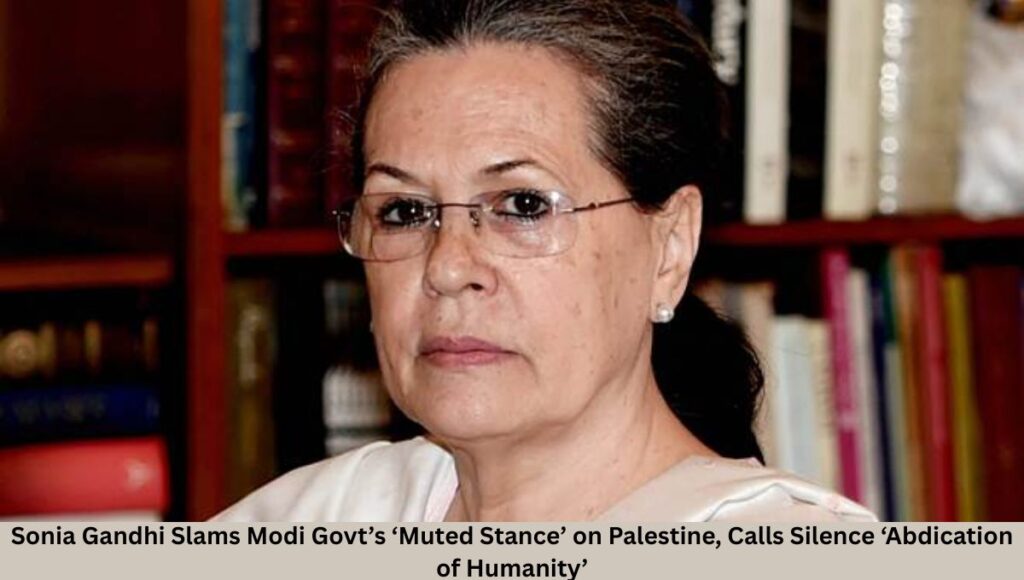
Sonia Gandhi Slams Modi Govt’s ‘Muted Stance’ on Palestine, Calls Silence ‘Abdication of Humanity’
Modi-Netanyahu Friendship at the Center of Criticism
According to Sonia Gandhi, the Modi government’s muted stance on Palestine is not just a diplomatic misstep but an “abdication of humanity and morality.” She claimed India’s foreign policy today is being disproportionately influenced by personal ties between Prime Minister Narendra Modi and Israeli Prime Minister Benjamin Netanyahu.
“This style of personalised diplomacy is never tenable and cannot be the guiding compass of India’s foreign policy,” Gandhi wrote. “Attempts to do the same in other parts of the world, most notably in the United States, have come undone in the most painful and humiliating ways in recent months.”
Her statement highlights a larger debate about whether India’s foreign policy has shifted from its historic principles of non-alignment and solidarity with oppressed peoples to a more transactional, leader-centric approach.
India’s Legacy of Supporting Palestine
Gandhi reminded readers that India formally recognised Palestinian statehood on November 18, 1988, after years of support to the Palestine Liberation Organisation (PLO). This recognition was consistent with India’s historical positions on global justice struggles, including its opposition to apartheid South Africa and its vocal support for Algerian independence in the 1950s and 60s.
She cited several examples of India’s principled leadership:
- Apartheid South Africa: India raised the issue even before Independence.
- Algerian struggle (1954-62): India was one of the strongest voices demanding Algerian independence.
- Bangladesh Liberation (1971): India intervened decisively to prevent genocide in East Pakistan, helping midwife the birth of modern-day Bangladesh.
On Palestine too, Gandhi argued, India has historically maintained a delicate yet principled balance — emphasising peace, justice, and human rights while advocating for a two-state solution.
Gaza Crisis: “Nothing Less Than Genocidal”
Sonia Gandhi did not shy away from describing the scale of devastation in Gaza since the October 7, 2023 Hamas attack and Israel’s retaliatory strikes.
While condemning the “brutal and inhumane” Hamas attacks on Israeli civilians, she declared that Israel’s military response has been “nothing less than genocidal.”
According to Gandhi:
- Over 55,000 Palestinian civilians have been killed.
- At least 17,000 children are among the dead.
- Gaza’s residential, schooling, and healthcare infrastructure has been “obliterated.”
- Agriculture and industry have been destroyed, deepening economic collapse.
- Civilians face famine-like conditions, with Israel “cruelly obstructing” food and medicine supplies.
- Hundreds of Palestinians have been shot while trying to access food and aid.
Gandhi said such atrocities amount to “a drip-feeding of aid amidst an ocean of desperation” and represent one of the darkest humanitarian crises of our times.
Also Read: Melania Trump’s Viral Reaction Overshadows Donald Trump’s Blistering UN Speech
“Silence is Not Neutrality, It is Complicity”
One of the most powerful statements in Gandhi’s article was her warning that silence cannot be mistaken for neutrality.
“It is a reminder that in the modern world, silence is not neutrality, it is complicity,” she wrote.
This line underscores her core argument: India’s refusal to take a strong stance is not merely passive but contributes to legitimising Israeli excesses.
She argued that India’s voice — once “unwavering in the cause of freedom and human dignity” — has become muted at a time when Palestinians are enduring one of the worst humanitarian catastrophes in modern history.
Global Recognition of Palestinian Statehood
Gandhi hailed the recent moves by several Western nations to recognise Palestine as a sovereign state, describing it as a “historic moment” in global diplomacy.
Countries including France, the UK, Canada, Portugal, and Australia have either recognised Palestinian statehood or expressed explicit support for it.
She noted that more than 150 of the 193 United Nations member states have already recognised Palestine, making India’s silence even more glaring.
“These steps are not merely diplomatic gestures,” Gandhi wrote. “They are affirmations of the moral responsibility that nations bear in the face of prolonged injustice.”
India’s Dealings With Israel Amid Crisis
Adding to her criticism, Gandhi highlighted how India has deepened its diplomatic and economic engagement with Israel in recent weeks, despite global condemnation of Israeli actions.
She pointed out that:
- India signed a bilateral investment agreement with Israel just two weeks ago.
- New Delhi hosted Israel’s far-right Finance Minister, a politician facing global criticism for openly inciting violence against Palestinians in the occupied West Bank.
According to Gandhi, such moves send the wrong signal at a time when India should be asserting moral leadership rather than cosying up to controversial leaders.
Historical Empathy and Civilisational Responsibility
Sonia Gandhi argued that the question of Palestine is not merely about foreign policy but about India’s ethical and civilisational identity.
She drew parallels between the plight of Palestinians and India’s own history under colonialism:
- A people denied sovereignty.
- Stripped of rights and dignity.
- Exploited for resources.
- Deprived of security and identity.
“We owe Palestine a sense of historical empathy in its quest for dignity, and we also owe Palestine the courage to translate that empathy into principled action,” she wrote.
For Gandhi, supporting Palestine is not about political expediency but about safeguarding the very values India once stood for on the world stage.
Congress vs. BJP on Foreign Policy
This is the third article Sonia Gandhi has published in recent months criticising the Modi government’s handling of the Israel-Palestine crisis. Her repeated interventions suggest that the Congress party sees the issue not only as a matter of foreign policy but also as a moral battleground that highlights differences between India’s past and present global roles.
By accusing the government of being driven by Modi’s personal diplomacy with Netanyahu, Gandhi has sharpened Congress’s critique of what it sees as the BJP’s transactional, leader-centric approach to global affairs.
United Nations and International Calls for Justice
Her comments also came a day after UN Secretary-General Antonio Guterres reaffirmed that Palestinian statehood is “a right, not a reward.” Gandhi’s timing suggests a conscious effort to align with international voices calling for justice, dignity, and statehood for Palestinians.
She pointed out that India, which once spoke loudly and clearly on issues of global injustice, now finds itself marginalised in a moment of historical change.
A Call for Leadership
In closing her article, Sonia Gandhi urged India to reclaim its historical leadership on Palestine. She argued that India cannot allow its foreign policy to be reduced to “the personal glory-seeking ways of one individual” and must instead act with courage, continuity, and compassion.
“India’s standing on the world stage cannot be wrapped up into the personal glory-seeking ways of one individual, nor can it rest on its historical laurels. It demands persistent courage and a sense of historical continuity,” she said.
For Gandhi, the Palestine issue is a litmus test of whether India still stands for freedom, justice, and human dignity — values that once defined its role in global diplomacy.
Conclusion
Sonia Gandhi’s scathing critique of the Modi government’s stance on Palestine underscores a growing divide in Indian politics over foreign policy and ethical leadership. While the Modi government deepens ties with Israel and maintains strategic silence, Gandhi insists that India must rise to its historic role as a voice for justice and human rights.
Her repeated reminders — that “silence is not neutrality, it is complicity” — place moral responsibility at the heart of the debate.
With over 55,000 Palestinians killed, famine-like conditions in Gaza, and a global wave of recognition for Palestinian statehood, the question remains: will India continue its muted stance, or reclaim its legacy as a champion of oppressed peoples?
Related Posts:
- 8 Shocking Facts Behind JD Vance’s Call for his…

- 7 Key Developments in JD Vance’s Wife Conversion Remark

- 5 Major Takeaways from the US Supreme Court's…

- 7 Shocking Reasons Why Bangladesh’s Yunus Govt Bowed…

- 6 Shocking Signals as Hindu Awami League Leader Dies…

- 5 Key Signals from PM Modi’s Virtual ASEAN Summit Appearance