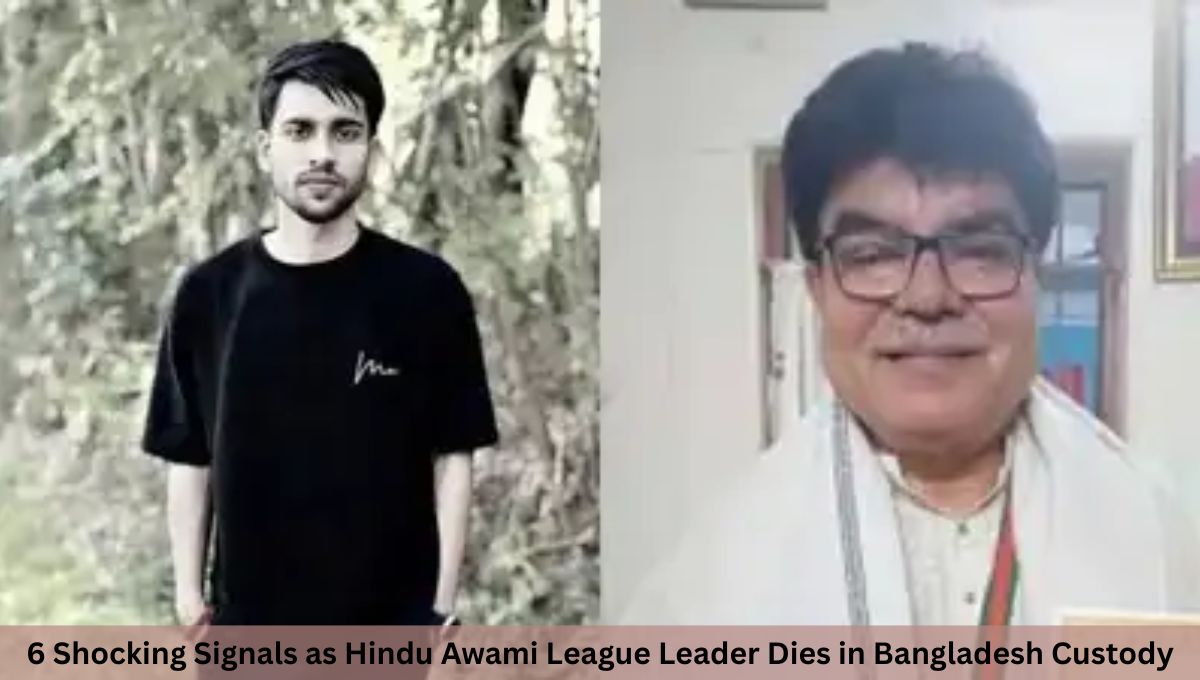
6 Shocking Signals as Hindu Awami League Leader Dies in Bangladesh Custody amid escalating violence.The death of Proloy Chaki, a senior Hindu leader of Bangladesh’s Awami League and a well-known cultural figure, while in police custody has sent shockwaves through the country’s political and cultural circles.
Coming amid a surge in violence against religious minorities, his death has intensified scrutiny of Bangladesh’s law-and-order situation under its interim government and raised renewed questions about custodial care, minority safety, and political targeting.
Chaki’s death in hospital while still officially under jail custody has triggered allegations of medical negligence, denial of timely treatment, and discriminatory treatment linked to both his religious identity and political affiliation.
Authorities deny wrongdoing, stating that he suffered from long-standing health conditions and died of natural causes. His family and supporters strongly contest this account.
6 Shocking Signals as Hindu Awami League Leader Dies in Bangladesh Custody
Who Was Proloy Chaki?
Proloy Chaki, 60, was more than a political functionary. A prominent Hindu singer, music director, and cultural organiser, he was widely known in northern Bangladesh for his contributions to music and progressive cultural movements, particularly during the 1990s.
Political Role
- Cultural Affairs Secretary, Pabna district unit of the Awami League
- Senior local organiser associated with the party of former Prime Minister Sheikh Hasina
- Active in cultural mobilisation aligned with secular and pluralist ideals
Cultural Identity
- Renowned singer and music director
- Secretary of Shree Shree Ram Krishna Shebashrom in Pabna
- A bridge between politics and culture, using music to connect communities
“He was a renowned singer and music director beyond his political identity,” said Bhaskar Chowdhury, secretary of the Pabna Sammilito Shangskritik Jote. “We cannot accept his death in this manner.”
Arrest and Detention
Chaki was arrested on December 16 from his home in Dilalpur, Pabna town.
Key Points About His Arrest
- Family says he was not named in any case at the time of arrest
- Later shown arrested in an explosives case
- Case linked to violence during the August 4, 2024 unrest, part of the broader anti-discrimination student movement
- The movement later escalated into the ‘July Uprising’, which led to the ouster of Sheikh Hasina
He remained in Pabna District Jail from the time of his arrest until his health deteriorated.
Health Conditions and Hospitalisation
Jail authorities have stated that Chaki had multiple chronic health conditions, including:
- Diabetes
- High blood pressure
- Heart disease
According to Md Omar Faruk, Superintendent of Pabna District Jail, Chaki’s condition worsened while in custody.
“Proloy Chaki was suffering from severe issues related to diabetes, high blood pressure, and heart problems. Prison doctors first sent him to Pabna Sadar Hospital, and from there he was referred to Rajshahi Medical College Hospital on Friday night.”
Chaki suffered a cardiac arrest and was initially taken to Pabna General Hospital on Friday. As his condition deteriorated, doctors referred him to Rajshahi Medical College Hospital, where he died around 9 pm on Sunday while still under jail custody.
Family’s Allegations of Medical Negligence
Chaki’s family has categorically rejected the official narrative of a natural death, alleging serious lapses in medical care.
Son’s Statement
His son, Sony (Sunny) Chaki, alleged:
- His father’s health condition worsened significantly in jail
- Authorities failed to officially inform the family
- He was not provided adequate or timely treatment
- Delays in shifting him to a better medical facility proved fatal
“My father had been suffering from diabetes and heart disease for a long time. His condition worsened in jail, but the authorities did not officially inform us,” Sony said. “We rushed to the hospital after being informed by others, but he did not receive proper treatment, which led to his death.”
Family members also claimed that Chaki was kept in a regular prison cell instead of a critical care unit despite his medical history.
Jail Authorities Deny Wrongdoing
Pabna jail officials have rejected all allegations of negligence.
Superintendent Faruk stated:
- Chaki was given medication based on medical records provided by his family
- He was shifted to hospital as soon as his condition became critical
- His death was due to natural causes linked to long-standing illness
“He was taken to the hospital as soon as his condition became critical,” Faruk said.
Authorities have said that standard legal and medical procedures are being followed and that an official report will be prepared.
Custodial Deaths: A Wider Pattern
Human rights groups argue that Chaki’s death cannot be viewed in isolation.
According to rights organisation Ain o Salish Kendra:
- 107 people died in Bangladeshi jails in 2025
- 69 were undertrial prisoners
- 38 were convicts
- This marked a sharp rise from 65 custodial deaths in 2024
Activists say custodial deaths often involve:
- Delayed medical care
- Poor prison health infrastructure
- Lack of independent oversight
A Climate of Fear for Minorities
Chaki’s death comes amid a sharp spike in violence against Hindus in Bangladesh over the past few months.
Recent Incidents
- Samir Kumar Das, 28, an auto-rickshaw driver, beaten and stabbed to death in Chittagong
- Joy Mahapatro killed in Sunamganj
- Hindu businessman and newspaper editor shot dead in Jessore
- Multiple lynchings and mob attacks reported since December
In one of the most disturbing cases, Dipu Chandra Das was lynched and set on fire in Mymensingh over alleged blasphemy on December 18.
Two Deaths in 24 Hours
The deaths of Proloy Chaki and Samir Das occurred within a span of just 24 hours, intensifying fears among minority communities.
Samir Das Case
- Autorickshaw driver from Daganbhuiyan, Chittagong
- Attacked with country-made weapons
- Beaten and stabbed to death
- Assailants stole his battery-operated vehicle
Police described the killing as pre-planned, and an investigation is underway.
Political Context: Bangladesh at a Crossroads
Bangladesh is heading towards national elections on February 12, the first since the 2024 uprising that led to the fall of Sheikh Hasina’s government.
The current political landscape is marked by:
- An interim government led by Muhammad Yunus
- Heightened political polarisation
- Crackdowns on Awami League leaders
- Increased street violence and mob attacks
Minority groups warn that communal violence is rising ahead of the polls, particularly in politically sensitive districts.
Awami League Leaders Under Pressure
Chaki’s supporters allege that he was targeted not only because he was Hindu but also because of his association with the now-outlawed Awami League.
Several party leaders claim:
- Arbitrary arrests
- Retrospective application of cases
- Harassment of grassroots organisers
They argue that Chaki’s detention and death reflect a broader campaign of political repression.
Cultural Community in Mourning
Chaki’s death has left a deep impact on Bangladesh’s cultural fraternity.
Prominent singers and artists, including:
- Tapan Chowdhury
- Kumar Bishwajit
- Dinat Jahan Munni
- Bappa Mazumder
- Kabir Bakul
have expressed grief and called for accountability.
Former Pabna Drama Circle president Gopal Sanyal demanded an independent probe, calling the death “a devastating loss for Pabna’s cultural heritage.”
India Raises Alarm
India has publicly expressed concern over the situation of minorities in Bangladesh.
MEA spokesperson Randhir Jaiswal said:
“We continue to witness a disturbing pattern of recurring attacks on minorities, as well as their homes and business establishments by extremists in Bangladesh.”
He criticised attempts to dismiss such incidents as personal disputes:
“Such disregard only emboldens the extremists and deepens the sense of fear and insecurity among minorities.”
Bangladesh Government Pushback
Interim leader Muhammad Yunus has accused India of exaggerating incidents of violence. However, human rights groups warn that the frequency and brutality of attacks indicate a deeper breakdown in minority protection.
Officials have repeatedly described incidents as “isolated” or “non-communal,” a characterisation that minority groups strongly dispute.
The Question of Accountability
At the heart of the controversy surrounding Proloy Chaki’s death lies a fundamental question:
who is accountable when detainees die in custody?
Family members and rights advocates are demanding:
- A judicial inquiry
- Independent medical review
- Transparency in custodial procedures
Without credible investigations, they warn, mistrust will deepen.
Conclusion: A Symbol Beyond One Death
Proloy Chaki’s death has become more than a personal tragedy.
For many in Bangladesh, it symbolises:
- The vulnerability of minorities
- The risks faced by opposition voices
- The fragility of custodial safeguards
As Bangladesh approaches a critical election, the treatment of minorities and political detainees will remain under international scrutiny.
Whether the authorities pursue transparency and accountability—or dismiss concerns as routine—will shape not only public trust but also the country’s democratic credibility in the months ahead.
For now, the death of a Hindu singer and political organiser in jail custody stands as a stark reminder that the promise of equal protection under the law remains deeply contested in Bangladesh.
Also Read: 7 Alarming Signs as Bangladesh Student Leader Shot Amid Pre-Poll Chaos
Also Read: Son Of Awami League’s Hindu Leader Alleges Torture, Medical Negligence In Custodial Death