
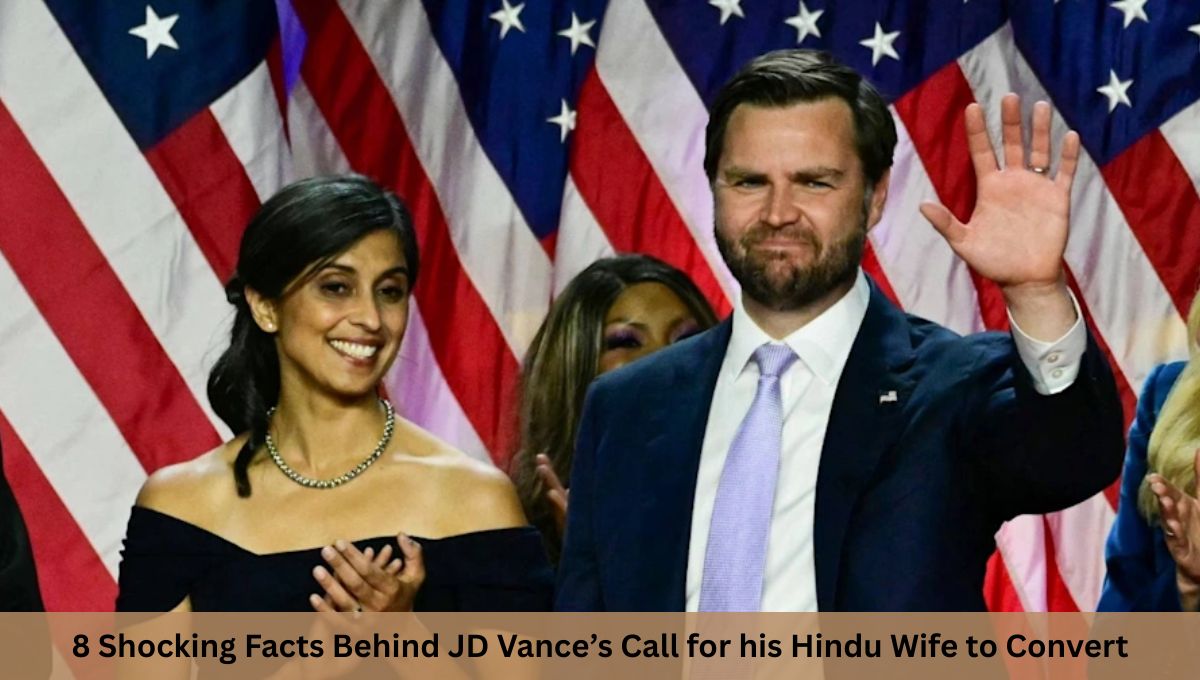
8 Shocking Facts Behind JD Vance’s Call for his Hindu Wife to Convert, sparking Indian-American backlash. United States Vice President JD Vance recently made remarks that have stirred a storm of controversy—he publicly stated that he hopes his wife, Usha Vance, who hails from a Hindu background, will one day embrace Christianity.
Thank you for reading this post, don't forget to subscribe!At a forum hosted by Turning Point USA at the University of Mississippi, Vance revealed that although Usha often joins him for church, he “honestly… hope[s]” she will “be somehow moved by the same thing” that moved him to the Christian gospel.
What may have seemed like a casual expression of hope quickly turned into one of the biggest controversies of his political career—particularly among the Indian-American and Hindu communities, who accused him of hypocrisy, cultural insensitivity and “Hindu-phobia”.
As Vance eyes a potential bid in the 2028 presidential race, many observers say this moment is less about domestic religious dynamics and more about political positioning in the faith-first wing of his party. Let’s unpack what led up to this moment, what was said, how Usha responded, and what it means going forward.
8 Shocking Facts Behind JD Vance’s Call for his Hindu Wife to Convert
Who are JD Vance and Usha Vance?
JD Vance
JD Vance is the Vice President of the United States, a former U.S. senator and best-selling author of Hillbilly Elegy. He grew up in Ohio in a working-class, evangelical Protestant environment and later identified as an atheist before converting to Catholicism in 2019.
Usha Vance
Usha Vance (née Usha Bala Chilukuri) is the Second Lady of the United States (since 2025). She was born in San Diego County, California, to immigrants from a Telugu-speaking Hindu family. She holds a BA and JD from Yale and clerked for senior U.S. federal judges before focusing on family and public-life roles.
The couple met at Yale Law School, married in 2014 in an interfaith ceremony officiated by both a Hindu pandit and a Catholic priest. They have three children: Ewan, Vivek and Mirabel.
What Did Vance Actually Say?
At the Turning Point USA event on 29 October 2025, Vance took a question from a student about how he balances his religion with his wife’s. He responded that when he and Usha first met, they were both “agnostic or atheist”, and later he became more serious about his faith. He then said:
“Most Sundays, Usha will come with me to church… Do I hope, eventually, that she is somehow moved by the same thing that I was moved in by church? Yeah, honestly, I do wish that. Because I believe in the Christian gospel and I hope eventually my wife comes to see it the same way. But if she doesn’t, then God says everybody has free will, and so that doesn’t cause a problem for me.”
He further disclosed that the couple had decided to raise their children in the Christian faith, and the children attend a Christian school.
Why the Backlash?
Perceived Dismissal of Usha’s Faith & Heritage
Many Indian-American commentators and publications criticised Vance for framing his wife as “agnostic” when she was raised in a Hindu family, which some say erases her heritage. For example, former Indian foreign secretary Kanwal Sibal tweeted that Vance was “afraid to admit his wife’s Hindu origin.”
Accusations of Hindu-Phobia / Religious Insensitivity
The controversy escalated when some claimed that explicitly hoping a spouse convert to another religion is inappropriate and disrespectful of religious pluralism. The Hindu American Foundation (HAF) described the remarks as an attack on Hindu traditions and a “not-winning strategy” for political outreach.
Political Timing & Electability Signals
Critics contend that Vance’s remark is less about personal faith and more about appealing to the Christian nationalist or MAGA-aligned base ahead of a possible 2028 run. Some argue that Usha’s Hindu identity may be seen as an electoral liability in that wing of his party.
Inter-Faith Marriage in the Public Eye
Because Vance’s marriage is inter-faith (Christian-Hindu), his statement put pressure on how such marriages are publicly perceived. Some Indians saw it as a sign of unequal respect between the faiths.
Usha Vance’s Own Statements
Usha has publicly addressed her faith and their family’s religious dynamics. In a 2024 interview she said:
- She grew up with Hindu parents and believes “that is one of the things that made them such good parents… I knew that JD was searching for something. This just felt right for him.”
- She clarified she is not intending to convert to Catholicism. “I’m not Catholic, and I’m not intending to convert or anything like that.”
- On their children, she said: “We send our kids to Catholic school, and we have given them each the choice… They know that I’m not Catholic, and they have plenty of access to the Hindu tradition from books that we give them.”
Thus, Usha has tried to emphasize respect and pluralism within their home, even as her husband’s remarks turned public.
8 Key Facts and Contexts to Note
- Conversion Timeline: Vance converted to Catholicism in 2019, years after marrying Usha.
- Marriage Ceremony: Their 2014 wedding included both Hindu and Catholic elements, showing prior interfaith respect.
- Children’s Religious Upbringing: They attend a Christian school and are being raised Christianly, though Usha says they have access to Hindu traditions.
- “Free Will” Disclaimer: Vance did add that if Usha doesn’t convert, it “doesn’t cause a problem for me” because “God says everybody has free will.”
- Indian-American Sentiment: The reaction among Indian Americans and Hindu groups was quick and sharp, framing the remarks as dismissive of Hindu identity.
- Other Public Optics: Alongside the faith remark, photos of Vance hugging conservative activist Erika Kirk at the event went viral, feeding speculation about his motivations and personal life.
- Political Implications: Analysts suggest that such a public remark appeals directly to evangelical Christian voters—highlighting faith alignment in politics.
- Inter-faith Balance: Usha’s own remarks indicate they tried to balance Christian schooling with respect for Hindu heritage; the controversy shows how delicate that balance is in the public sphere.
Why This Matters: Broader Implications
For Religious Freedom & Pluralism
When a high-profile figure publicly hopes a spouse will convert, it raises questions about the respect due to minority religions and inter-faith equality. The Hindu-American response is that if the roles were reversed (say, a Christian spouse hoping for a Hindu conversion) the outcry might be stronger. This incident invites a discussion about tolerance and hierarchy among faiths in public life.
For Indian-American & Hindu Representation
Usha is the first Asian-American, first Indian-American, and first Hindu Second Lady of the United States. Many in the Indian-American community feel this moment is both symbolic and risky: symbolic of progress, risky because of how the faith issue was handled. The sense of “erasure” of her Hindu identity has been emotionally charged.
For Inter-Faith Marriages in Politics
Politicians often navigate their private faith lives quietly. Here, Vance’s remarks made his home faith dynamic public in a potentially divisive way. The incident may influence how future public-figures approach inter-faith family issues, especially when faith becomes part of political identity.
For 2028 Political Dynamics
Observers believe Vance is setting a tone for a 2028 presidential run: faith-aligned messaging, Christian nationalist appeal, and clearly defined family values. The remark may score points with some evangelical voters, but it risks alienating minority faith voters and moderates who value pluralism.
What Comes Next?
- We can expect Indian-American advocacy groups to increase scrutiny of the Vice President’s rhetoric and how it addresses minority faiths.
- Vance may attempt to clarify or walk back elements of the remark if it proves politically costly—especially in general-election contexts where faith-minority outreach matters.
- The incident may prompt Usha to speak more clearly and frequently on her Hindu background and beliefs to assert her individual identity separate from political optics.
- The media may examine how inter-faith marriages in the U.S. public sphere navigate religious identity, especially when one spouse is in high office and one is from a minority faith.
Conclusion
The comments made by Vice President JD Vance regarding his hope that his Hindu-raised wife, Usha, will embrace Christianity have ignited a multifaceted firestorm. On one level, it is a personal statement of faith and hope.
On another, it is a flashpoint for national conversations about religious pluralism, the role of faith in politics, minority-heritage identity and inter-faith marriage in America’s public life.
For Usha Vance, the moment places additional public scrutiny on her personal faith and cultural identity—she is not just the spouse of a high-profile politician but also the first Hindu and Indian-American Second Lady, with the expectations that accompany that role.
And for Vance, the remark may bolster his credibility with evangelical supporters while risking backlash from the broader, more diverse electorate.
As the 2028 election cycle looms, the incident may prove a litmus test of how America’s shifting demographics and faith landscapes intersect with politics. Will it be a brief controversy or a deeper signal of faith-driven politics evolving in new directions?
Also Read: 7 Powerful Reactions to Jen Psaki’s ‘Disgraceful’ Remarks on JD and Usha Vance
Related Posts:
- 7 Key Developments in JD Vance’s Wife Conversion Remark

- 7 Powerful Reactions to Jen Psaki’s ‘Disgraceful’…

- 5 Powerful Firsts as Usha Vance Announces Fourth Pregnancy

- Sarah Mullally Appointed First Female Archbishop of…
- Mass Stabbing at Salem Homeless Shelter Leaves 12…

- Carlo Acutis Becomes First Millennial Saint: Vatican…
