7 Powerful Signals as India Joins G7 Critical Minerals Push Against China, deepening alignment with the US.India’s entry into high-level discussions on critical minerals in Washington marks a significant moment in the evolving geopolitics of resources, technology, and global supply chains.
As the United States widens its effort to reduce dependence on China-dominated mineral ecosystems, New Delhi’s presence alongside the Group of Seven (G7) economies signals both strategic trust and growing expectations from India as a pillar of future global value chains.
At the heart of the discussions is a shared concern: China’s overwhelming control over the refining and processing of critical minerals that underpin clean energy technologies, semiconductors, electric vehicles, defence systems, and artificial intelligence infrastructure.
India’s participation underscores a broader recalibration underway—one that places New Delhi increasingly “at the high table” of global economic and strategic decision-making.
7 Powerful Signals as India Joins G7 Critical Minerals Push Against China
India Enters the G7 Critical Minerals Room
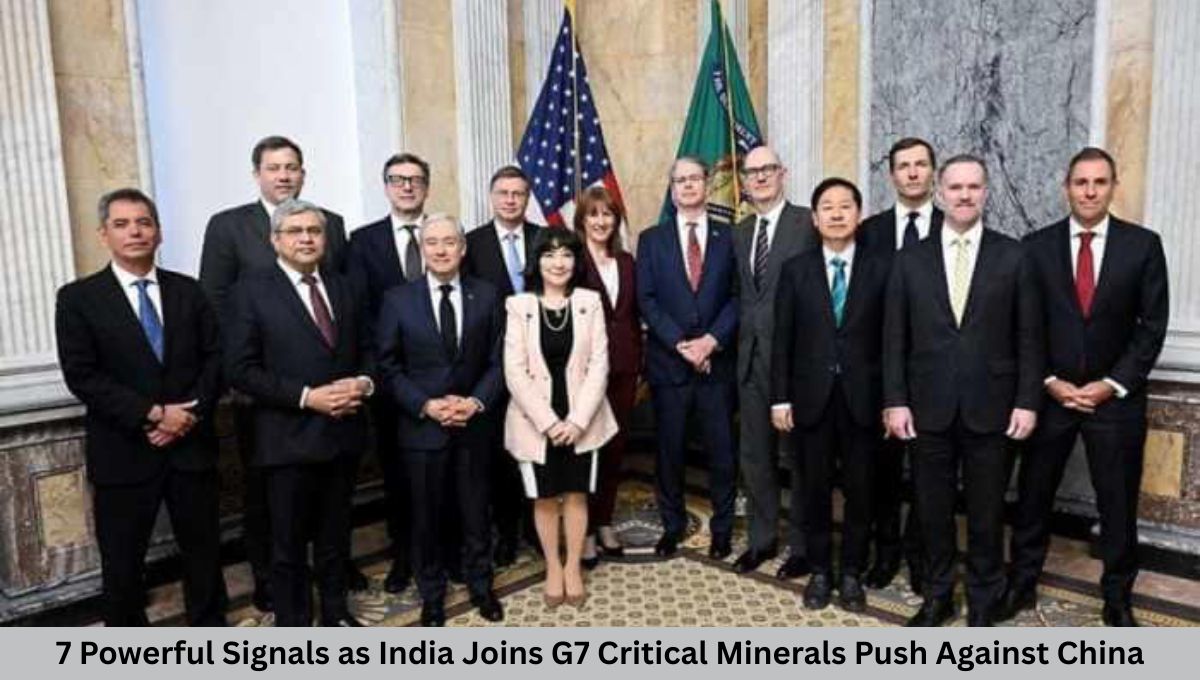
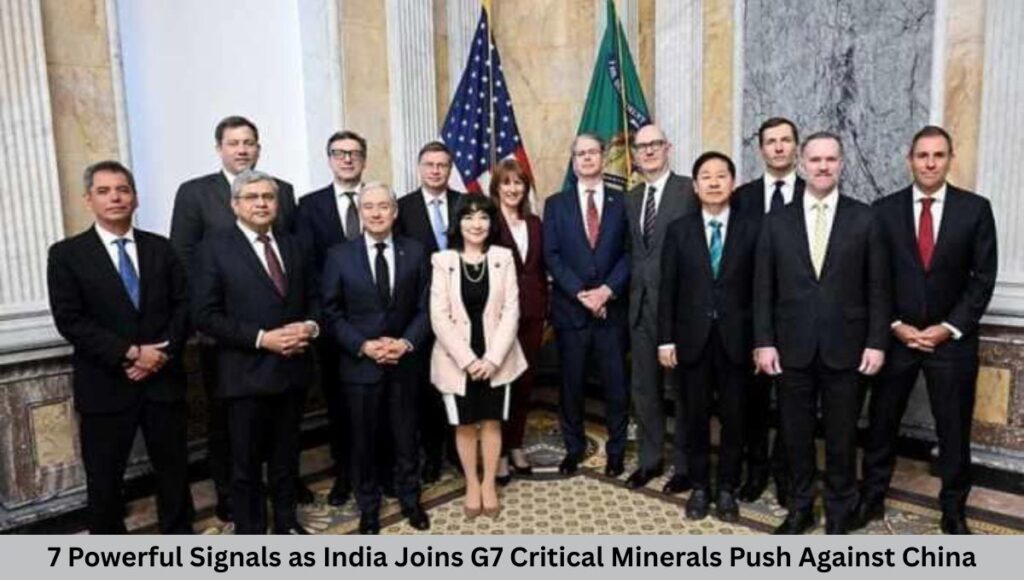
Union Minister for Electronics and Information Technology Ashwini Vaishnaw arrived in Washington, DC, on Sunday to participate in a Critical Minerals Ministerial Meeting hosted by US Treasury Secretary Scott Bessent.
The meeting is being held on the sidelines of a gathering of finance ministers from the G7 nations—Canada, France, Germany, Italy, Japan, the United Kingdom, and the United States—along with the European Union.
India and Australia were invited to join these discussions, reflecting Washington’s decision to broaden coordination beyond advanced Western economies.
“Arrived in Washington, DC. Will participate in the Critical Minerals Ministerial Meeting tomorrow. Secure critical mineral supply chains are vital for our goal of Viksit Bharat,” Vaishnaw said in a social media post.
The message was concise but pointed. For India, critical minerals are no longer a peripheral issue—they are central to economic growth, technological sovereignty, and long-term national security.
Why Washington Is Widening the Table
US Treasury Secretary Scott Bessent has been explicit about the rationale behind expanding participation in critical minerals talks. Speaking to reporters, he said India, Australia, and several other countries were being brought into the discussion to accelerate collective action against what he described as China’s “weaponisation” of supply chains.
Bessent revealed that he had been advocating a dedicated G7 discussion on critical minerals since last summer’s leaders’ summit. A virtual meeting among G7 finance ministers had already taken place in December, but Washington remains dissatisfied with the pace of progress.
“Urgency is the theme of the day,” a senior US official told Reuters. “It’s a very big undertaking. There are a lot of different angles, a lot of different countries involved, and we really just need to move faster.”
Together, the countries participating in the Washington meeting account for around 60 per cent of global demand for critical minerals, making coordination both necessary and complex.
China’s Grip on the Global Refining Chain
The sense of urgency stems from stark realities outlined by the International Energy Agency (IEA).
China is the world’s leading refiner for most major critical minerals, including:
- Copper
- Lithium
- Nickel
- Cobalt
- Graphite
- Rare earth elements
On average, China controls around 70 per cent of global refining capacity across these minerals. In some categories, the dominance is even higher.
The IEA has also flagged China’s control over downstream chemical inputs such as manganese sulphate and phosphoric acid—both essential for batteries and advanced manufacturing.
This concentration gives Beijing disproportionate leverage at a time when demand is accelerating rapidly due to:
- The global energy transition
- Electric vehicle adoption
- AI-led data centre expansion
- Semiconductor manufacturing
For Western economies and emerging technology hubs alike, this concentration represents a strategic vulnerability.
India’s Role Expands Beyond the Quad
India’s participation in the Washington meeting reflects a broader expansion of its role in US-led and G7-aligned initiatives beyond traditional frameworks such as the Quad.
Notably, India is set to join the US-led Pax Silica initiative, which focuses on securing critical supply chains spanning:
- Silicon
- Advanced manufacturing
- Semiconductors
- Artificial intelligence
Although India is a Quad partner, it was not initially included in Pax Silica, which currently includes the US, Japan, South Korea, Singapore, the Netherlands, the UK, Israel, the UAE, and Australia. That exclusion is now being reversed.
US Ambassador to India Sergio Gor announced that New Delhi would be invited next month to formally join the initiative, reinforcing India’s growing strategic relevance in technology and supply chain resilience.
Strategic Trust and the “High Table”
The significance of India’s inclusion was underscored by Ministry of Electronics and Information Technology (MeitY) Secretary S Krishnan, who described the invitation as recognition of India’s status as a trusted global partner.
“My minister is in Washington attending a meeting on critical minerals. From a strategic point of view, it’s important that India is at the high table as far as all of these important issues are concerned,” Krishnan said.
“Fundamentally, it’s about addressing the supply chain of critical minerals and critical materials, and it is important for a country like India to be part of that. It is a recognition of the trust.”
This framing is important. Trust, in this context, is not rhetorical—it determines access to sensitive technologies, shared standards, joint investments, and long-term partnerships.
The Pakistan Angle
India’s inclusion also needs to be viewed against the backdrop of parallel US engagement with Pakistan on critical minerals. Washington has pursued a distinct minerals dialogue with Islamabad, strengthening bilateral ties in a domain that carries both economic and geopolitical weight.
India’s elevation into broader G7 and Pax Silica discussions, however, signals differentiation rather than parity—placing New Delhi within a framework of trusted partners shaping future supply chains, rather than merely participating as a resource holder.
Rare Earth Price Floors Enter the Debate
Germany’s Finance Minister Lars Klingbeil confirmed that the Washington meeting also addressed the idea of price floors for rare earths, a mechanism designed to protect producers outside China from market manipulation.
The concept involves setting a minimum price that guarantees producers a viable return even if China floods the market to drive prices down—a tactic Beijing has been accused of using in the past.
“The advantage of minimum prices is that the market knows what prices it can expect, and that we can minimise the influence of countries that may try to influence market prices,” Klingbeil said.
However, he cautioned that many questions remain unresolved and that the implications of such mechanisms must be carefully weighed. The issue is expected to remain central under France’s presidency of the G7 this year.
De-Risking, Not Decoupling
European officials have been careful to emphasise that their approach towards China is one of de-risking, not decoupling. Klingbeil stressed that the discussions were not aimed at targeting any specific country but at strengthening cooperation among partners.
“There has been no reaction from China,” he said, adding that dialogue would continue across finance, foreign, and energy ministries in the coming weeks.
This nuanced positioning reflects the challenge facing G7 economies: reducing vulnerability without triggering destabilising retaliation.
India’s Domestic Stakes in Critical Minerals
For India, the global scramble for critical minerals is not an abstract concern.
It intersects directly with domestic priorities:
- Electric mobility
- Renewable energy targets
- Semiconductor manufacturing
- Defence modernisation
- Artificial intelligence
India currently lacks significant midstream processing capacity, even when mineral resources are available. Globally, processing—not mining—is where economic and strategic power is concentrated.
China controls nearly 90 per cent of processing capacity for minerals such as lithium, cobalt, graphite, and rare earths. Even ores mined in countries like Australia or Chile are often refined in China before re-entering global markets.
Without urgent intervention, India risks becoming permanently dependent on external processors.
Building India’s Midstream Muscle
Policy thinkers argue that India must now focus on building domestic midstream capabilities. The Geological Survey of India plans to undertake 1,200 exploration projects by 2031, but mining alone will not be enough.
Developing a new mine typically takes 15 years, making overseas sourcing essential in the short to medium term. Long-term offtake agreements, equity stakes, and strategic acquisitions will be necessary to secure feedstock for future processing plants.
Government-backed Khanij Bidesh India Ltd. (KABIL) has been tasked with acquiring overseas mineral assets, but analysts warn that speed and decisiveness will be critical to avoid being outpaced by global competitors.
National Critical Mineral Mission
India has begun laying policy foundations:
- A list of 30 critical minerals was notified in 2023
- The National Critical Mineral Mission (NCMM) was launched this year
The mission aims to cover the entire value chain—from exploration and mining to processing and recycling.
Among its goals:
- Establish four critical mineral processing parks
- Achieve self-sufficiency in processing at least five critical minerals
Rapid implementation, coordinated clearances, and anchor investors will determine whether these ambitions translate into reality.
Leveraging Strategic Partnerships
India’s growing alignment with the US, Australia, Japan, the UK, and the EU offers access to advanced processing technologies and know-how.
Examples include:
- The India–Australia Critical Minerals Investment Partnership
- UK’s designation of India as a priority partner under its new critical minerals strategy
- Potential collaboration with Japanese and German firms in high-purity metallurgy
The objective is to move beyond buyer-seller relationships toward joint ownership of midstream assets.
AI, Semiconductors, and the Pax Silica Link
Critical minerals are inseparable from India’s ambitions in artificial intelligence and semiconductors.
Speaking ahead of the India AI Impact Summit, MeitY Secretary S Krishnan outlined a technology-agnostic strategy to avoid vendor lock-in. India, he said, would not restrict itself to any single chip supplier.
“We are not going to necessarily say that we will buy only NVIDIA GPUs. Our approach is whoever produces the chips,” he said.
Recent developments like DeepSeek, he noted, demonstrate that AI innovation need not be prohibitively expensive.
India as the Global AI Use-Case Capital
Krishnan argued that India’s unique advantage lies in its openness and scale.
“It is legitimate for India to aspire towards becoming the use case capital for AI in the world,” he said, comparing the moment to the early transformation of India’s IT industry.
The Prime Minister’s recent meeting with startups selected under the India AI Mission to develop foundation models further signals the government’s commitment to indigenous capabilities.
Semiconductors and Industrial Policy Validation
India’s semiconductor push is beginning to show results. According to Krishnan:
- 20 per cent of the global semiconductor design workforce is based in India
- Fabs and advanced packaging units under the India Semiconductor Mission are receiving export orders
“The best test of industrial policy is whether you’re competitive and whether you can export,” he said, adding that this validates India’s approach.
What the Washington Meeting Signals
India’s participation in the G7-linked critical minerals discussions sends multiple signals:
- India is viewed as a trusted partner in strategic supply chains
- The US is serious about broadening coordination beyond traditional allies
- Critical minerals are now central to global economic diplomacy
- De-risking from China will be gradual but deliberate
- India’s AI and semiconductor ambitions are tightly linked to resource security
Conclusion: India Steps Into a Strategic Contest
The Washington meeting underscores a reality that is no longer in dispute: critical minerals sit at the heart of global power, economic resilience, and technological leadership.
By joining G7-level discussions and being invited into initiatives like Pax Silica, India is no longer on the periphery of this contest. It is increasingly being asked to help shape outcomes.
Whether India can translate trust into tangible industrial capacity—especially in midstream processing—will determine whether it emerges as a genuine anchor of future clean energy and digital value chains, or remains dependent on others for the most strategic inputs of the 21st century.
What is clear is that India has now entered the room where those decisions are being made.
Also Read: US and Ukraine Sign Historic Minerals Deal Amid War, Reconstruction, and Global Tensions
Also Read: PM Modi’s Bold Move: Securing Global Critical Minerals & Boosting India’s Recycling Power!