5 Critical Signals: Pax Silica That Could Redefine India–US Ties have raised serious questions. India’s exclusion from Pax Silica, a new US-led strategic initiative aimed at securing the global silicon and artificial intelligence supply chain, has triggered sharp political reactions and raised uncomfortable questions about the trajectory of India–United States relations.
Announced by the Trump administration amid ongoing trade negotiations with New Delhi, Pax Silica brings together countries considered central to the world’s most advanced technology, semiconductor, and AI ecosystems.
While the grouping includes key US allies across Asia, Europe, and the Middle East, India — the world’s fourth-largest economy and a major Indo-Pacific partner — has been conspicuously left out. The decision comes at a moment when Washington and New Delhi are locked in disputes over tariffs, agriculture market access, and the future shape of their economic partnership.
It also unfolds against the backdrop of intensifying global competition over critical minerals, largely dominated by China.
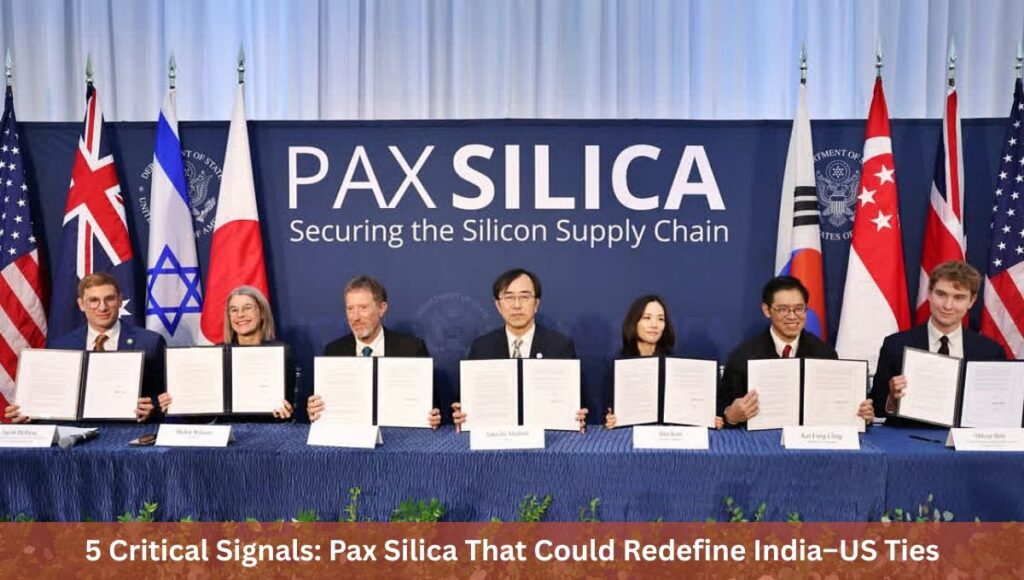
5 Critical Signals: Pax Silica That Could Redefine India–US Ties
What Is Pax Silica?
Pax Silica is a US-led strategic framework designed to build a secure, prosperous, and innovation-driven silicon supply chain — from critical minerals and energy inputs to semiconductors, AI infrastructure, advanced manufacturing, and logistics.
According to the US State Department, Pax Silica aims to:
- Reduce coercive dependencies
- Protect materials foundational to artificial intelligence
- Enable aligned nations to deploy transformative technologies at scale
- Establish a durable economic order for the AI-driven global economy
The initiative reflects Washington’s evolving doctrine that economic security is national security, particularly in an era where control over chips, minerals, and compute power determines geopolitical influence.
Who Is In — And Who Is Out
Founding Members of Pax Silica
The initiative includes:
- United States
- Japan
- Republic of Korea (South Korea)
- Singapore
- Netherlands
- United Kingdom
- Israel
- United Arab Emirates
- Australia
Guest participants include Taiwan, the European Union, Canada, and the OECD.
India’s Absence Stands Out
India’s exclusion is striking for several reasons:
- All other Quad countries — the US, Japan, and Australia — are members
- India is a central player in Indo-Pacific strategy
- Washington and New Delhi signed a critical minerals MoU in 2024
- India positions itself as an alternative to China in global supply chains
Despite these factors, India was not invited to join the founding group.
Why Pax Silica Matters Strategically
The US government describes Pax Silica as a response to growing vulnerabilities exposed by China’s dominance in rare earths, semiconductor processing, and mineral refining.
The China Factor
China controls large portions of:
- Rare earth mining and processing
- Critical mineral refining
- Intermediate semiconductor manufacturing
Recent Chinese restrictions on rare earth magnets have accelerated Western efforts to diversify supply chains. Pax Silica is explicitly designed to counter “Pax Sinica” — Beijing’s economic and technological influence.
AI as the New Strategic Frontier
Washington views AI not merely as a commercial technology, but as a civilisational driver of long-term prosperity and power. Pax Silica organizes countries around “strategic stacks” including:
- Compute and semiconductors
- Data and connectivity infrastructure
- Advanced manufacturing
- Mineral refining and energy grids
This is the first time countries are formally aligning around silicon, minerals, and energy as shared geopolitical assets.
Congress Attacks Modi Government
India’s opposition Congress party seized on the development, blaming Prime Minister Narendra Modi for a downturn in ties with US President Donald Trump.
Congress leader Jairam Ramesh said India’s exclusion was “not surprising” given what he described as strained Trump–Modi relations since May 2025.
He argued that joining Pax Silica would have clearly benefited India and mocked the optics of Modi’s recent publicised phone call with Trump, referring to their past “hug diplomacy” in Ahmedabad, Houston, and Washington.
The political reaction underscores how Pax Silica has quickly become a domestic political issue in India.
Trade Tensions Loom Large
Tariffs and Agriculture Deadlock
At the heart of the current India–US friction are:
- Trump-era 50% tariffs on Indian goods
- Disagreements over agriculture market access
- US pressure on India to open sensitive domestic sectors
India’s reluctance to liberalise agriculture for US exports appears to be a key factor influencing Washington’s approach.
While technical trade talks continue and several rounds of negotiations have been completed, the lack of a final agreement has created strategic mistrust.
Economic Statecraft Under Trump
The US State Department describes Pax Silica as advancing Trump’s vision of economic statecraft, where trade, investment, and technology alignment are tools of geopolitical leverage.
In this context, exclusion can function as pressure — signalling that access to elite technology clubs depends on economic compliance.
Impact on India–US Strategic Trust
A Contradiction in US Policy
The United States frequently portrays India as:
- A cornerstone of Indo-Pacific strategy
- A counterweight to China
- A trusted democratic partner
Excluding India from a China-focused supply chain initiative undercuts that narrative.
For New Delhi, the move reinforces perceptions that US partnerships remain conditional and transactional, particularly when commercial interests clash.
Critical Minerals: A Missed Opportunity?
India is one of the few countries with:
- Scale of workforce
- Growing manufacturing base
- Strategic motivation to diversify away from China
India has also been actively pursuing overseas mineral assets and supply agreements to reduce Chinese dependence.
By keeping India outside Pax Silica, the US risks slowing diversification efforts and weakening alternative supply chains meant to challenge Beijing’s dominance.
Quad vs Pax Silica: Competing Logics
Initiatives like the Quad are built on shared strategic objectives rather than strict economic alignment. Pax Silica, by contrast, appears more selective and commercially driven.
If India perceives Pax Silica as a closed club rather than an inclusive strategic platform, it may:
- Become more cautious about US-led frameworks
- Slow momentum on technology and climate cooperation
- Re-evaluate participation in future economic coalitions
This could weaken both the initiative’s credibility and broader Indo-US strategic cohesion.
India’s Parallel AI Push
Ironically, India’s exclusion comes as New Delhi prepares to host the India-AI Impact Summit 2026, the first global AI summit in the Global South.
Announced by Modi at the France AI Action Summit, the event will focus on People, Planet, and Progress, positioning India as a bridge between advanced economies and developing nations in AI governance.
The contrast highlights a growing divergence: India as a norm-setter and scale provider, versus Pax Silica’s focus on countries hosting the world’s most advanced AI companies.
Is India Seen as an End-to-End Partner?
While the US and India cooperate through:
- The critical minerals MoU
- The Initiative on Critical and Emerging Technologies (iCET)
Pax Silica’s composition suggests Washington may not yet view India as a core, end-to-end player in the highest-value segments of the AI supply chain.
That perception — whether accurate or not — carries long-term implications for India’s ambition to move beyond “China+1” into a preferred global manufacturing hub.
What Happens Next?
The US State Department has said additional signatories may follow, leaving the door theoretically open for India in the future.
However, much will depend on:
- Progress in trade negotiations
- Resolution of tariff disputes
- Alignment on market access and regulatory issues
For India, the episode serves as a reminder that strategic rhetoric does not always translate into economic inclusion.
Conclusion: A Strategic Warning Shot
India’s exclusion from Pax Silica is more than a diplomatic snub. It is a signal — about priorities, leverage, and the evolving nature of US-led economic alliances.
At a time when global power competition is increasingly defined by control over silicon, minerals, and artificial intelligence, being outside the room matters.
Whether Pax Silica becomes a missed opportunity or a temporary setback will depend on how Delhi and Washington recalibrate trust, trade, and strategic expectations in the months ahead.
Also Read: Israel joins US-led ‘Pax Silica’ initiative to cooperate on securing AI supply chains
Related Posts:
- 7 Powerful Signals as India Joins G7 Critical…

- 5 Major Takeaways from the US Supreme Court's…

- 7 Powerful Facts About Ayatollah Ali Khamenei’s…

- 7 Heartbreaking Facts About Venezuela's Earthquake Disaster

- 5 Key Signals from PM Modi’s Virtual ASEAN Summit Appearance
- 11 Explosive Revelations From Ted Cruz’s Leaked…