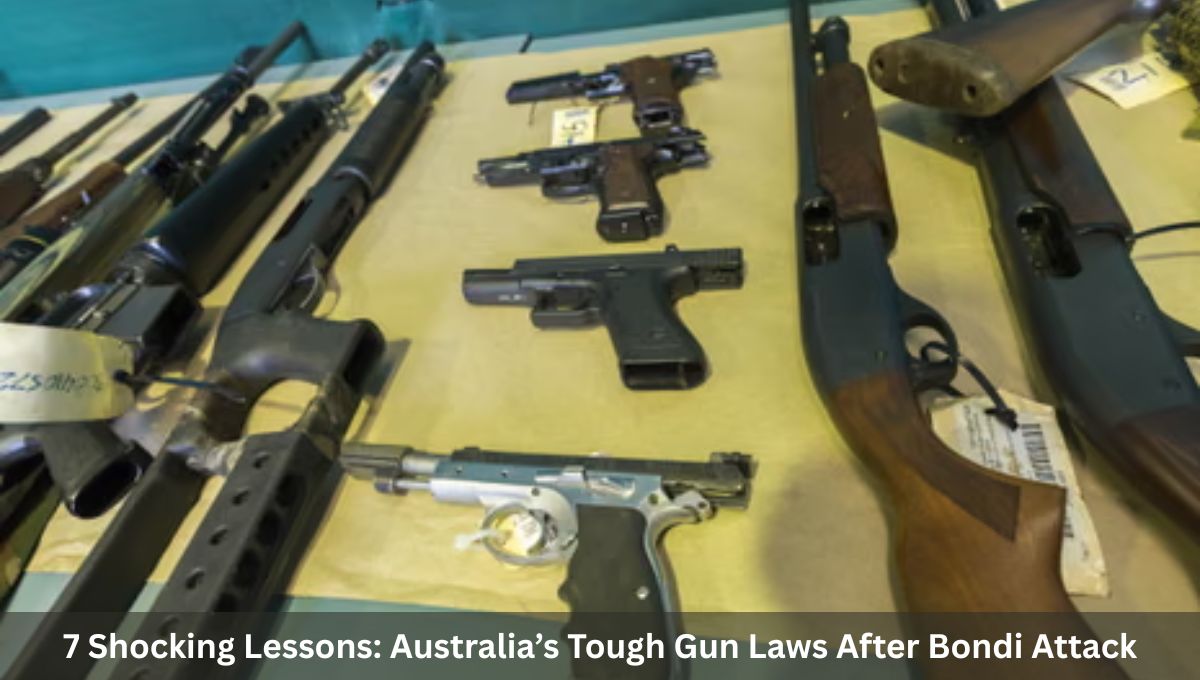
7 Shocking Lessons: Australia’s Tough Gun Laws After Bondi Attack now face a new reckoning. Australia has long been held up as a global model for gun control. Nearly three decades after the Port Arthur massacre shocked the nation into action, the country boasts one of the world’s lowest gun homicide rates.
Thank you for reading this post, don't forget to subscribe!Yet the Bondi Beach shooting, described by authorities as a targeted terrorist attack, has forced a painful national question: Are Australia’s gun laws still strong enough? The attack, which occurred during celebrations for the first day of Hanukkah, left at least 16 people dead and dozens injured.
It also exposed gaps in licensing oversight, firearm tracking, and enforcement — despite Australia’s reputation for strict regulation. Now, political leaders, law enforcement, and the public are confronting the uncomfortable reality that even the toughest laws may need to go further.
7 Shocking Lessons: Australia’s Tough Gun Laws After Bondi Attack
Australia’s Gun Control Legacy: Born From Tragedy
The Port Arthur Turning Point
In 1996, a lone gunman armed with semi-automatic weapons killed 35 people at the Port Arthur historic site in Tasmania. The massacre horrified the nation and triggered one of the fastest legislative responses to mass violence anywhere in the world.
Within two weeks, Australia enacted the National Firearms Agreement (NFA), which:
- Banned semi-automatic rifles and shotguns
- Introduced mandatory gun licensing and registration
- Required a “genuine reason” to own a firearm
- Launched a nationwide gun buyback and amnesty
The reforms were politically contentious but transformative. More than 650,000 firearms were destroyed, and mass shootings virtually disappeared for decades.
Global Validation
New Zealand followed a similar path after the Christchurch mosque attacks in 2019, banning semi-automatic weapons and launching buyback schemes. Australia’s example became proof that decisive gun reform could save lives.
Low Gun Deaths — But Rising Gun Ownership
Australia’s gun homicide rate remains among the lowest globally.
- 31 gun-related murders were recorded between July 2023 and June 2024
- This equates to 0.09 deaths per 100,000 people, according to the Australian Institute of Criminology
However, beneath that success lies a growing concern.
Four Million Legal Guns — And Counting
Think tank The Australia Institute reports that legally owned firearms now exceed four million, surpassing pre-1996 levels. Gun ownership has risen steadily for more than two decades, even as regulations remained largely unchanged.
This growth has raised alarms about whether existing safeguards are sufficient in a changing threat environment that includes lone-wolf terrorism and ideological extremism.
The Bondi Beach Attack: What We Know
The Bondi Beach shooting unfolded rapidly and brutally.
Authorities say two gunmen — later identified as Sajid Akram (50) and his son Naveed Akram (24) — opened fire on civilians gathered to celebrate Hanukkah. Sajid was shot dead by police at the scene.
Naveed was critically injured and remains under guard. Police recovered multiple weapons at the scene and additional firearms from a rented property in Campsie.
Investigators are probing possible links to extremist ideology after discovering:
- A black Islamic State flag in the attackers’ vehicle
- Improvised explosive devices
- Evidence of recent travel to the Philippines
The Australian government has since classified the incident as a terrorist attack targeting the Jewish community.
A Civilian Hero: Ahmed Al Ahmed
Amid the chaos, one extraordinary act likely saved countless lives.
Captured on Camera
Video footage shows Ahmed Al Ahmed, a 43-year-old fruit shop owner and father of two, charging one of the gunmen from behind, grappling with him, and forcibly disarming him — all while a second shooter continued firing from a nearby bridge.
Mr Al Ahmed was shot multiple times and has since undergone surgery. He remains hospitalized but is expected to recover.
National Praise
New South Wales Premier Chris Minns called the footage “the most unbelievable scene I’ve ever seen,” adding:
“There are many, many people alive tonight as a result of his bravery.”
Prime Minister Anthony Albanese hailed Mr Al Ahmed and other civilians as heroes who “ran toward danger to help others.”
How the Gunman Was Licensed
One of the most troubling revelations is that the shooter legally owned firearms.
In New South Wales, multiple gun license categories exist, including recreational and sporting licenses tied to gun club membership. Police confirmed the shooter held a valid recreational license and had six registered firearms.
License holders are legally required to use guns only for approved purposes — such as sport shooting — but critics now argue that enforcement and suitability checks may be insufficient.
Government Response: Tougher Laws on the Table
Following an emergency National Cabinet meeting, Prime Minister Albanese announced unanimous agreement among state and territory leaders to pursue stronger gun controls.
Proposed Reforms Include:
- Gun licenses restricted to Australian citizens only
- Limits on the number and type of firearms an individual can own
- License expiration, requiring more frequent background and suitability checks
- Tougher restrictions on firearm imports,
including:
“These are practical responses,” Albanese said. “If there’s more that can be done, we will do it.”
The National Firearms Register: A Critical Gap
One of the most significant weaknesses exposed by the Bondi attack is the absence of a fully functional National Firearms Register.
Although required under the 1996 agreement, Australia still lacks a single, real-time database of gun ownership. A four-year integration program began last year, but progress has been slow.
Albanese acknowledged the challenge:
“In some cases, state jurisdictions were still using paper identification.”
The delay has hindered law enforcement’s ability to track firearms across borders and identify risk patterns quickly.
New South Wales Signals Change
NSW Premier Chris Minns has indicated that state laws will be revisited, questioning the necessity of high-powered weapons outside agricultural use.
“If you’re not a farmer, if you’re not involved in agriculture, why do you need these massive weapons that put the public in danger?”
Any changes in NSW would likely influence national standards, given the state’s population size and political weight.
India Reacts: PM Modi Condemns Attack
Indian Prime Minister Narendra Modi strongly condemned the Bondi Beach attack, expressing solidarity with Australia and reaffirming India’s zero-tolerance stance on terrorism.
In a post on X, Modi wrote that India “stands in full solidarity with the people of Australia” and supports the global fight against all forms of terrorism.
A Global Debate Rekindled
Australia’s experience has long been cited in global gun control debates, particularly in the United States. The Bondi attack complicates that narrative — not because the laws failed outright, but because evolving threats may require constant recalibration, not complacency.
The central question now confronting Australia is whether incremental tightening is enough — or whether another transformative shift is required.
Conclusion: A Model Under Pressure
Australia’s gun laws have saved countless lives. The data is clear. But the Bondi Beach tragedy has revealed that even the strongest systems can develop blind spots over time.
As reforms move forward, the country once again faces a defining test: whether it can act swiftly, decisively, and politically bravely — just as it did in 1996.
If history is any guide, Australia may yet prove that meaningful change is still possible, even in the face of unimaginable violence.
Also Read: Indian-Origin Man on Life Support After Violent Arrest by Australian Police
Also Read: Explainer: How Australia’s Gun Laws Work And What Sets Them Apart From Other Countries