Trump Says He Will Not Allow Israel to Annex West Bank Amid Global Pressure, signaling major shift in US-Israel relations. US President Donald Trump has declared that he will not allow Israeli Prime Minister Benjamin Netanyahu to annex the occupied West Bank, marking one of the strongest statements yet by Washington against Israeli settlement expansion.
Speaking at the White House ahead of Netanyahu’s address to the United Nations General Assembly (UNGA), Trump drew a sharp line:
“I will not allow Israel to annex the West Bank. Nope, I will not allow it. It’s not going to happen.”
His comments, coming just days before a scheduled meeting with Netanyahu, signal a rare moment of divergence between Washington and Tel Aviv—especially given Trump’s long-professed friendship with the Israeli leader. The statement also comes as Israel faces unprecedented international pressure over its war in Gaza, its settlement expansion in the West Bank, and its treatment of Palestinians.
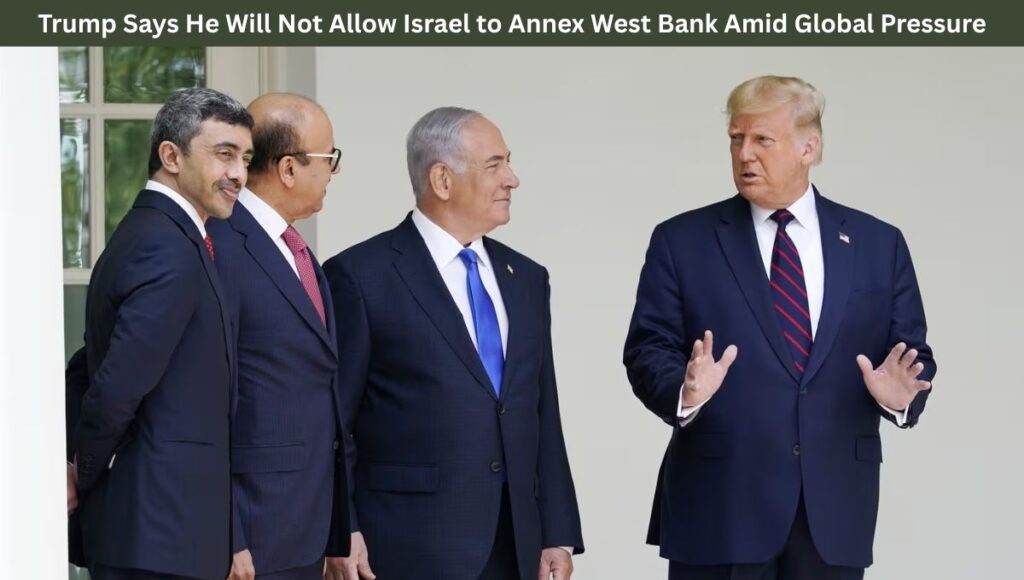
Trump Says He Will Not Allow Israel to Annex West Bank Amid Global Pressure
Background: The Annexation Debate
The West Bank, home to over 2.7 million Palestinians and 700,000 Israeli settlers, has been under Israeli military occupation since the 1967 Six-Day War.
While Israel has never formally annexed the territory (apart from East Jerusalem), ultranationalist members of Netanyahu’s coalition have repeatedly called for full annexation as a means to block the creation of a Palestinian state.
Such a move would effectively bury the long-standing two-state solution, long backed by the international community.
Even Israel’s closest allies—including the UK, Germany, and France—have warned that annexation would be “morally, legally, and politically intolerable.”
Trump’s Warning to Netanyahu
Trump’s remarks surprised many, given his historically pro-Israel policies during his first administration. Yet in this instance, the US president placed a red line on Netanyahu’s ambitions.
“There’s been enough. It’s time to stop now,” Trump said.
He also suggested that progress was being made toward a ceasefire deal in Gaza, describing negotiations as “pretty close.”
Trump said he had spoken with Netanyahu and multiple Arab leaders in recent days, noting:
“We’re getting pretty close to having a deal on Gaza, and maybe even peace.”
Also Read: Trump’s Gaza Peace Plan Wins Global Backing
Arab Leaders Deliver a Warning
Arab and Muslim nations strongly oppose annexation of the West Bank. During meetings with Trump on the sidelines of the UNGA, Saudi Arabia’s Foreign Minister Prince Faisal bin Farhan said leaders had delivered a clear message:
“The Arab and Muslim countries made very clear to the president the danger of annexation of any type in the West Bank and the risk that poses not just to the potential of peace in Gaza, but also to any sustainable peace at all.”
This underscores the Arab world’s red line: annexation could collapse not only negotiations over Gaza but also the broader regional peace process, including the Abraham Accords.
Also Read: Trump says he ‘will not allow’ Netanyahu to annex West Bank
Growing International Recognition of Palestine
Trump’s comments come at a time of shifting global sentiment.
In just one week, more than a dozen nations—including Canada, Australia, the UK, Portugal, France, Belgium, Luxembourg, Malta, Monaco, San Marino, Andorra, and Denmark—announced recognition of a Palestinian state.
This wave of recognition marks a significant break from the US and Israel, both of which reject Palestinian statehood at this time, arguing it would “reward Hamas.”
Meanwhile, Palestinian President Mahmoud Abbas addressed the UNGA by video, thanking countries that recognized Palestine and calling for a peace plan that ensures a sovereign Palestinian state encompassing Gaza and the West Bank.
Abbas Calls for Palestinian Leadership in Gaza
Barred from traveling to New York by US restrictions, Abbas delivered his message virtually:
- He welcomed Western recognition of Palestinian statehood.
- He said Hamas would play no role in governance after Gaza’s reconstruction.
- He called for the Palestinian Authority to take “full responsibilities” in Gaza and to link it politically with the West Bank.
His remarks were aimed at reassuring both Western and Arab allies that Palestinian governance would not be dominated by Hamas in a post-war future.
Israel Pushes Forward With Settlements
Despite global warnings, Netanyahu’s coalition has doubled down on settlement activity.
Earlier this month, Israel approved construction under the controversial E1 settlement plan, which would effectively bisect the West Bank and make the formation of a contiguous Palestinian state nearly impossible.
Far-right ministers such as Bezalel Smotrich hailed the move as the “erasure of the Palestinian state idea.”
Israel also closed its only border crossing with Jordan, cutting off millions of Palestinians from the outside world. The move came shortly after a shooting at the crossing by a Jordanian gunman.
Humanitarian Crisis in Gaza
The Gaza war continues to inflict catastrophic losses.
According to the Hamas-run health ministry in Gaza, over 65,000 Palestinians have been killed, including 18,000 children, since Israel’s military campaign began after the October 7, 2023 Hamas-led attack on southern Israel.
- That attack killed about 1,200 Israelis and saw 251 hostages taken.
- In Gaza, hospitals report hundreds of deaths daily, mostly civilians.
- The UN-backed IPC warned in August that over half a million Gazans face “catastrophic” famine conditions.
A UN Commission of Inquiry recently accused Israel of committing genocide in Gaza—a finding Israel rejected as “false and distorted.”
Western Nations Push for Accountability
Alongside state recognitions, Western governments are tightening pressure on Israel:
- The European Commission is weighing trade restrictions and sanctions on extremist Israeli ministers.
- Microsoft suspended services to a unit of Israel’s Defense Ministry after revelations of surveillance abuses in Gaza.
- France’s President Emmanuel Macron called annexation a “red line” that would end the Abraham Accords.
The United Arab Emirates, a key signatory of the accords, has echoed this warning, saying annexation would end its pursuit of regional integration.
Trump’s 21-Point Gaza Peace Plan
Behind closed doors, Trump’s administration has floated a 21-point proposal to Arab leaders for resolving the Gaza war.
Key elements include:
- Immediate ceasefire.
- Release of all Israeli hostages.
- Gradual Israeli withdrawal from Gaza.
- Gaza governance without Hamas.
- Increased humanitarian aid.
- Guarantee of no annexation of the West Bank.
- Maintaining Jerusalem’s status quo.
While Arab leaders endorsed much of the plan, they stressed that preventing annexation of the West Bank was non-negotiable.
Domestic Pressure in Israel
Netanyahu faces political turmoil at home. Far-right allies demand annexation, while moderates warn it would isolate Israel further.
Israeli Foreign Minister Gideon Sa’ar recently said the government does not plan to annex Palestinian Authority areas but is considering extending Israeli law to settlements—a move seen as de facto annexation.
Israel is also weighing sanctions against Palestinian Authority leaders, restricting their movement and targeting their businesses, in retaliation for Western recognition of Palestine.
What Comes Next?
Trump’s declaration that annexation is “not going to happen” raises several questions:
- Will Netanyahu defy Washington? – Netanyahu has not confirmed whether he will pursue annexation but hinted a response will come after his meeting with Trump.
- Can Trump broker peace? – His 21-point Gaza plan may offer a framework, but gaps remain, particularly regarding settlements and Jerusalem.
- How will Arab states react? – Annexation could collapse normalization efforts, while rejecting Palestinian statehood risks alienating allies.
- Will global pressure grow? – With over 150 UN member states now recognizing Palestine, momentum may isolate Israel further.
Conclusion: Trump’s Red Line and the Future of the West Bank
Donald Trump’s refusal to allow West Bank annexation signals a rare alignment with Arab and Western allies against Netanyahu’s far-right coalition.
At a time when the Gaza war rages on, the humanitarian crisis deepens, and international recognition of Palestinian statehood surges, Trump’s stance could be a pivotal moment in shaping the future of the Israeli-Palestinian conflict.
Whether this translates into lasting change—or simply delays an inevitable clash over the West Bank—remains to be seen. For now, Trump has drawn a line in the sand: “It’s not going to happen.”