Donald Trump Signs Executive Order on TikTok Deal, $14B US Venture with Oracle, Dell & Murdoch, cutsByteDance’s stake to 20% amid national security concerns. US President Donald Trump has officially signed an executive order that paves the way for TikTok’s US operations to be spun into a $14 billion American-led joint venture.
The deal, which reduces Chinese parent company ByteDance’s stake to 20%, puts control of TikTok’s US assets in the hands of US investors including Oracle’s Larry Ellison, tech mogul Michael Dell, and media tycoon Rupert Murdoch. While Trump declared that Chinese President Xi Jinping had given the go-ahead, Beijing has not yet publicly confirmed approval, leaving questions about regulatory clearance on both sides. Still, the executive order marks the most decisive step yet in resolving the years-long battle over TikTok’s ownership and its role in US national security.
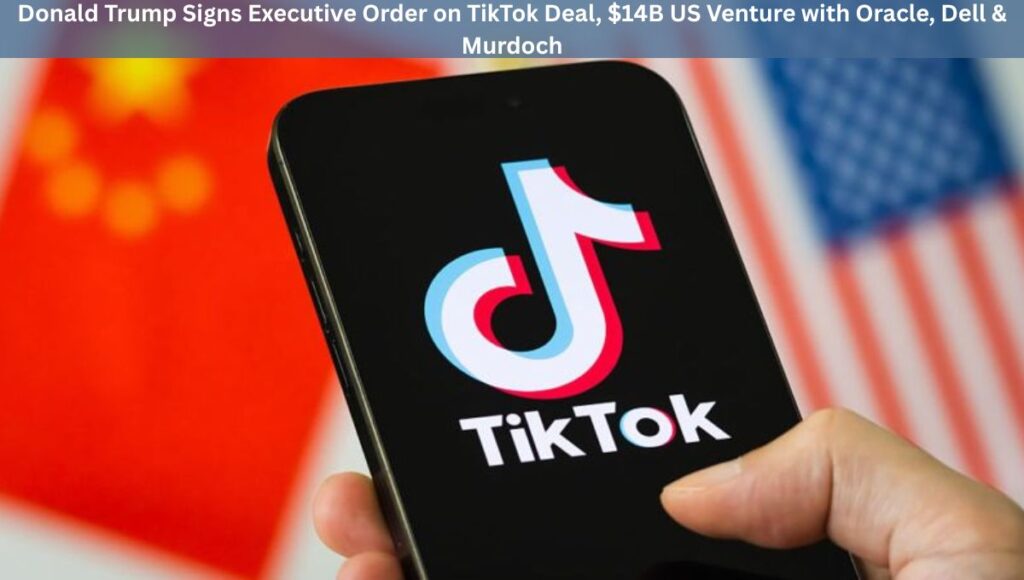
Donald Trump Signs Executive Order on TikTok Deal, $14B US Venture with Oracle, Dell & Murdoch
TikTok’s Rocky Path in the US
Since its meteoric rise, TikTok has faced skepticism in Washington due to concerns about data privacy, foreign influence, and algorithmic control. In 2024, President Joe Biden signed legislation mandating that ByteDance must divest TikTok’s US assets or face a nationwide ban.
Enforcement of that law has been repeatedly delayed by Trump, who sought a negotiated outcome that would preserve the app’s availability for its 170 million US users. TikTok’s popularity, especially among younger demographics, has also made it politically significant.
Trump himself has 15 million followers on TikTok, and he credited the app with boosting his successful reelection campaign. The White House even launched its own official TikTok account recently, further signaling the platform’s political importance.
Structure of the TikTok Deal
According to the executive order and White House officials:
- US investors will hold approximately 80% ownership of TikTok’s US entity.
- ByteDance will retain a minority stake capped at 20%.
- Governance will heavily favor US investors, with most board seats reserved for American representatives. ByteDance will hold only one seat, excluded from national security oversight committees.
- Oracle will oversee TikTok’s algorithm, data security, and privacy compliance.
- The new entity is projected to be valued at $14 billion, a figure Vice President JD Vance said reflects “market realities” even though analysts once valued TikTok’s US assets at up to $100 billion.
Key Investors
- Larry Ellison (Oracle) – Longtime Trump ally and central figure in tech deals.
- Michael Dell (Dell Technologies) – Expanding his footprint into media-tech investments.
- Rupert Murdoch (Fox Corp.) – Media mogul with deep ties to both politics and communications.
- Silver Lake and other private equity groups are also expected to join.
Trump and Xi: A Diplomatic Bargain?
At the Oval Office signing, Trump declared:
“I had a very good talk with President Xi. We talked about TikTok and he gave us the go-ahead.”
However, China’s foreign ministry has not publicly confirmed this endorsement, instead emphasizing that any TikTok transaction must comply with Chinese export control laws. Analysts say Beijing views TikTok as a low-priority bargaining chip in broader US-China trade talks, but is leveraging the issue to extract concessions on larger economic matters.
TikTok Staff React with Anxiety
While the executive order provides clarity for TikTok’s uncertain future, employees remain unsettled.
- Some worry about the impact on their ByteDance stock holdings.
- Others fear job losses or structural changes under new ownership.
- Concerns persist over whether a US-only algorithm will be as effective as ByteDance’s globally managed system.
One employee told Business Insider:
“If it works out, great. If it doesn’t, we’ll have to look for another job.”
Still, many say the deal brings more stability compared to the endless uncertainty of the past year.
Algorithm Under American Oversight
TikTok’s algorithm, often described as the app’s “secret sauce”, is at the heart of US national security debates.
- The US version of TikTok will use a domestically controlled algorithm monitored by Oracle.
- ByteDance may license algorithmic technology to the US venture, pending Chinese export approval.
- A separate US TikTok app could emerge, depending on final regulatory terms.
Trump jokingly said he would make the app “100% MAGA”, but later clarified that all perspectives would be “treated fairly.” Vice President JD Vance added:
“We don’t want this used as a propaganda tool by any foreign government. We just want it to be fair.”
Also Read: US Approves TikTok Deal: Oracle to Oversee Algorithm, Silver Lake Joins in Security Oversight
Why the TikTok Deal Matters
National Security Concerns
US lawmakers have long argued that ByteDance’s Chinese ties make TikTok vulnerable to state surveillance. The executive order emphasizes that the new US entity will “protect data of American users” and safeguard against propaganda risks.
Political Stakes
With 170 million US users, TikTok is a cultural powerhouse. Any ban could carry significant political fallout, especially among young voters.
Global Implications
The deal represents a new precedent: a foreign-owned app restructured to appease US national security law. Other Chinese firms may face similar divest-or-ban ultimatums in the future.
Also Read: Trump signed executive order on TikTok deal. But the deal isn’t complete
Timeline: From Threatened Ban to $14B Deal
- 2023 – Biden signs law mandating TikTok’s US divestiture.
- 2024 – Trump delays enforcement, seeks negotiated solution.
- 2025 – Multiple extensions keep TikTok running as deal talks progress.
- September 2025 – Trump signs executive order approving US joint venture.
- January 2026 (deadline) – Final enforcement of the law, unless deal fully closes.
Concerns That Remain
Despite Trump’s executive order, the TikTok deal is not finalized.
- Regulatory hurdles in both the US and China remain.
- The investor group is not yet fully confirmed.
- Questions linger about whether US users must download a separate TikTok app.
- Some fear that the algorithm’s new overseers — investors allied with Trump — could still influence content moderation.
What Comes Next?
- The joint venture must secure formal approval from US regulators.
- China’s export controls may complicate transfer of algorithmic technology.
- Trump is expected to extend TikTok’s legal operating window by another 120 days.
- A Trump-Xi meeting at the APEC Summit in South Korea could finalize political details.
Conclusion
The TikTok deal is one of the most consequential intersections of technology, politics, and national security in recent memory. With Donald Trump signing the executive order, TikTok has been given a lifeline in the US, but at the cost of heavy restructuring and American investor dominance.
While Trump insists TikTok will remain open to all perspectives, the platform’s future is still shaped by geopolitical tensions, investor influence, and regulatory scrutiny.
For its 170 million US users, the app survives — but in a new form that reflects the evolving power struggle between Washington and Beijing.