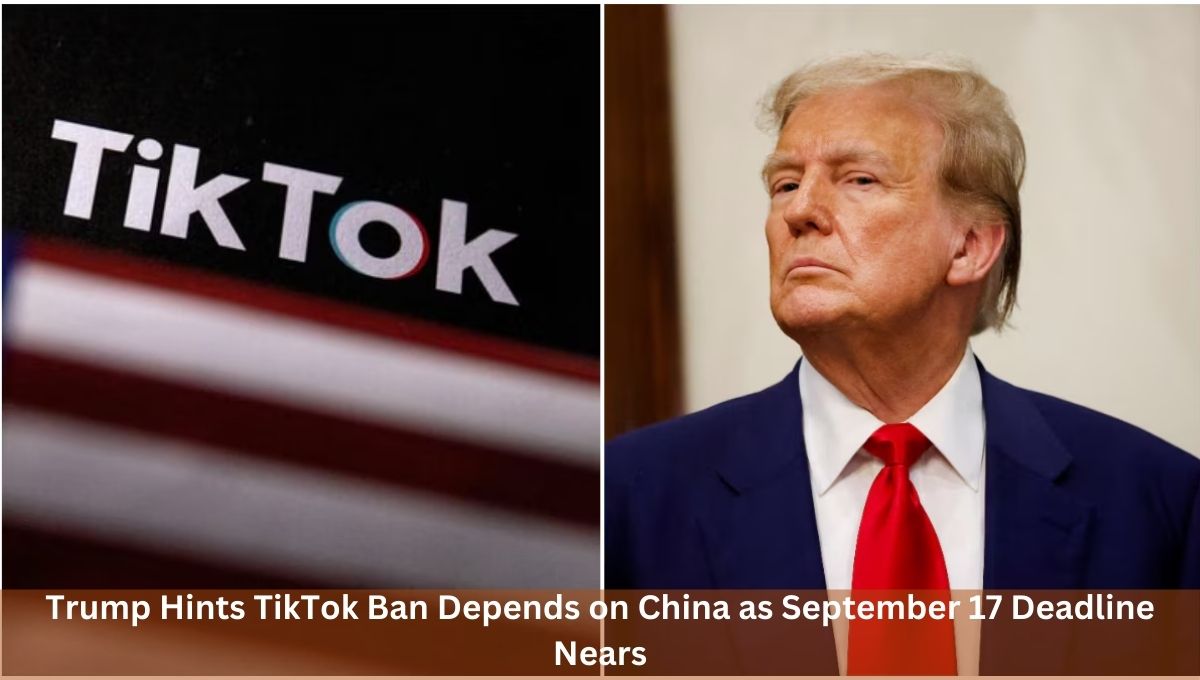
Leaving Open the Possibility of Letting the App “Die,” Trump Hints TikTok Ban Depends on China as September 17 Deadline Nears. US President Donald Trump has once again left TikTok’s future in the United States uncertain, suggesting that the social media app could either survive or “die” depending on China’s next move. With a September 17 deadline looming, the president’s remarks have reignited debate over whether his administration will enforce a ban, extend the deadline for a fourth time, or push ByteDance, TikTok’s parent company, to finalize a sale.
Speaking to reporters on Sunday, September 14, in Morristown, New Jersey, Trump struck an ambiguous tone. “I may or may not. We are negotiating TikTok right now. We may let it die, or we may…I don’t know. It depends on China. It doesn’t matter too much. I would love to do it for the kids, they like it,” he said before boarding Air Force One.
His comments come just days before ByteDance faces a legal requirement to sell or divest TikTok’s U.S. operations or face a nationwide ban. The mandate, first issued in January 2025, has already been delayed three times under Trump’s leadership.
Trump Hints TikTok Ban Depends on China as September 17 Deadline Nears
A Deadline Extended Again and Again
If the September 17 deadline is pushed back, it will mark the fourth extension granted by Trump since the law was enacted. Initially, ByteDance was given until January 2025 to sell TikTok’s U.S. assets or shut down the platform altogether.
But Trump has repeatedly chosen delay over enforcement, first extending the deadline to early April, then to June, and later to September. Each extension has reflected both political calculations and ongoing negotiations with Beijing.
National security concerns have fueled calls from lawmakers in Congress for immediate action, while Trump himself has shown reluctance to eliminate an app used by more than 170 million Americans, particularly young voters who helped boost his performance in the 2024 presidential election.
Also Read: Trump seen again pushing deadline on TikTok sale or divestment, source says
Trump’s Election Strategy and TikTok’s Role
Despite strong warnings from China hawks in Washington, Trump has openly acknowledged that TikTok played a significant role in his re-election campaign. “I performed very well on TikTok. I gained strong support from younger voters and achieved numbers no one in the Republican Party has ever reached,” Trump told reporters.
The president even credited conservative activist Charlie Kirk, assassinated last week at Utah Valley University, as instrumental in energizing the youth vote alongside TikTok. “Some of it was thanks to TikTok, and much of it was thanks to Charlie,” he said.
Trump’s comments suggest a personal and political motivation to preserve the platform, despite persistent concerns from intelligence officials that TikTok could be exploited by Beijing for surveillance, influence campaigns, or censorship.
China’s Role in the Deadlock
The fate of TikTok is now tied directly to China’s approval of any deal involving its core technology. The app’s algorithm—widely seen as the secret to TikTok’s global success—is classified by Beijing as a sensitive export. That means any sale to American investors would require a green light from the Chinese government.
A deal was close earlier this year that would have spun off TikTok’s U.S. operations into a new company majority-owned by American investors. However, the plan collapsed after China signaled disapproval, particularly in response to Trump’s announcement of steep tariffs on Chinese goods.
Analysts believe Beijing may be using TikTok as a bargaining chip in broader trade negotiations, testing Washington’s willingness to compromise.
U.S.–China Trade Talks and TikTok
The TikTok issue has now become entwined with broader U.S.-China economic discussions. On Sunday, U.S. Treasury Secretary Scott Bessent and Trade Representative Jamieson Greer met with Chinese Vice Premier He Lifeng and trade negotiator Li Chenggang in Spain.
For the first time, TikTok was placed on the official agenda, a move that observers say provides Trump political cover for another extension.
In earlier rounds of talks held in Geneva, London, and Stockholm, TikTok was not publicly discussed. By including the app now, the Trump administration can justify further delays while negotiations continue.
Still, officials have acknowledged that no breakthrough is expected before September 17, leaving TikTok’s status in limbo.
National Security Concerns vs. Political Realities
Congressional lawmakers from both parties remain deeply skeptical about TikTok’s ties to China. They argue that the app could allow Beijing to:
- Harvest sensitive user data from millions of Americans
- Shape public opinion through algorithmic manipulation
- Pressure or blackmail U.S. citizens with compromising information
Yet Trump has repeatedly dismissed these concerns in public, framing TikTok more as a political and cultural issue than a security threat. “It doesn’t matter too much. I would love to do it for the kids, they like it,” he said.
This disconnect between Trump and Congress could heighten political tensions if the president grants another reprieve. Lawmakers who voted to mandate TikTok’s sale may see yet another delay as undermining legislative authority.
The Algorithm at the Heart of the Stalemate
At the center of the debate lies TikTok’s powerful recommendation algorithm, often credited with driving the app’s addictive nature and explosive growth. U.S. buyers, according to Trump, are ready to acquire TikTok’s operations if Beijing allows the algorithm to be transferred.
However, China considers the technology part of its export-control framework, essentially blocking its sale to foreign entities without government approval.
This puts TikTok’s future in a bind: any U.S. deal without the algorithm may render the app ineffective, while Beijing’s refusal to release it stalls negotiations indefinitely.
Trump Balancing Politics and Pressure
Trump’s decision-making on TikTok reflects a balancing act between political strategy, trade negotiations, and national security concerns. On one hand, his base and young voters benefited from his presence on TikTok during the 2024 campaign.
On the other, China hawks in Washington and bipartisan lawmakers are urging swift enforcement of the law mandating divestment.
By repeatedly extending the deadline, Trump has managed to keep both options open while avoiding an immediate confrontation with Beijing. But with September 17 approaching, his administration will face renewed scrutiny for kicking the can down the road.
What Comes Next?
Several scenarios remain possible:
- Another Extension – Trump grants a fourth reprieve, giving negotiators more time while avoiding a ban.
- Enforcement of Ban – If no deal is reached and Trump chooses to enforce the law, TikTok could face a nationwide shutdown.
- U.S. Buyer Steps In – Should Beijing unexpectedly approve, American investors could acquire TikTok’s U.S. operations.
- Trade-Off in Negotiations – TikTok may become part of a broader trade agreement between Washington and Beijing.
For now, the most likely outcome appears to be another extension, with U.S. officials quietly acknowledging that no deal is imminent.
TikTok’s Popularity vs. Uncertainty
TikTok continues to thrive among American users, with an estimated 170 million monthly active users in the United States.
The app remains especially popular among younger demographics, making it a unique cultural and political force.
Yet uncertainty over its future creates anxiety for creators, advertisers, and businesses who rely on the platform for income and visibility.
The longer the deadlock persists, the greater the risk of disruption to an ecosystem that has become integral to U.S. social media culture.
Conclusion: A Platform in Political Crossfire
As the September 17 deadline approaches, TikTok’s future in America hangs in the balance. President Trump’s remarks—“We may let it die, or we may not. It depends on China”—encapsulate the uncertainty.
For now, TikTok sits at the intersection of trade tensions, political maneuvering, and national security concerns. Whether Trump grants another extension, enforces a ban, or secures a last-minute deal, the outcome will shape not only U.S.-China relations but also the digital lives of millions of Americans.
One thing remains clear: TikTok’s fate is no longer just about a social media platform—it has become a symbol of the broader struggle between Washington and Beijing over technology, influence, and control in the 21st century.
Also Read: Nepal Lifts Social Media Ban Amid Youth Protests, Political Crisis, and Demands for Reform