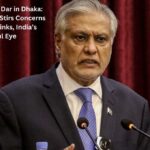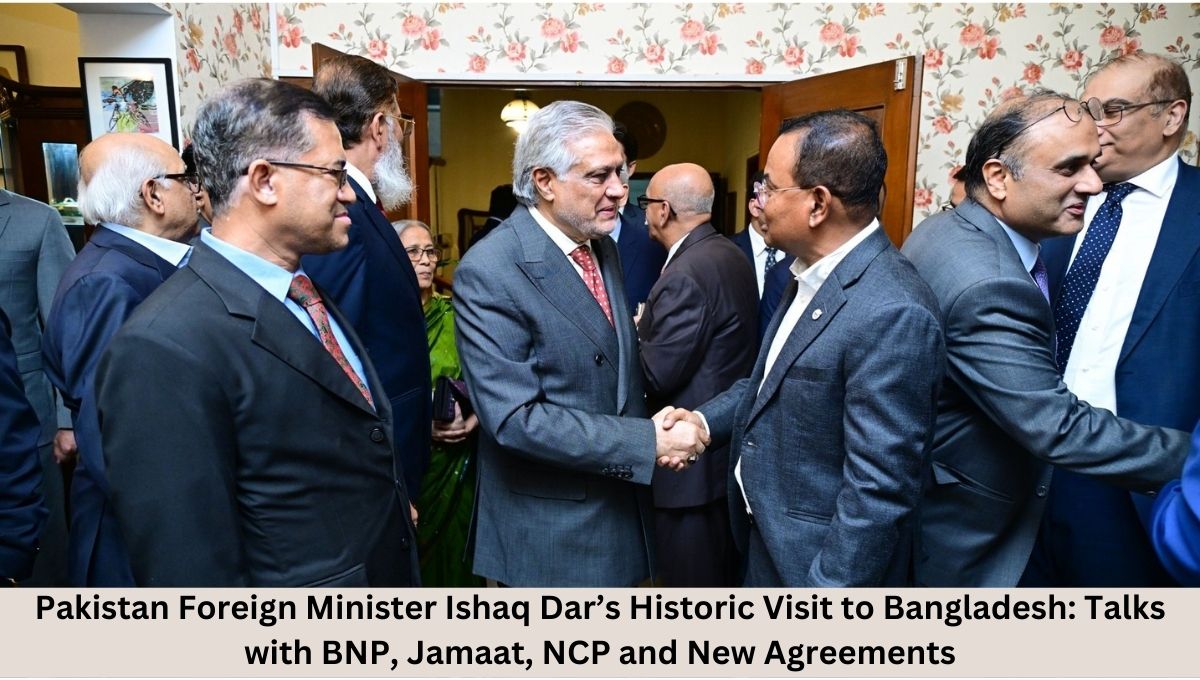
The first in 13 years, Pakistan Foreign Minister Ishaq Dar’s Historic Visit to Bangladesh: Talks with BNP, Jamaat, NCP and New Agreements. Pakistan’s Deputy Prime Minister and Foreign Minister Ishaq Dar has embarked on a landmark visit to Bangladesh, marking the first high-level trip by a Pakistani foreign minister to Dhaka in 13 years.
The visit, which began on August 23, 2025, is being described as a “historic milestone” in Pakistan-Bangladesh relations. During his stay, Dar held back-to-back meetings with political leaders, interim government officials, and civil society representatives, signaling Islamabad’s intent to reset ties with Dhaka after years of estrangement.
Pakistan Foreign Minister Ishaq Dar’s Historic Visit to Bangladesh: Talks with BNP, Jamaat, NCP and New Agreements
Meetings with Bangladesh’s Political Parties
One of the highlights of Dar’s visit was his outreach to major political parties in Bangladesh.
Talks with BNP Leadership
At the Pakistan Embassy in Dhaka, Dar met with a six-member delegation of the Bangladesh Nationalist Party (BNP), led by its secretary-general Mirza Fakhrul Islam Alamgir.
The discussions centered on strengthening bilateral relations, reviving the South Asian Association for Regional Cooperation (SAARC), and ensuring fair elections in Bangladesh.
BNP leader Shama Obayed noted that the party welcomed Pakistan’s efforts to rebuild ties and hoped for meaningful regional cooperation.
The meeting was followed by a private dinner at the residence of Pakistan’s ambassador in Dhaka.
Engagement with Jamaat-e-Islami
Dar also met Abdullah Muhammad Taher, a senior leader of Jamaat-e-Islami, a party historically opposed to Bangladesh’s 1971 independence. When asked whether the 1971 Liberation War atrocities were raised, Taher remarked:
“These matters are for the two governments to discuss. We hope the government will take them up.”
Student-Led National Citizen Party (NCP)
In another key meeting, Dar engaged with leaders of the National Citizen Party (NCP), a student-led movement that emerged with the blessing of interim government chief Professor Muhammad Yunus.
Akhtar Hossain, a senior NCP leader, stressed the importance of addressing unresolved historical issues:
“We raised the matter of 1971 during our meeting. To enhance bilateral ties, Pakistan must address the issue directly.”
Talks with the Interim Government
On Sunday, Ishaq Dar met Touhid Hossain, Bangladesh’s Foreign Affairs Adviser in the interim government, for delegation-level talks.
Both sides reviewed the full spectrum of bilateral relations, from diplomacy and trade to cultural exchange and education.
Dar is also scheduled to meet Chief Adviser Muhammad Yunus and BNP Chairperson Khaleda Zia. The meetings are expected to pave the way for over half a dozen agreements and MoUs.
Key Agreements Signed
The visit produced a series of six major agreements, institutionalising cooperation across multiple sectors:
- Visa-free entry for holders of diplomatic and official passports
- MoU on a Joint Working Group on Trade, expanding commercial and investment cooperation
- MoU between the Foreign Service Academies of both nations to strengthen diplomatic training
- MoU between the Associated Press of Pakistan (APP) and Bangladesh Sangbad Sangstha (BSS) to foster media collaboration
- MoU between the Institute of Strategic Studies Islamabad and Bangladesh Institute of International and Strategic Studies (BIISS) to boost academic and policy research
- Cultural Exchange Programme, deepening people-to-people ties
Officials also confirmed ongoing discussions on agricultural cooperation, quality control standards between Pakistan’s Halal Authority and Bangladesh’s BSTI, and direct flights between Dhaka and Karachi.
Launch of the Pakistan-Bangladesh Knowledge Corridor
Perhaps the most notable initiative was the unveiling of the Pakistan-Bangladesh Knowledge Corridor, a landmark step aimed at fostering educational and professional collaboration.
Under this program:
- 500 scholarships will be offered to Bangladeshi students in Pakistan over the next five years
- 25% of these scholarships will be dedicated to medical studies
- 100 Bangladeshi civil servants will receive training under specialized programs
- Scholarships under the Pakistan Technical Assistance Program will increase from 5 to 25 annually
Dar emphasized that the Knowledge Corridor would strengthen long-term bonds between the two nations’ youth and professionals.
Economic Cooperation: Trade and Connectivity
Alongside diplomatic outreach, the visit focused heavily on economic collaboration.
Pakistan’s Commerce Minister Jam Kamal Khan, who arrived in Dhaka ahead of Dar, held talks with Bangladesh’s Commerce Adviser Sheikh Bashiruddin. Both sides agreed to:
- Revive the long-stalled Joint Economic Commission (JEC) after two decades
- Expand sea trade routes, which began last year
- Consider launching direct Dhaka-Karachi flights
The Pakistani Foreign Ministry said the talks explored strategies to enhance trade, connectivity, and investment, while aiming to build a forward-looking economic partnership.
Sensitive Issues: 1971 Atrocities and Apology Demands
Despite the forward momentum, unresolved issues from the 1971 Liberation War remain a sensitive sticking point.
Bangladeshi leaders, including the NCP, explicitly raised the need for Pakistan to acknowledge and apologize for wartime atrocities, in which hundreds of thousands were killed.
While Dar did not directly address the issue in public, he maintained that Islamabad was committed to a constructive partnership based on mutual respect and shared aspirations.
Regional Dimensions: SAARC, India, and Beyond
The visit also carried broader regional implications. Dar reiterated Pakistan’s commitment to reviving SAARC, which has remained largely dormant due to India-Pakistan tensions.
“We must work together to create an environment where youth from Karachi to Chittagong, Quetta to Rajshahi, Peshawar to Sylhet, and Lahore to Dhaka join hands to realize their shared dreams,” Dar said at a press conference.
Bangladesh’s interim government under Muhammad Yunus has also cooled ties with India, particularly after Sheikh Hasina’s ouster in 2024.
Dhaka recently accused New Delhi of backing Hasina’s outlawed Awami League, while demanding her extradition to face trial for alleged crimes against humanity. This shift has opened new space for Pakistan to re-engage Dhaka.
Reception and Symbolism
Dar’s trip, the first since Hina Rabbani Khar’s 2012 visit, has been welcomed by analysts as a turning point in Pakistan-Bangladesh relations.
At a reception hosted by Pakistan’s High Commissioner in Dhaka, Dar stressed:
“Pakistan is committed to engaging with all stakeholders, including political parties, academia, civil society, media, and the youth, for the realization of common goals peace, progress, and prosperity of our nations and the region.”
The symbolism of this visit, combined with new agreements, has reinforced optimism about a long-term reset in bilateral ties.
Conclusion: A New Chapter in Pakistan-Bangladesh Relations
Ishaq Dar’s historic Dhaka visit has re-opened the door to multi-dimensional cooperation between Pakistan and Bangladesh. By meeting political leaders across the spectrum, addressing historical grievances, and signing transformative agreements, both countries have taken steps toward building a forward-looking partnership.
The launch of the Pakistan-Bangladesh Knowledge Corridor, revival of trade commissions, and emphasis on youth and cultural ties highlight a roadmap for future collaboration. While challenges remain, particularly surrounding the legacy of 1971, this visit signals that Islamabad and Dhaka are ready to move forward, with regional stability, trade, and shared prosperity as their guiding objectives.
Also Read: Committed to ceasefire but…: What Pak Minister said on relations with neighbours