The latest US-China Tariff Talks End Without Deal but Truce Holds. The latest chapter in the long-running US-China trade saga unfolded in Stockholm this week, where top negotiators from both nations met for two days of intense, high-stakes discussions. Though no final deal was reached, the most critical outcome emerged: the ongoing tariff truce will be extended, offering a glimmer of stability amid economic uncertainty.
With August 12 fast approaching the deadline that could trigger triple-digit tariffs both sides emerged from the talks striking a cautiously optimistic tone. The consensus: no comprehensive agreement yet, but constructive dialogue continues.
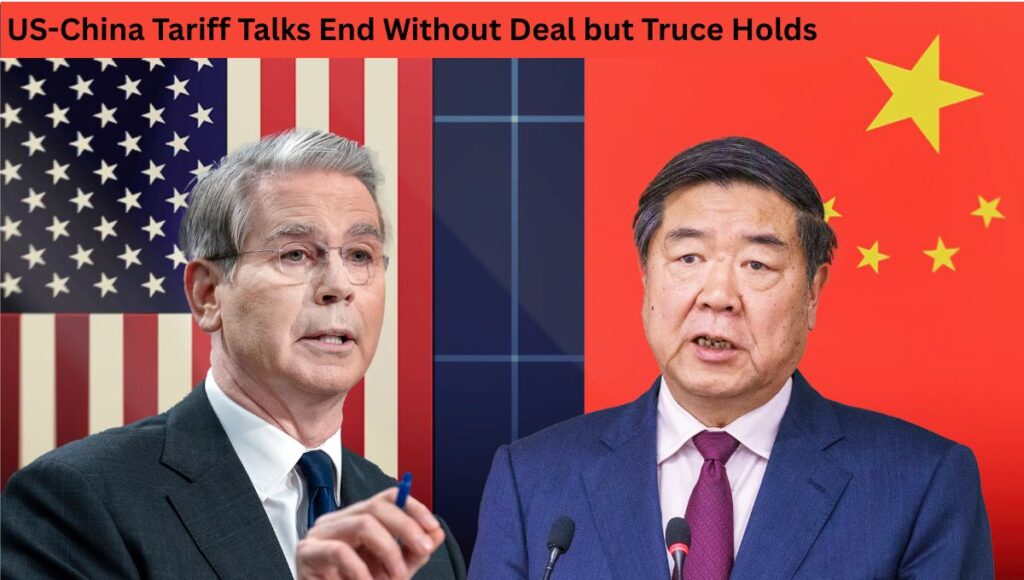
US-China Tariff Talks End Without Deal but Truce Holds
What Was on the Table in Stockholm?
Key Flashpoints Shaping the Global Trade Landscape
The Stockholm trade meetings were led by U.S. Treasury Secretary Scott Bessent and Trade Representative Jamieson Greer on the American side, and Vice Premier He Lifeng and Trade Representative Li Chenggang for China.
Topics on the agenda reflected the complexity of modern global trade:
- Rare earth mineral exports
- Semiconductors and pharmaceuticals
- Section 232 trade investigations
- China’s oil purchases from Iran
- Fentanyl-related chemical exports
- Intellectual property rights
- Balanced trade practices and trade deficit reduction
Talks were held under high security near the Swedish Prime Minister’s office, signaling the seriousness both countries attach to avoiding a new phase in the ongoing trade war.
Rare Earths: The Critical Battleground
“We Don’t Ever Want to Talk About Magnets Again”
Among the most sensitive issues in the US-China trade talks was the export of rare earth minerals elements vital for semiconductors, military hardware, and green energy.
The U.S. pushed hard for assurances on consistent shipments after recent Chinese restrictions rattled tech and defense sectors globally.
U.S. trade negotiator Jamieson Greer joked, “We don’t ever want to talk about magnets again,” encapsulating the fatigue and frustration with the repeated conflict over these vital resources.
While no permanent agreement was reached, China did offer to resume rare earth exports temporarily, which U.S. officials acknowledged as a goodwill gesture, albeit a fragile one.
President Trump Holds the Final Word
“Not SEEKING Anything!” Trump’s Unpredictable Trade Posture
Despite progress in Stockholm, the real decision-making power lies in Washington specifically, with President Donald Trump.
As Secretary Bessent emphasized:
“Nothing is agreed until we speak with President Trump.”
Trump’s message from Scotland was characteristically blunt.
“I am not SEEKING anything! I may go to China, but it would only be at the invitation of President Xi… Otherwise, no interest!” he posted on Truth Social.
This cooled speculation about a potential Trump-Xi summit, but experts believe such a meeting could eventually become necessary to reach a comprehensive trade accord.
August 12 Looms Large: What Happens If Talks Collapse?
Tariff Rates Could Skyrocket, Crippling Global Supply Chains
The clock is ticking. If no formal agreement is in place by August 12, the current 90-day tariff truce will expire.
The consequences could be severe:
- U.S. tariffs on Chinese imports could rise from 30% to as high as 145%
- China could retaliate with tariffs of 100% or more
- Global markets and supply chains would face renewed turmoil
U.S. negotiator Greer noted,
“We’re looking at another 34% jump if a deal doesn’t materialize by August 12.”
A breakdown in talks would likely send shockwaves through equities, commodity markets, and consumer prices worldwide.
Fentanyl Trade Enters the Discussion
New Trade-Public Health Link Adds Complexity
For the first time, the fentanyl crisis made its way into the US-China trade talks. China raised the issue of U.S. sanctions on Chinese chemicals believed to be used in synthetic opioid production.
The U.S. had paused a planned 20% tariff in exchange for China’s move to add two fentanyl precursors to its list of controlled substances.
This shows a rare point of alignment between public health and trade policy but also introduces new diplomatic hurdles.
China’s Trade Strategy: Pragmatic, Assertive
Beijing Plays Long Game While Protecting Strategic Sectors
Chinese negotiator Li Chenggang described the talks as “comprehensive and in-depth,” reflecting both ambition and caution.
While China signaled interest in continued dialogue, it stopped short of any firm commitment to a longer-term truce.
Analysts say Beijing is playing a more experienced hand compared to Trump’s first term. The goal: avoid escalation while retaining leverage in rare earths, AI, and pharmaceuticals.
“Beijing has learned lessons… they won’t buy into a one-sided deal this time,” said Wendy Cutler, former U.S. trade negotiator.
Russia and Iran: Geopolitics Bleed into Trade Talks
U.S. Warns China Over Russian Oil, Dual-Use Exports
Though Stockholm was ostensibly about trade, several geopolitical tensions emerged, complicating negotiations. Key among them:
- China’s ongoing purchase of Russian oil, in defiance of international sanctions
- Over $15 billion in dual-use exports to Russia
- Chinese shipments of tech components used in conflict zones
U.S. officials warned that new bipartisan legislation could authorize tariffs up to 500% on any country found aiding Russia’s war economy. Bessent was blunt:
“Anyone buying sanctioned Russian oil should be ready for this… The Chinese would prefer to pay a 100% tariff than surrender their sovereignty.”
Business Community Reacts: Stability Urged
Global Industries Fear Supply Chain Chaos
With billions in goods hanging in the balance, business leaders and economists are urging restraint from both governments.
“The increased US tariffs on steel, aluminum, copper, and automotive goods will harm the U.S. economy,” warned David A. Gantz of Rice University.
From China, exporters like Yuyao Huanchain Electric Co. which posted a 28% YoY increase in U.S. shipments also raised concerns.
“We’ve developed new products and strong customer loyalty to offset tariff impacts,” said company president Liu Min.
Trade Volatility Takes a Toll
Bilateral Trade Volume Drops in First Half of 2025
The economic impact of ongoing tariff threats is already visible:
- 9.3% YoY drop in U.S.-China trade during H1 2025
- 20.8% Q2 decline, reflecting growing uncertainty
- China remains top importer of Russian oil, with over 2 million barrels per day
Such statistics illustrate how uncertainty itself is a major disruptor, prompting firms to pause investments, reroute supply chains, or raise prices.
Trump’s Broader Trade Agenda
Tariffs with EU, Vietnam Complicate China Negotiations
President Trump’s aggressive “America First” strategy isn’t limited to China. He recently announced:
- 15% tariffs on EU goods, down from a proposed 30%
- Preliminary trade agreements with Vietnam (details pending)
- A temporary pause in enforcement of the U.S. TikTok ban
These parallel moves affect leverage in talks with Beijing, especially as U.S. industry braces for sweeping trade changes in a highly politicized environment.
“There’s plenty of horse trading left to do,” Commerce Secretary Howard Lutnick noted.
Cooperation Still Possible: Recent Concessions Show Flexibility
Signs of Goodwill as Both Sides Seek Common Ground
Despite the lack of a deal, both the U.S. and China made recent concessions to lower tensions:
- U.S. lifted its ban on Nvidia AI chip exports to China
- China paused antitrust probes into U.S. firms like DuPont
- China took steps to control fentanyl precursors
- U.S. responded by pausing a 20% fentanyl-linked tariff
These steps are not a full resolution, but they build the trust necessary for a larger deal.
Will a Trump-Xi Summit Happen?
Face-to-Face May Be the Only Way to Break the Deadlock
There is no current plan for a Trump-Xi summit, but analysts suggest it may be the only path to a long-term trade framework.
“Whether there’s a deal or not, I can’t say… but the conversations are constructive,” Greer told MSNBC.
With only days remaining before the August 12 deadline, such a high-level meeting if it happens would need to be arranged quickly and carefully.
Conclusion: A Pause, Not a Peace
Stockholm Talks Buy Time but Not Resolution
The Stockholm US-China trade talks did not deliver a breakthrough. But they did extend the tariff truce, providing breathing room and averting immediate economic chaos.
As President Trump prepares to announce his decision, global investors, manufacturers, and policymakers remain on edge. Whether the pause leads to peace or merely delays the next round of escalation will depend on what happens next in Washington. “The future of global trade hinges not only on economics, but on diplomacy, politics, and trust.”
Also Read: No deal on China tariffs until Trump agrees, says Bessent
Also Read: US-China Trade Talks in Stockholm: Truce Extension, Fentanyl Tariffs, and Rare Earth Deal in Focus
Related Posts:
- US-China Trade Talks in Stockholm: Truce Extension,…
- 7 Powerful Signals US-Ukraine Peace Talks Are…

- Trump says India Working Toward Trade Deal Similar…
- 7 Powerful Revelations from New Ukraine Peace Talks…

- 9 High-Stakes Moves: US-Iran Nuclear Talks Show…
- 10 Critical Breakthroughs in US–Iran Peace Talks in Pakistan