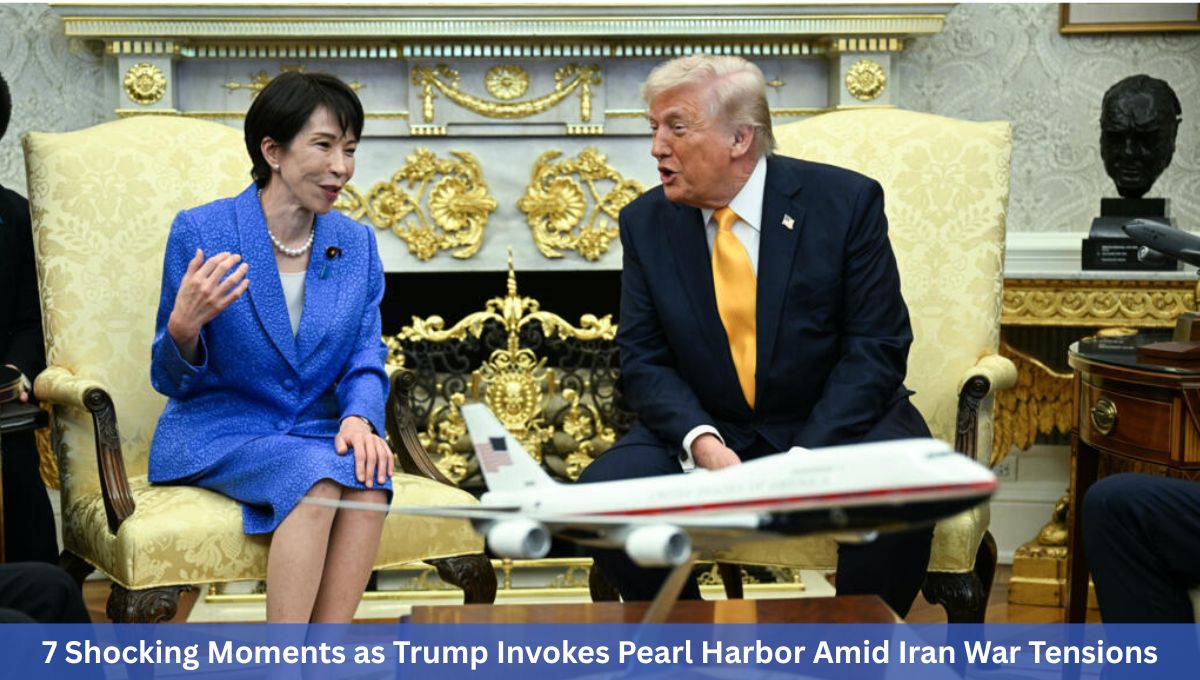
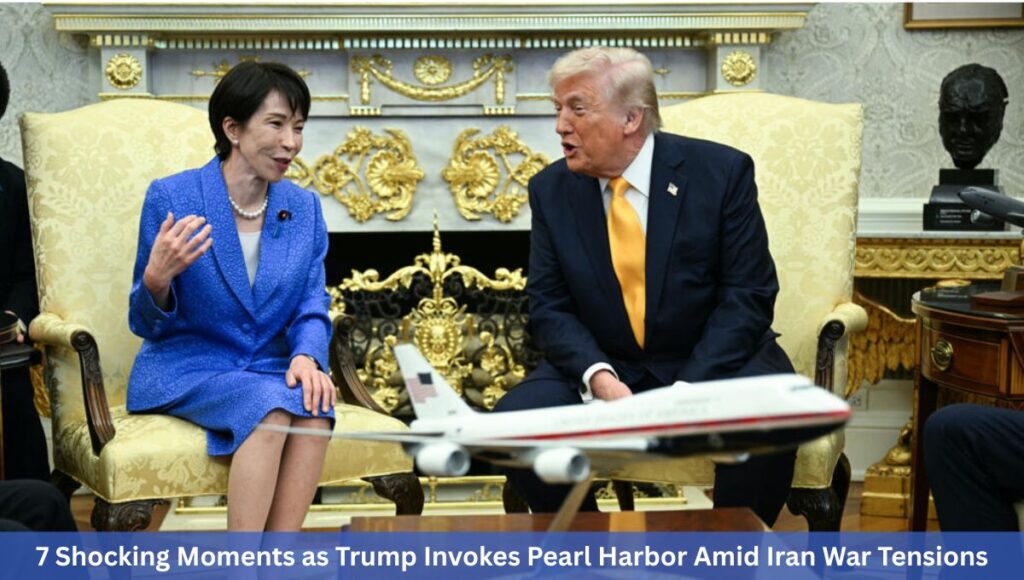
7 Shocking Moments as Trump Invokes Pearl Harbor Amid Iran War Tensions, turning global headlines. A high-level diplomatic meeting between US President Donald Trump and Japan’s Prime Minister Sanae Takaichi took an unexpected and controversial turn, sparking global debate and media attention.
What began as a strategic discussion on the escalating Iran war quickly shifted into a moment that blended history, geopolitics, and rhetoric—when Trump invoked the 1941 Pearl Harbor attack.
The remark, delivered during a press interaction in the Oval Office, stunned observers and highlighted the increasingly unpredictable tone of global diplomacy amid one of the most volatile geopolitical crises in recent years.
As tensions rise in the Middle East, and as the United States navigates its role in the Iran conflict, this single moment reflects deeper complexities:
shifting alliances, energy security concerns, military strategy, and the delicate balance of international relations.
7 Shocking Moments as Trump Invokes Pearl Harbor Amid Iran War Tensions
The Pearl Harbor Remark That Sparked Controversy
A Question That Changed the Tone
During the press briefing, a Japanese journalist asked why the United States did not inform its allies, including Japan, before launching strikes on Iran.
It was a straightforward question—one that typically invites a measured diplomatic response. Instead, Trump responded by defending the element of surprise in military strategy.
He stated that revealing plans in advance would undermine operational effectiveness, emphasizing that secrecy was critical to the success of the strikes.
The Unexpected Historical Reference
What followed caught many off guard.
Trump remarked:
“We wanted surprise. Who knows better about surprise than Japan? Why didn’t you tell me about Pearl Harbor?”
The reference to the Japanese attack on Pearl Harbor in 1941—an event that led to the United States entering World War II—instantly shifted the atmosphere in the room.
Visible Reaction from Japan’s Prime Minister
Observers noted that Prime Minister Sanae Takaichi appeared visibly uncomfortable. Her expression changed, and she shifted in her seat, choosing not to respond to the remark.
The moment quickly went viral across global media and social platforms, with reactions ranging from amusement to criticism.
Understanding the Historical Sensitivity
What Was Pearl Harbor?
The attack on Pearl Harbor, carried out by Japan on December 7, 1941, remains one of the most significant events in modern history.
It resulted in the deaths of over 2,400 Americans and marked the United States’ entry into World War II.
The event holds deep emotional and historical significance for both countries, despite their strong alliance today.
Why the Reference Matters Today
Referencing Pearl Harbor in a modern diplomatic context is highly sensitive because:
- It recalls wartime hostility between two now-close allies
- It evokes memories of loss and conflict
- It risks being perceived as inappropriate or dismissive
While Trump’s comment appeared intended as a rhetorical or humorous remark, its historical weight made it far more consequential.
Trump’s Position on Troop Deployment
A Clear Statement: No New Troops
During the same briefing, Trump addressed questions about US military involvement in the Middle East.
He stated:
- The United States is not currently planning to deploy additional troops
- If such plans existed, they would not be publicly disclosed
- The US will take necessary actions to protect its interests
This statement signals a cautious approach, despite the escalating conflict.
Contradictions and Strategic Ambiguity
Interestingly, Trump’s remarks come amid reports suggesting that the administration is considering sending additional troops to the region.
This creates a pattern of strategic ambiguity, where:
- Public statements emphasize restraint
- Behind-the-scenes discussions indicate possible escalation
Such contradictions can create uncertainty among allies and adversaries alike.
The Iran War: A Rapidly Escalating Conflict
Background of the Conflict
The ongoing war involving the United States, Israel, and Iran has intensified over recent weeks, with:
- Airstrikes targeting Iranian infrastructure
- Retaliatory missile and drone attacks
- Rising tensions across the Gulf region
The conflict has quickly evolved into a broader geopolitical crisis with global implications.
The Role of Surprise in Military Strategy
Trump’s defense of secrecy highlights a key military principle: surprise.
By not informing allies, the US aimed to:
- Maximize operational impact
- Minimize advance warnings to Iran
- Achieve rapid initial success
Trump claimed that the first phase of the operation exceeded expectations, suggesting that surprise played a crucial role.
Japan’s Delicate Position in the Crisis
Energy Dependence on the Middle East
Japan finds itself in a particularly vulnerable position due to its reliance on Middle Eastern energy supplies.
Key facts include:
- Over 90% of Japan’s crude oil imports come from the region
- A significant portion passes through the Strait of Hormuz
- Any disruption directly impacts Japan’s economy
Balancing Alliance and Neutrality
Japan must navigate a complex balancing act:
- Maintaining its alliance with the United States
- Avoiding direct military involvement
- Preserving diplomatic relations with Iran
This balancing act is made even more difficult by domestic political constraints.
The Strait of Hormuz: A Global Flashpoint
Why It Matters
The Strait of Hormuz is one of the world’s most critical energy chokepoints.
- Roughly 20% of global oil passes through it
- Disruptions can trigger global price spikes
- It is a key strategic target in the Iran conflict
US Pressure on Allies
Trump has repeatedly urged allies, including Japan, to:
- Deploy naval forces
- Help secure shipping lanes
- Share the burden of maintaining stability
However, his messaging has been inconsistent, alternating between:
- Demanding support
- Claiming the US does not need assistance
Mixed Signals from Washington
“We Don’t Need Help” vs “Step Up”
Trump’s statements reflect a broader inconsistency:
- He insists the US can handle the situation alone
- Simultaneously calls on allies to contribute
This dual messaging creates confusion and diplomatic tension.
Impact on Allies
Countries like Japan and South Korea face difficult decisions:
- Support the US and risk entanglement
- Stay neutral and risk straining alliances
This uncertainty complicates global coordination efforts.
Sanae Takaichi’s Diplomatic Strategy
Maintaining Composure
Despite the awkward moment, Takaichi handled the situation carefully:
- She did not respond to the Pearl Harbor remark
- She maintained a composed and diplomatic demeanor
- She focused on broader strategic discussions
Expressing Support for Trump
In a notable statement, she expressed strong confidence in Trump:
- Calling him a key figure in achieving global peace
- Emphasizing cooperation with international partners
This approach reflects a pragmatic strategy aimed at preserving relations.
Global Economic Implications
Rising Oil Prices
The Iran conflict has already impacted global markets:
- Oil prices are rising sharply
- Supply chains face disruptions
- Inflation risks are increasing
Impact on Global Economies
Countries heavily dependent on energy imports are particularly affected:
- Japan
- India
- European nations
Economic instability could become one of the most significant consequences of the conflict.
Public and Political Reactions
Supporters vs Critics
Trump’s remark has divided opinion:
Supporters argue:
- It was a humorous or rhetorical comment
- It reflects his direct communication style
Critics argue:
- It was inappropriate in a diplomatic setting
- It risked undermining US-Japan relations
Social Media Amplification
The moment quickly spread online, amplifying:
- Public scrutiny
- Political debate
- International reactions
The Bigger Picture: Diplomacy in a Time of Crisis
Evolving Nature of Leadership
The incident reflects a broader shift in global leadership styles:
- More direct and unconventional communication
- Greater reliance on media-driven narratives
- Increased unpredictability
Challenges for Global Stability
Such dynamics create challenges for:
- Diplomatic coordination
- Crisis management
- Alliance stability
7 Key Takeaways from the Incident
1. Trump Prioritizes Strategic Surprise
Secrecy remains central to US military operations in Iran.
2. Pearl Harbor Reference Sparked Global Debate
The historical analogy drew widespread attention and criticism.
3. No Immediate Plan for More US Troops
Trump publicly ruled out additional deployments—for now.
4. Allies Face Growing Pressure
Countries like Japan are being asked to play a bigger role.
5. Japan Walks a Diplomatic Tightrope
Balancing alliance obligations with domestic constraints.
6. Energy Security Is a Major Concern
The Strait of Hormuz remains a critical flashpoint.
7. Global Markets Are Feeling the Impact
Oil prices and economic uncertainty continue to rise.
Conclusion: A Defining Moment in a Volatile Era
The meeting between Donald Trump and Sanae Takaichi will likely be remembered not just for its policy discussions, but for a single remark that captured the complexity of modern geopolitics.
In an era defined by rapid escalation, shifting alliances, and economic uncertainty, even brief moments can carry significant weight.
Trump’s Pearl Harbor comment underscores the challenges of balancing rhetoric with diplomacy—especially when the stakes involve global security, historical memory, and international cooperation.
As the Iran conflict continues to unfold, the world will be watching closely—not only for military developments, but for the words and actions that shape the path forward.
Also Read: 7 Explosive Ways Donald Trump Pressures Japan Over Iran War at High-Stakes White House Meeting
Also Read: Trump invokes Pearl Harbor in front of Japanese prime minister to defend Iran attack secrecy
Related Posts:
- 5 Powerful Highlights as Trump Lands Second Nobel…

- 10 Powerful Revelations from the Trump–Putin Call on…
- Sanae Takaichi Becomes Japan’s First Female Prime…

- 7 Crucial Insights Into Trump and Xi’s High-Stakes…
- 7 Powerful Measures: Trump Sanctions Russian Oil…

- Trump's 3 Blunt Warnings to China and Russia Over…