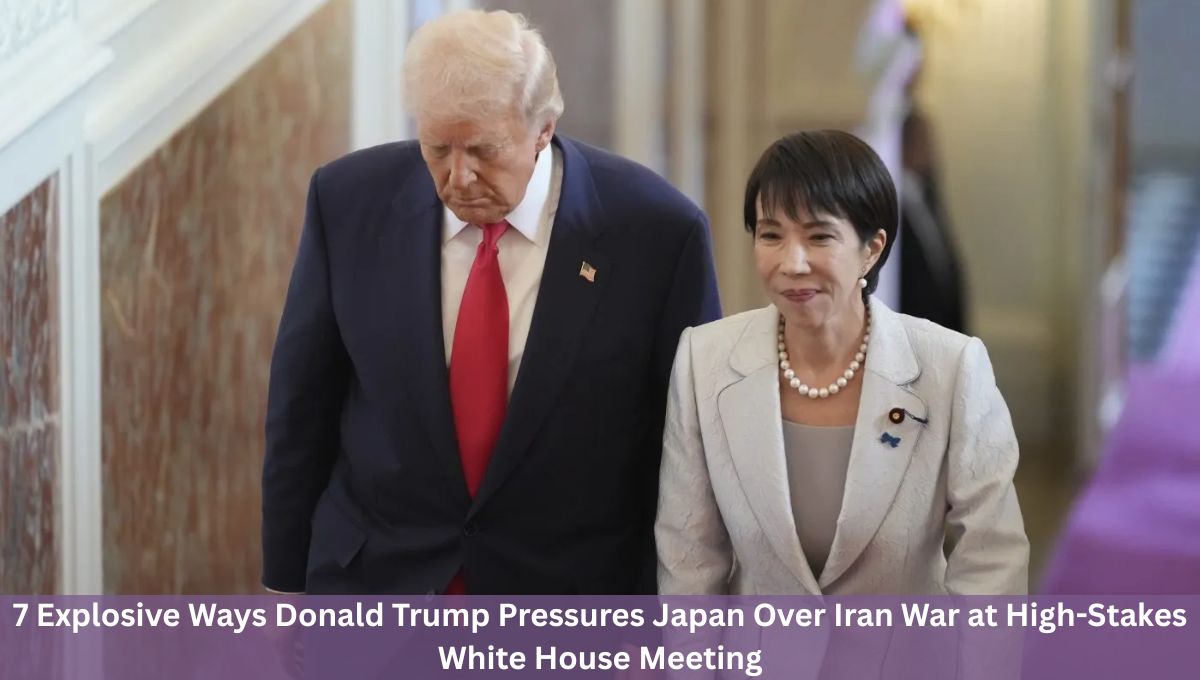
7 Explosive Ways Donald Trump Pressures Japan Over Iran War at High-Stakes White House Meeting, raising global security concerns. As the war involving Iran intensifies and spreads across the Middle East, a critical diplomatic moment is unfolding in Washington. Donald Trump is set to meet Sanae Takaichi at the White House, a meeting that was initially planned to strengthen economic and strategic ties but has now been overshadowed by the escalating conflict.
Thank you for reading this post, don't forget to subscribe!What was once expected to be a routine summit has transformed into a high-pressure geopolitical negotiation.
The central issue:
whether Japan will support the United States in securing the Strait of Hormuz and potentially contribute to military or logistical operations related to the Iran war.
This meeting is not just about bilateral relations—it has implications for global energy markets, international law, and the balance of power across multiple regions.
7 Explosive Ways Donald Trump Pressures Japan Over Iran War at High-Stakes White House Meeting
Why the Strait of Hormuz Is the Center of Attention
A Strategic Lifeline for Global Energy
The Strait of Hormuz is one of the most critical chokepoints in the global energy system.
Roughly one-fifth of the world’s oil supply passes through this narrow waterway. Any disruption here sends shockwaves across global markets.
Iran’s actions in the region—targeting shipping routes and threatening energy infrastructure—have already led to:
- Rising oil prices
- Supply chain disruptions
- Increased geopolitical risk premiums
For Japan, the stakes are even higher. The country depends on the Strait for over 90% of its oil imports, making stability in the region essential for its economic survival.
Trump’s Push for Allied Support
Despite publicly stating that the United States does not need help, Trump has repeatedly called on allies—including Japan—to contribute ships and resources to secure the Strait.
His argument is straightforward:
Countries that benefit most from the energy flow should help protect it.
However, this demand has created tension. Many US allies, including European nations, have declined to participate in any Gulf mission, citing legal, political, and security concerns.
Japan now finds itself at the center of this diplomatic pressure.
Japan’s Dilemma: Alliance vs Constitution
The Limits of Japan’s Pacifist Constitution
Japan’s post-World War II constitution strictly limits the use of military force. The Japanese Self-Defense Forces (JSDF) are permitted to act only in defensive scenarios.
Although reforms in 2015 introduced the concept of “collective self-defense,” allowing limited support to allies, the threshold remains extremely high.
Any deployment must meet strict legal criteria, including:
- A direct threat to Japan’s survival
- Lack of alternative solutions
- Parliamentary and public support
Currently, Tokyo does not classify the Iran conflict as a “survival-threatening situation.”
Domestic Political Pressure
Public opinion in Japan strongly opposes involvement in the Iran war.
Polls indicate that a vast majority of citizens do not support US-led military actions in the region.
For Prime Minister Sanae Takaichi, this creates a political tightrope:
- Supporting the US risks domestic backlash
- Refusing support risks damaging the US-Japan alliance
This balancing act makes the White House meeting exceptionally delicate.
What Trump Might Ask From Japan
The most immediate request is likely for Japan to deploy naval vessels to:
- Escort oil tankers
- Clear mines
- Support maritime security operations
However, sending ships into a potential conflict zone would push Japan to the edge of its constitutional limits.
2. Missile Production and Defense Cooperation
Another likely area of discussion is defense manufacturing.
The US has reportedly depleted significant munitions stockpiles due to ongoing conflicts, including the Iran war and the war in Ukraine.
Trump may push Japan to:
- Co-develop missile systems
- Increase defense production
- Support advanced military technologies
This aligns with Japan’s growing focus on strengthening its defense capabilities, but it also raises questions about militarization.
3. Financial and Economic Contributions
Japan has already committed massive investments in the United States, including a broader $550 billion trade framework.
During the meeting, Tokyo may:
- Announce additional investments
- Expand cooperation in energy and critical minerals
- Strengthen supply chain partnerships
These economic contributions could serve as an alternative to direct military involvement.
Japan’s Possible Responses
A Diplomatic Middle Path
Rather than committing to military action, Japan is likely to pursue a hybrid approach that includes:
- Intelligence sharing
- Logistical support
- Refueling operations
- Diplomatic mediation
Japan’s long-standing diplomatic ties with Tehran position it as a potential intermediary, although past mediation efforts have had limited success.
Avoiding Direct Military Engagement
Experts widely agree that Japan is unlikely to deploy combat forces in the current phase of the conflict.
Instead, Tokyo may emphasize:
- Post-conflict reconstruction support
- Maritime security after hostilities end
- International coalition-building
This allows Japan to contribute without violating constitutional constraints.
The Broader Geopolitical Context
China and the Indo-Pacific Factor
The meeting is also influenced by tensions in East Asia. Japan is increasingly concerned about China’s growing military presence, particularly around Taiwan.
Sanae Takaichi is expected to remind Donald Trump that:
- The Indo-Pacific remains a critical strategic priority
- US troop redeployments to the Middle East could weaken regional deterrence
- China’s actions require sustained attention
This adds another layer of complexity to the discussions.
Global Energy Shockwaves
The Iran conflict has already triggered:
- Oil prices nearing $100–$110 per barrel
- Increased inflation pressures worldwide
- Supply disruptions across Asia and Europe
For countries heavily dependent on energy imports—like Japan—the stakes are immediate and severe.
A Test of the US–Japan Alliance
Historical Context
The US-Japan alliance has long been a cornerstone of global stability. However, moments like this test its resilience.
During the 1991 Gulf War, Japan faced criticism for contributing financially rather than militarily—a strategy labeled “checkbook diplomacy.”
Today, Tokyo is trying to avoid repeating that perception while still adhering to its legal and political constraints.
Trump’s Leverage
Trump holds significant leverage over Japan through:
- Security guarantees (including US troop presence)
- Trade policies and tariffs
- Defense cooperation agreements
This gives Washington the upper hand in negotiations, increasing pressure on Tokyo to offer meaningful support.
Potential Outcomes of the Meeting
Scenario 1: Limited Support Agreement
Japan agrees to:
- Non-combat logistical support
- Increased intelligence sharing
- Economic cooperation
This is the most likely outcome.
Scenario 2: Expanded Defense Cooperation
Tokyo commits to:
- Missile development
- Defense technology partnerships
- Greater military readiness
This strengthens the alliance without direct war involvement.
Scenario 3: Diplomatic Initiative
Japan positions itself as a mediator between the US and Iran, leveraging its diplomatic ties to de-escalate tensions.
Scenario 4: Strategic Tensions
If Japan refuses to provide sufficient support, it could lead to:
- Strained US-Japan relations
- Increased pressure from Washington
- Shifts in alliance dynamics
Why This Meeting Matters Globally
This is not just a bilateral discussion—it has global consequences.
Key Implications
- Energy Security: Stability in the Strait of Hormuz affects every major economy
- Military Alliances: The outcome could redefine how allies respond to US-led conflicts
- Geopolitical Balance: The focus on the Middle East may shift attention away from Asia
- Economic Impact: Oil prices and supply chains will respond to any escalation or stabilization
The Human and Political Reality
Behind the strategic calculations lies a deeper reality:
political survival.
For Sanae Takaichi, the challenge is to return home without:
- Committing to an unpopular war
- Damaging Japan’s alliance with the US
- Undermining Japan’s constitutional principles
For Donald Trump, the goal is to:
- Build a coalition of support
- Reduce US burden in the conflict
- Strengthen his geopolitical position
Conclusion: A Defining Diplomatic Moment
The White House meeting between Donald Trump and Sanae Takaichi represents a defining moment in global geopolitics.
It encapsulates the tensions between:
- Military power and legal constraints
- Alliance obligations and national interests
- Immediate conflict and long-term strategy
As the Iran war continues to reshape the global order, the decisions made in this meeting could influence not just the trajectory of the conflict, but the future of international cooperation itself.
Whether Japan steps forward, holds back, or charts a middle course, the world will be watching closely.
Also Read: 10 Explosive Reasons Trump Says “We Don’t Need Oil” Amid Hormuz Crisis
Also Read: Japan PM Takaichi Meets Trump As US Seeks Support On Iran War, Hormuz Security
Related Posts:
- 5 Powerful Highlights as Trump Lands Second Nobel…

- 12 Explosive Shifts as Japan’s Iron Lady Takaichi…

- Sanae Takaichi Becomes Japan’s First Female Prime…

- 12 Explosive Claims as Donald Trump Says Iran War…
- 11 Explosive Warnings as Trump Vows to ‘Knock the…

- 10 Powerful Revelations from the Trump–Putin Call on…