
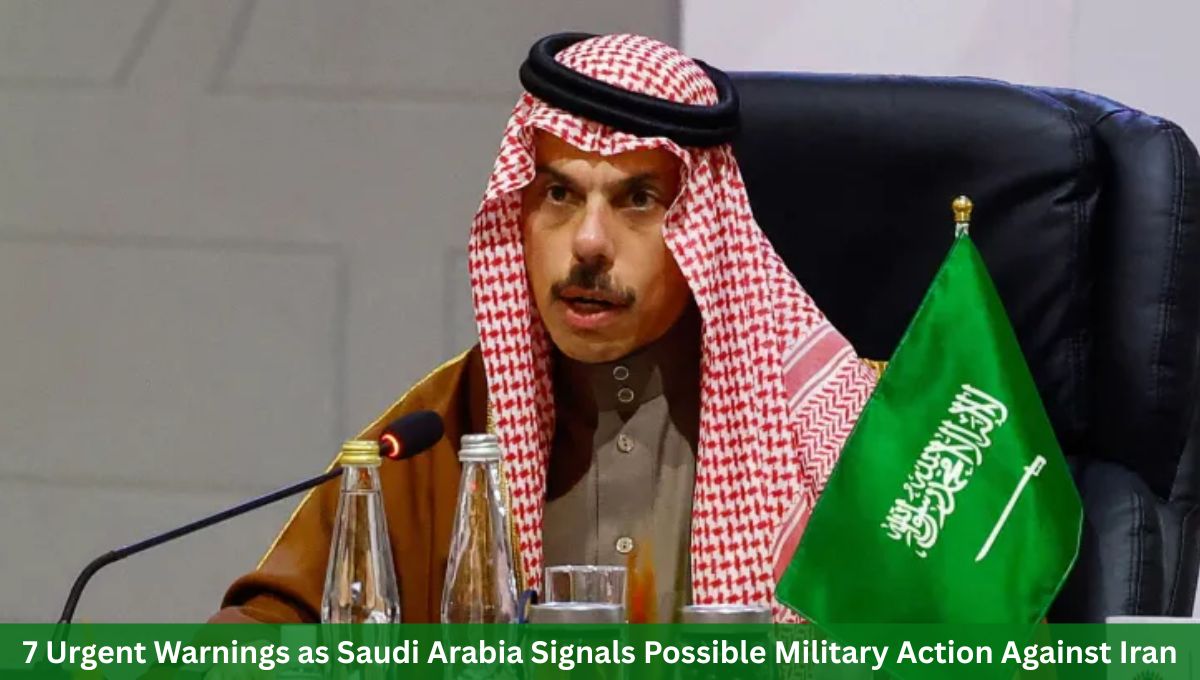
7 Urgent Warnings as Saudi Arabia Signals Possible Military Action Against Iran as tensions near breaking point. The Middle East crisis has entered a dangerous new phase, with Saudi Arabia issuing one of its strongest warnings yet to Iran. As missile and drone attacks target key energy infrastructure across the Gulf, Riyadh has made it clear that its patience is “not unlimited.”
Saudi Foreign Minister Prince Faisal bin Farhan Al Saud’s remarks signal a potential shift from defensive restraint to active retaliation. His warning comes amid escalating strikes on energy facilities in Qatar, the United Arab Emirates (UAE), and Saudi Arabia itself—raising fears of a broader regional war.
With global oil prices already surging and supply chains under pressure, the stakes extend far beyond the region.
What began as a conflict centered on Iran and Israel is now threatening to engulf multiple Gulf nations, disrupt global energy markets, and destabilize the international economy.
7 Urgent Warnings as Saudi Arabia Signals Possible Military Action Against Iran
Saudi Arabia’s Warning: “Patience Is Not Unlimited”
A Direct Message to Iran
Saudi Arabia’s Foreign Minister delivered a blunt and calculated message to Tehran:
stop attacking Gulf nations immediately or face consequences.
Prince Faisal emphasized that:
- Iran’s attacks appear premeditated and strategically planned
- Gulf nations possess significant military capabilities
- Continued aggression could trigger direct military action
His statement avoided detailing specific triggers for retaliation, signaling strategic ambiguity while reinforcing deterrence.
Strategic Ambiguity and Deterrence
By refusing to outline a clear red line, Saudi Arabia is maintaining flexibility in its response.
This approach:
- Keeps Iran uncertain about potential consequences
- Preserves escalation control
- Signals readiness without committing to immediate action
However, the warning that patience could run out “in a day, two days, or a week” suggests urgency and growing frustration.
Escalation Across the Gulf: What Happened?
Iran’s Expanding Strike Campaign
Since late February, Iran has broadened its retaliation strategy beyond Israel to include Gulf nations.
Key developments include:
- Missile strikes targeting Riyadh, Saudi Arabia’s capital
- Attacks on Qatar’s Ras Laffan Industrial City
- Drone and missile threats against UAE energy facilities
Saudi Arabia reported intercepting multiple ballistic missiles aimed at its territory, while the UAE neutralized dozens of drones and missiles.
Energy Infrastructure Under Attack
The most alarming aspect of the escalation is the targeting of critical energy infrastructure:
- Oil refineries in Saudi Arabia
- LNG facilities in Qatar
- Gas facilities in the UAE
These attacks are not just military actions—they are strategic attempts to disrupt the global energy system.
Qatar and UAE in the Crosshairs
Ras Laffan: A Global Energy Lifeline
Qatar’s Ras Laffan Industrial City—home to the world’s largest LNG production facilities—has been repeatedly targeted.
The consequences include:
- Fires and significant damage to infrastructure
- Temporary shutdowns affecting global supply
- Heightened security risks for energy exports
Ras Laffan alone accounts for a major share of global LNG production, making it a critical node in the global energy network.
UAE Facilities Targeted
Iranian strikes also extended to the UAE:
- Habshan gas facility faced missile threats
- Bab oil field targeted
- Operations temporarily suspended due to debris
Although many attacks were intercepted, the disruption itself has significant economic implications.
Saudi Arabia’s Position: Defence First, But Options Open
Right to Military Action
Saudi Arabia has made it clear that it reserves the right to respond militarily if necessary.
Prince Faisal stated that the Kingdom will:
- Use all available tools—political, economic, and military
- Protect its territory and economic resources
- Act decisively if attacks continue
This marks a shift toward a more assertive posture compared to earlier restraint.
Focus on Protecting Stability
Despite the strong language, Saudi Arabia continues to emphasize:
- Ending attacks on Gulf nations
- Avoiding broader regional conflict
- Maintaining stability in global energy markets
However, the balance between restraint and retaliation is becoming increasingly fragile.
“Trust Completely Shattered”: Diplomatic Fallout
Breakdown in Saudi-Iran Relations
Saudi Arabia and Iran had begun rebuilding ties in recent years, but the latest attacks have undone much of that progress.
Prince Faisal stated that:
- Trust in Iran has been “completely shattered”
- Rebuilding relations could take years
- Continued attacks may make reconciliation impossible
Accusations of Premeditation
Saudi officials argue that Iran’s actions are not reactive but part of a long-term strategy:
- Targeting neighbors to exert pressure
- Using energy infrastructure as leverage
- Coordinating attacks with precision
This perception makes diplomatic resolution more difficult.
Regional Response: A United Front Emerging
Arab and Islamic Nations React
A meeting of foreign ministers from multiple countries in Riyadh highlighted growing regional unity.
Key points from the joint response:
- Strong condemnation of attacks on civilian infrastructure
- Calls for Iran to respect international law
- Emphasis on protecting regional stability
Countries involved included:
- Saudi Arabia
- Qatar
- UAE
- Turkey
- Egypt
- Pakistan
Collective Security Concerns
The attacks have created a shared sense of vulnerability among Gulf nations:
- Energy facilities are critical economic assets
- Civilian infrastructure is increasingly at risk
- Regional cooperation is becoming essential
Energy Crisis: Global Impact Intensifies
Oil Prices Surge
The escalation has already affected global markets:
- Oil prices rising toward $110 per barrel
- Increased volatility in energy markets
- Concerns over long-term supply disruptions
LNG Supply at Risk
Liquefied natural gas (LNG) markets are also under pressure:
- Qatar is a major global supplier
- Disruptions affect Asia, Europe, and emerging markets
- Prices likely to remain elevated
Strait of Hormuz Tensions
The Strait of Hormuz remains a critical chokepoint:
- Handles about 20% of global oil supply
- Increased military activity raising risks
- Shipping disruptions impacting global trade
Why Energy Infrastructure Is a Strategic Target
Economic Warfare
Targeting energy facilities is a form of economic warfare:
- Disrupts revenue streams
- Weakens economic stability
- Creates global pressure
High-Impact Targets
Energy infrastructure offers:
- Maximum economic damage
- Global visibility
- Strategic leverage
However, it also increases the risk of widespread consequences.
Military Balance: Capabilities and Risks
Saudi Arabia’s Strength
Saudi Arabia possesses:
- Advanced air defense systems
- Significant financial and military resources
- Strong regional alliances
Iran’s Strategy
Iran’s approach includes:
- Missile and drone attacks
- Use of proxies
- Targeting critical infrastructure
Risk of Escalation
A direct military confrontation could lead to:
- Wider regional war
- Involvement of global powers
- Severe economic disruption
Global Reactions and Diplomatic Efforts
Calls for De-escalation
International leaders are urging restraint:
- Protection of civilian infrastructure
- Immediate halt to attacks
- Diplomatic solutions
Economic Concerns Worldwide
Countries around the world are watching closely:
- Rising energy costs impacting economies
- Inflationary pressures increasing
- Supply chain disruptions spreading
What Happens Next?
Possible Scenarios
- De-escalation through diplomacy
- Continued limited strikes and counterstrikes
- Full-scale regional conflict
Key Factors to Watch
- Iran’s next moves
- Saudi Arabia’s response
- Global diplomatic efforts
- Energy market reactions
Conclusion: A Region on the Edge
Saudi Arabia’s warning marks a critical moment in the Middle East crisis. With patience wearing thin and attacks continuing, the risk of escalation is higher than ever.
The targeting of energy infrastructure has transformed the conflict into a global concern, affecting markets, economies, and political stability worldwide. As tensions rise, the possibility of military retaliation looms large.
For now, the world is watching closely—hoping diplomacy can prevail before the situation spirals into a broader and more devastating conflict.
Also Read: 9 Shocking Escalations After Iran Strikes Gulf and Israel Amid Hormuz Crisis
Also Read: Arab-Islamic bloc condemns Iran strikes on Gulf states as Saudi Arabia signals military option
Related Posts:
- Saudi Arabia's 'Sleeping Prince' Dies After 20-Year Coma

- 3 Explosive Conditions Iran Sets to End War with US…
- Saudi Prince's Death: 5 Startling Findings from the…

- 10 Explosive Warnings as Donald Trump Calls Iran…
- 7 Stunning Strikes: Iran Claims Destruction of US…
- 10 Explosive Strikes: Israel Bombs Tehran Oil Depots…
