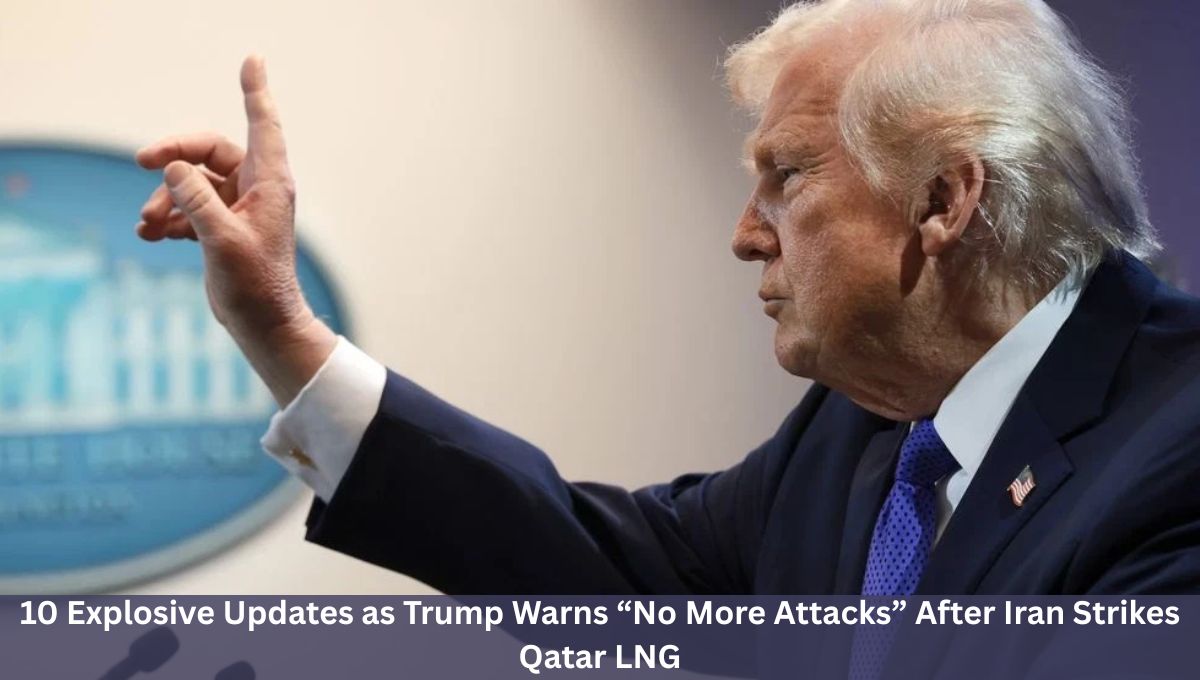
10 Explosive Updates as Trump Warns “No More Attacks” After Iran Strikes Qatar LNG — A dangerous turn in the middle east conflict. The ongoing conflict in the Middle East has entered a highly volatile phase, with energy infrastructure now becoming a central battlefield. Former U.S. President Donald Trump has issued a stark warning following Iran’s missile strikes on Qatar’s liquefied natural gas (LNG) facilities.
His statement signals a potential escalation that could reshape not only regional geopolitics but also the global energy landscape. Trump’s declaration that there will be “no more attacks” by Israel on Iran’s South Pars gas field—unless Iran strikes Qatar again—has introduced a fragile conditional deterrence.
However, his simultaneous threat to “massively blow up” the entire gas field if Iran continues its attacks has raised alarm worldwide. This development comes as Iran expands its retaliation strategy beyond military targets, striking energy facilities across the Gulf, including Qatar and the United Arab Emirates.
The consequences are already being felt in global oil markets, with prices surging and supply chains under strain.
10 Explosive Updates as Trump Warns “No More Attacks” After Iran Strikes Qatar LNG
Trump’s Warning: Conditional Peace or Escalation Threat?
What Trump Said
Donald Trump made it clear that Israel would refrain from further attacks on Iran’s South Pars gas field under one condition: Iran must not target Qatar again.
His message emphasized that Qatar is an “innocent” party in the conflict and should not be drawn into the war. However, the warning came with a severe caveat.
Trump stated that if Iran attacks Qatar’s energy infrastructure again, the United States would respond with overwhelming force—potentially destroying the entire South Pars gas field.
Implications of the Statement
This dual message reflects a mix of restraint and deterrence:
- Restraint: Attempt to prevent further Israeli strikes on critical energy infrastructure
- Deterrence: Strong warning aimed at Iran to halt attacks on Gulf nations
- Escalation Risk: Threat of massive retaliation raises stakes significantly
The statement also underscores the complexity of alliances and miscalculations in the region, particularly regarding whether the U.S. had prior knowledge of Israel’s actions.
Iran’s Attack on Qatar: What Happened?
Missile Strikes on LNG Facilities
Iran launched missile attacks targeting Qatar’s key LNG infrastructure, including facilities in Ras Laffan Industrial City.
These strikes caused:
- Large fires across multiple sites
- Significant structural damage
- Temporary shutdown of production
Despite the scale of the attack, no casualties were reported, and emergency crews managed to bring fires under control.
Why Qatar Matters Globally
Qatar plays a critical role in global energy supply:
- Supplies a major share of the world’s LNG
- Serves key markets in Asia and Europe
- Acts as a stabilizing force in energy pricing
Any disruption to its production has immediate ripple effects across global markets.
Israel’s Strike on South Pars: A Major Escalation
Why South Pars Is Crucial
The South Pars gas field is the largest natural gas reserve in the world. It is shared between Iran and Qatar and is vital to both nations.
Key facts:
- Accounts for a significant portion of Iran’s gas production
- Central to Iran’s domestic energy supply
- Critical for economic stability
Impact of the Strike
Israel’s attack marked a turning point in the conflict:
- First direct strike on major energy production infrastructure
- Triggered Iran’s retaliation against Gulf states
- Raised fears of long-term supply disruptions
Even partial damage to such a massive field can have lasting consequences.
Regional Fallout: Gulf Nations Under Pressure
United Arab Emirates and Saudi Arabia
Iran’s escalation did not stop with Qatar.
It extended to:
- UAE’s Habshan gas facility
- Bab oil field
- Missile threats toward Saudi infrastructure
Air defense systems intercepted several incoming threats, but the psychological and economic impact remains significant.
Diplomatic Tensions Rising
Gulf nations have responded strongly:
- Qatar expelled Iranian diplomatic staff
- UAE labeled the attacks a “dangerous escalation”
- Saudi Arabia warned of potential military responses
The region is now on edge, with countries trying to avoid full-scale involvement while defending critical assets.
Global Energy Markets: Shockwaves Begin
Oil Prices Surge
The attacks have already triggered a spike in oil prices:
- Brent crude rose sharply above $100 per barrel
- Markets reacting to supply disruption fears
- Volatility increasing across energy sectors
Strait of Hormuz Crisis
The Strait of Hormuz remains a critical chokepoint:
- Handles about one-fifth of global oil supply
- Disruptions affecting tanker traffic
- Increased risk premiums for shipping
Any prolonged disruption here could severely impact global trade and energy availability.
Why Energy Infrastructure Is Now a Target
Strategic Shift in Warfare
The conflict has shifted toward targeting economic lifelines:
- Oil and gas facilities as high-value targets
- Disrupting energy supply to weaken opponents
- Increasing global pressure for de-escalation
Long-Term Consequences
Damage to energy infrastructure is not easily repaired:
- Repairs can take years
- High costs and logistical challenges
- Potential for prolonged supply shortages
This makes such attacks particularly dangerous for global stability.
Europe and Global Reactions
Calls for De-escalation
Global leaders are urging restraint:
- Emphasis on protecting civilian infrastructure
- Calls for ceasefire or moratorium on energy strikes
- Diplomatic efforts intensifying
Economic Concerns
Europe and other regions are especially vulnerable:
- Increased dependence on LNG imports
- Risk of prolonged high energy prices
- Potential inflationary pressures
Emerging economies may face the hardest impact due to limited resources.
The Bigger Picture: A War Expanding Beyond Borders
From Regional Conflict to Global Crisis
The conflict is no longer confined to direct participants:
- Gulf nations increasingly involved
- Global energy markets destabilized
- Rising geopolitical tensions worldwide
Risk of Further Escalation
Key risks include:
- Direct confrontation between major powers
- Expanded targeting of infrastructure
- Disruption of global supply chains
The situation remains highly fluid, with each development carrying significant implications.
Conclusion: A Fragile Balance on the Brink
The latest developments highlight how quickly the Middle East conflict is evolving into a global crisis.
Trump’s warning represents an attempt to impose limits on escalation, but it also introduces new risks by raising the stakes dramatically.
Iran’s attacks on Qatar’s LNG facilities and Israel’s strike on South Pars have crossed a critical threshold—bringing energy infrastructure into the center of warfare.
This shift has immediate consequences for global markets and long-term implications for geopolitical stability. As tensions continue to rise, the world watches closely.
Whether diplomacy can contain the situation or whether further escalation is inevitable remains uncertain.
What is clear, however, is that the stakes have never been higher—not just for the region, but for the global economy and energy security.
Also Read: 7 Shocking Oil Tanker Attacks Near Iraq: Iran Strikes Ignite Global Energy Crisis
Also Read: Europe scrambles to limit effects of energy escalation in Iran war