
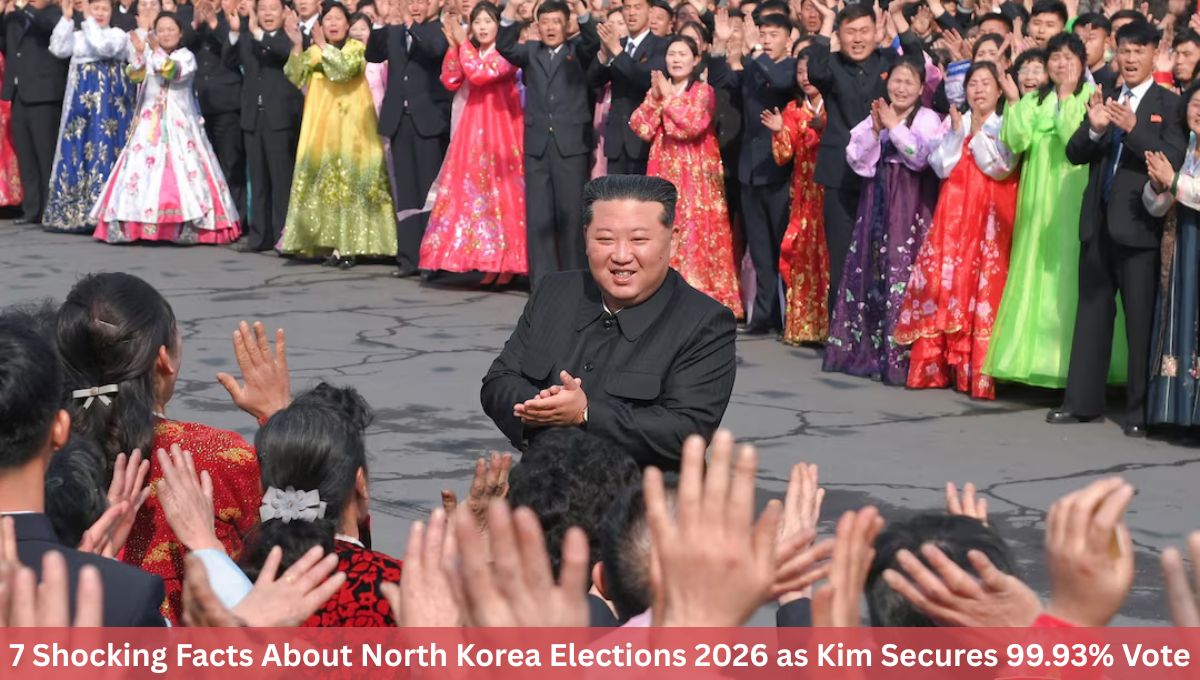
7 Shocking Facts About North Korea Elections 2026 as Kim Secures 99.93% Vote, with a rare 0.07% dissent. In a political system where electoral outcomes are rarely uncertain, North Korea has once again delivered a near-unanimous result.
The 2026 parliamentary elections saw an overwhelming 99.93% vote in favour of candidates backed by the ruling establishment, reinforcing Kim Jong Un’s dominance over one of the world’s most tightly controlled political systems.
Yet, beyond the headline figures lies a deeper story—one that includes a rare acknowledgment of dissent, a sweeping reshuffle of political elites, and signals that could shape the country’s domestic and foreign policy trajectory in the years ahead.
This article breaks down the key developments, what they mean, and why the world is paying closer attention this time.
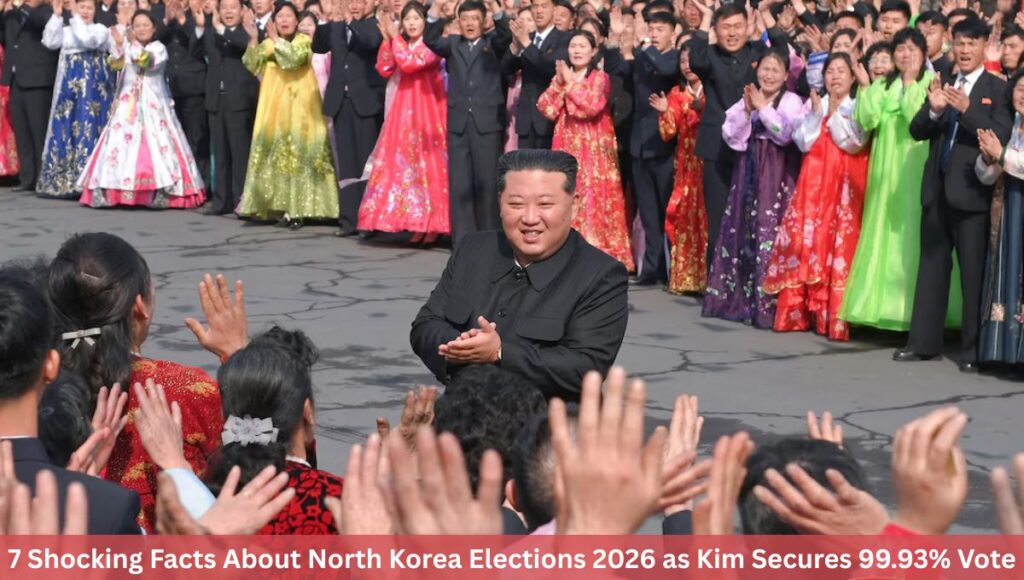
7 Shocking Facts About North Korea Elections 2026 as Kim Secures 99.93% Vote
North Korea Elections 2026: A Near-Perfect Victory
North Korea held its parliamentary elections on March 15, 2026, to select 687 deputies for the 15th Supreme People’s Assembly (SPA), the country’s legislature.
According to official figures:
- 99.93% voted in favour of candidates
- Voter turnout reached 99.99%
- All 687 seats were won by the ruling alliance
Such numbers are consistent with past elections in North Korea, where the political system ensures near-total support for leadership-approved candidates.
Unlike democratic systems, voters in North Korea are typically presented with only one candidate per constituency.
Their role is not to choose between competing options, but to either approve or reject a pre-selected nominee. This structure effectively guarantees the outcome.
What Makes the 2026 Election Different?
Despite the predictability of the results, the 2026 election stands out for several reasons.
1. A Massive Political Reshuffle
More than 70% of deputies are new faces, marking one of the most significant political shake-ups in recent years.
This suggests a deliberate effort to:
- Consolidate loyalty within the system
- Remove older or potentially independent power centers
- Bring in a younger, more aligned leadership
Such large-scale turnover is rare and indicates a strategic restructuring rather than routine renewal.
2. Rise of Key Loyalists
Several figures close to the leadership have gained prominence:
- Senior aides are expected to take top parliamentary roles
- Influential insiders have secured seats in the assembly
- Family members continue to play a critical role in governance
This consolidation reinforces a centralised power structure where loyalty is a primary qualification for advancement.
3. Removal of Veteran Figures
Equally notable is the exclusion of long-standing political figures from key roles.
The removal of senior leaders suggests:
- A shift in internal power dynamics
- Possible disagreements or loss of favour
- A broader generational transition within the political elite
Such changes often signal internal recalibration rather than instability.
The 0.07% Dissent: Why It Matters
Perhaps the most widely discussed figure from the election is the 0.07% of votes cast against candidates.
On the surface, this appears insignificant. However, in the context of North Korea, it is highly unusual.
Why Is This Significant?
- It is reportedly the first acknowledged dissent since 1957
- North Korean elections rarely admit any opposition
- Even symbolic dissent carries political meaning
How Voting Works in Reality
While voters technically have the option to reject a candidate, doing so involves:
- Using a separate, non-secret process
- Publicly marking opposition
- Risking scrutiny or consequences
This makes genuine dissent extremely rare.
So What Does 0.07% Really Mean?
Experts believe this figure is likely:
- Symbolic rather than genuine
- Intended to create an illusion of democratic choice
- A controlled way to project limited tolerance for dissent
In essence, it may be a calculated move rather than an organic outcome.
Understanding North Korea’s Electoral System
To understand these results, it’s essential to examine how elections function in North Korea.
A One-Party Dominant System
North Korea operates under a system led by the ruling party, with minor allied parties that do not provide real competition.
Key characteristics include:
- Centralised candidate selection
- State-controlled media
- Limited political expression
No Real Opposition
There are no independent opposition parties in the conventional sense.
Instead:
- All candidates are pre-approved
- Political diversity is absent
- Elections serve as endorsements, not contests
Elections as a Political Ritual
Rather than determining leadership, elections in North Korea function as:
- A demonstration of unity
- A mechanism for political mobilisation
- A tool for legitimising leadership decisions
This explains the consistently high turnout and near-unanimous results.
What Happens Next: The Role of the Assembly
Following the election, the Supreme People’s Assembly will convene in Pyongyang.
Key Decisions Expected
The upcoming session is likely to:
- Reappoint Kim Jong Un as head of the State Affairs Commission
- Approve leadership positions across the government
- Endorse policy directions set by the ruling party
Potential Constitutional Changes
One of the most closely watched developments is the possibility of constitutional revisions.
Observers suggest the assembly may:
- Redefine relations with South Korea
- Officially label the South as a hostile state
- Reinforce national security and military priorities
Such changes would mark a significant shift in regional dynamics.
A “Rubber-Stamp” Parliament—But Still Important
The Supreme People’s Assembly is often described as a “rubber-stamp” body.
This label reflects the perception that it:
- Approves decisions already made by leadership
- Lacks independent legislative power
- Functions within strict political boundaries
Why It Still Matters
Despite this, the assembly plays a crucial role:
- It provides legal backing to policies
- It formalises leadership appointments
- It institutionalises strategic decisions
In other words, while it may not debate policies, it gives them official legitimacy.
Kim Jong Un’s Position: Stronger Than Ever
Interestingly, Kim Jong Un himself was not a candidate in the election.
However, this does not diminish his authority.
Why He Didn’t Need to Run
Kim’s leadership is rooted in:
- His role as General Secretary of the ruling party
- His position as head of the State Affairs Commission
- His command of the military
These roles place him above the electoral process.
Expected Outcome
The assembly is widely expected to:
- Reaffirm his leadership
- Extend his authority across state institutions
- Strengthen his strategic agenda
Foreign Policy Implications
The election and upcoming assembly session could influence North Korea’s global stance.
Key Areas to Watch
- Relations with South Korea
- Nuclear policy and military development
- Diplomatic engagement with global powers
Potential Shifts
If constitutional changes are implemented, North Korea may:
- Adopt a more confrontational posture
- Formalise long-standing hostilities
- Reduce prospects for diplomatic reconciliation
This would have significant implications for regional stability.
Global Reactions and Media Coverage
International observers have largely described the elections as:
- Symbolic
- Controlled
- Non-competitive
Media coverage has focused on:
- The near-total vote share
- The unusual 0.07% dissent
- The political reshuffle
Some outlets have used terms like “sham” and “rubber-stamp,” reflecting skepticism about the process.
Social Media Buzz: The 0.07% Goes Viral
The small dissent figure has sparked widespread discussion online.
Many users reacted with humor and irony, with comments such as:
- “Moment of silence for the 0.07%”
- “The bravest voters in the world”
While lighthearted, these reactions highlight global perceptions of the system.
What This Means for the Future
The 2026 election is not just about reaffirming leadership—it is about shaping the next phase of governance.
Key Takeaways
- Power Consolidation
The leadership is tightening control through structural changes. - Elite Reshaping
The political class is being reconfigured with loyalists. - Controlled Messaging
Even dissent is carefully managed and presented. - Policy Direction
Upcoming decisions could redefine domestic and foreign policy.
Conclusion
North Korea’s 2026 parliamentary elections delivered exactly what many expected: overwhelming support for the ruling system and its leadership.
However, beneath the surface, the results reveal a more complex picture.
The rare acknowledgment of dissent, the large-scale political reshuffle, and the anticipation of constitutional changes all point to a system that is evolving—carefully, strategically, and entirely under central control.
For global observers, the key question is not whether the results were predictable, but what they signal about North Korea’s future direction.
As the Supreme People’s Assembly prepares to meet, the decisions made in the coming days could shape not only the country’s internal structure but also its role on the world stage.
Also Read: 9 Explosive Signals Kim Jong Un Is Grooming His Daughter as North Korea’s Next Leader
Related Posts:
- Kim Ju Ae: What We Know About Kim Jong Un’s Daughter…

- 11 Power Signals: Kim Jong Un Arms Elites as…
- 7 Powerful Signals as Kim Jong Un’s Daughter Enters…

- 9 Explosive Signals Kim Jong Un Is Grooming His…
- 9 Defining Signals as Kim Unleashes Nuclear Power…
- Putin and Kim Jong Un to Join Xi Jinping at China’s…
