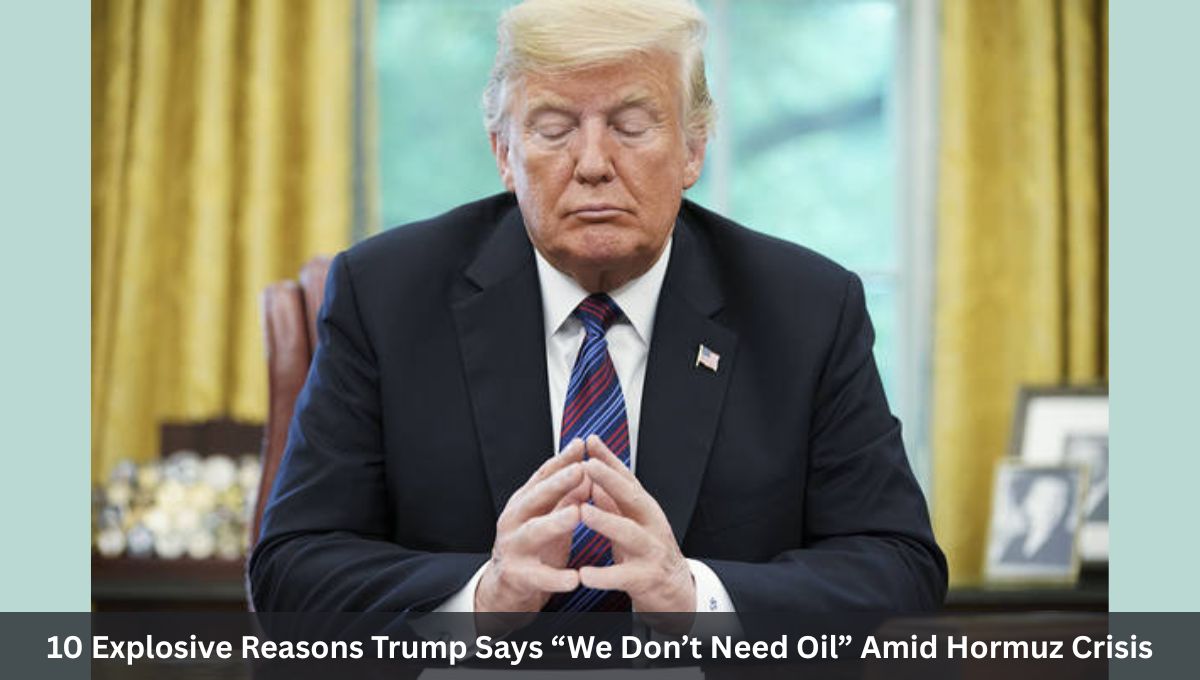
10 Explosive Reasons Trump Says “We Don’t Need Oil” Amid Hormuz Crisis — while urging allies to secure the Strait. As the Iran war enters its 18th day, one statement from Donald Trump has sparked global debate: “We don’t need oil.”
At first glance, the claim seems bold—perhaps even contradictory—given the spiraling global energy crisis triggered by escalating conflict in the Middle East. But beneath the rhetoric lies a complex geopolitical strategy centered around one of the world’s most critical chokepoints: the Strait of Hormuz.
This narrow waterway, responsible for transporting nearly 20% of the world’s oil supply, has become the epicenter of a rapidly intensifying conflict involving the United States, Israel, Iran, and a hesitant coalition of global powers.
This article breaks down Trump’s statement, the strategic reality behind it, and why reopening the Strait of Hormuz is proving far more difficult than anticipated.
10 Explosive Reasons Trump Says “We Don’t Need Oil” Amid Hormuz Crisis
Trump’s Statement: “We Don’t Need Oil” — What He Really Meant
Speaking during a press conference, Trump emphasized that the United States is energy independent:
“We have all the oil we need… We did this for our allies, not for us.”
This assertion reflects a key shift in U.S. energy policy over the past decade—one driven by increased domestic production, particularly from shale reserves.
Key Takeaways from Trump’s Remarks
- The U.S. is less dependent on Middle Eastern oil than in previous decades
- The mission in the Strait of Hormuz is framed as protecting global supply chains
- Trump is pressuring allies to contribute militarily
- The U.S. sees itself as a security guarantor for global energy flows
However, the claim that the U.S. “doesn’t need oil” is only partially true.
While domestic production is high, global oil markets remain interconnected, meaning disruptions anywhere affect prices everywhere.
Why the Strait of Hormuz Matters So Much
The Strait of Hormuz is not just another shipping route—it is the lifeline of the global energy system.
Critical Facts About the Strait
- Handles 17–20 million barrels of oil daily
- Connects the Persian Gulf to the global market
- Serves major exporters like:
- Saudi Arabia
- UAE
- Kuwait
- Iraq
Even countries far removed from the Middle East—such as Japan, India, and China—depend heavily on this route.
The Real Reason Behind U.S. Involvement
Trump’s argument is straightforward:
The U.S. may not rely heavily on Hormuz oil—but its allies do.
Countries Dependent on Hormuz Oil
- China
- Japan
- South Korea
- India
Trump explicitly called out these nations, saying they should be “thanking” the U.S. and contributing to security efforts.
This reflects a broader doctrine:
“If you benefit, you should contribute.”
Why Allies Are Reluctant to Join
Despite repeated appeals, most U.S. allies have declined to send warships.
Key Responses from Allies
- Japan: No decision yet within legal framework
- Germany: No NATO mandate
- Australia: Refused naval deployment
- UK: Avoiding escalation into wider war
- EU: No appetite to expand missions
Even leaders like Keir Starmer and Kaja Kallas have signaled caution.
Why the Hesitation?
- Risk of direct conflict with Iran
- Lack of UN or NATO mandate
- Domestic political constraints
- Fear of escalation into a regional war
The Military Challenge: Why Securing Hormuz Is So Difficult
Reopening the Strait of Hormuz is not just a diplomatic issue—it’s a military nightmare.
Geographic Constraints
- Narrowest width: ~10 miles
- Shipping lanes: ~2 miles each
- Limited maneuverability for large tankers
Iran’s Tactical Advantages
Iran’s Islamic Revolutionary Guard Corps (IRGC) can deploy:
- Fast attack boats
- Naval mines
- Drones
- Coastal missile systems
- Mini-submarines
These capabilities make the strait a high-risk “kill zone.”
The U.S. has proposed escorting commercial vessels through the strait.
What This Requires
- 8–10 destroyers per convoy
- Air support (helicopters, AWACS)
- Mine-clearing operations
- Constant surveillance
Key Risks
- Warships becoming direct targets
- Limited reaction time to missile threats
- Vulnerability to swarm attacks
Experts warn that even a successful operation may restore only 10% of normal traffic.
Oil Markets React: Prices Surge Above $100
The conflict has already triggered a major oil shock.
Current Market Impact
- Brent crude: Above $100/barrel
- Prices up ~40% since war began
- Shipping traffic drastically reduced
The disruption is being described as one of the largest supply shocks in modern history.
Global Economic Fallout
The Hormuz crisis is not just about oil—it’s about the global economy.
Major Consequences
- Rising fuel prices worldwide
- Inflation pressures
- Threat to food supply chains
- Economic instability in developing nations
Countries heavily dependent on imports are particularly vulnerable.
Iran’s Strategy: Why Block the Strait Now
Iran has long threatened to close the Strait of Hormuz—but rarely acted.
Why Now?
- Retaliation for U.S.-Israeli strikes
- Loss of leadership, including top officials
- Framing the war as “existential”
Iran’s message is clear:
If it cannot export oil, no one will.
Alternative Routes: Are There Any?
Some Gulf countries have tried to bypass Hormuz.
Existing Alternatives
- UAE pipeline to Fujairah
- Saudi east-west pipeline
Limitations
- Limited capacity
- Vulnerable to attacks
- Not enough to replace Hormuz traffic
Trump vs NATO: A Growing Rift
Trump’s frustration with allies is becoming increasingly visible.
Key Complaints
- Lack of “enthusiasm”
- Perceived imbalance in defense commitments
- Historical grievances over NATO burden-sharing
This could deepen divisions within the alliance.
China’s Silence: Strategic or Calculated?
China, one of the biggest beneficiaries of Hormuz oil, has remained cautious.
Possible Reasons
- Avoiding military entanglement
- Preference for diplomatic solutions
- Economic vulnerability to disruption
Despite Trump’s pressure, Beijing has not committed to any coalition.
Could India Play a Role?
Interestingly, the U.S. has hinted at potential involvement from India.
Given India’s heavy reliance on Middle Eastern oil, its role could be significant—but no formal commitment has been made.
Can the U.S. Do It Alone?
Trump insists:
“We don’t need anybody.”
But reality suggests otherwise.
Limitations of Acting Alone
- Limited number of deployable ships
- Global military commitments
- Logistical strain over time
Even the U.S. Navy would struggle to sustain long-term operations without allies.
Historical Context: Lessons from the Past
The U.S. has dealt with similar threats before, particularly during:
- The 1980s Tanker War
- Gulf conflicts
However, today’s environment is more complex:
- Advanced drone warfare
- Greater regional instability
- More interconnected global economy
The Bigger Picture: A War Without a Clear End
Despite optimism from Washington, the conflict shows no signs of ending.
Current Situation
- Ongoing missile exchanges
- Expanding regional involvement
- Rising civilian casualties
The lack of a clear diplomatic path adds to uncertainty.
Conclusion: A Crisis That Goes Beyond Oil
Trump’s statement that the U.S. “doesn’t need oil” is both strategic messaging and political positioning.
But the reality is undeniable:
- The Strait of Hormuz remains critical to global stability
- The conflict is reshaping alliances
- The economic fallout is already being felt worldwide
Whether or not the U.S. needs oil, the world certainly does—and until the Strait of Hormuz is secure, the crisis will continue to reverberate across economies, markets, and geopolitics.
Also Read: 12 Explosive Claims as Donald Trump Says Iran War Could End Soon but Vows to “Finish the Job”
Also Read: Trump Makes Bombshell Confession He Was Shocked at Middle East War Escalation
Related Posts:
- 7 Powerful Reasons the U.S. Is Letting Countries Buy…
- 7 Shocking Reasons FIFA’s Peace Prize for Trump…

- 7 Explosive Reasons Oil Prices Are Surging as Trump…
- 7 Shocking Reasons Trump Says Oil Spike Is “Worth…

- 10 Explosive Signals Trump Says Iran War Could End…
- 12 Explosive Claims as Donald Trump Says Iran War…