Trade tensions Escalates with Trump’s 10% Tariff Threat on BRICS: Can India’s Reform Drive Lead a Global Shift? On July 6, U.S. President Donald Trump sent shockwaves through the global economy by threatening a 10% tariff on imports from nations he claims are aligned with the BRICS bloc’s “anti-American” agenda.
In a speech targeting what he called the “fading BRICS group,” Trump alleged that the coalition is designed to undermine the U.S. dollar’s dominance and weaken American leadership on the world stage. “If they ever really form in a meaningful way, it will end very quickly,” Trump warned, suggesting that the BRICS bloc is afraid to convene due to his aggressive stance.
Without naming specific countries, Trump made it clear that no BRICS nation including India, Brazil, and South Africa would be exempt from the looming tariffs, which are scheduled to take effect on August 1. The new policy intensifies existing tensions over de-dollarisation and challenges to U.S.-led financial institutions.
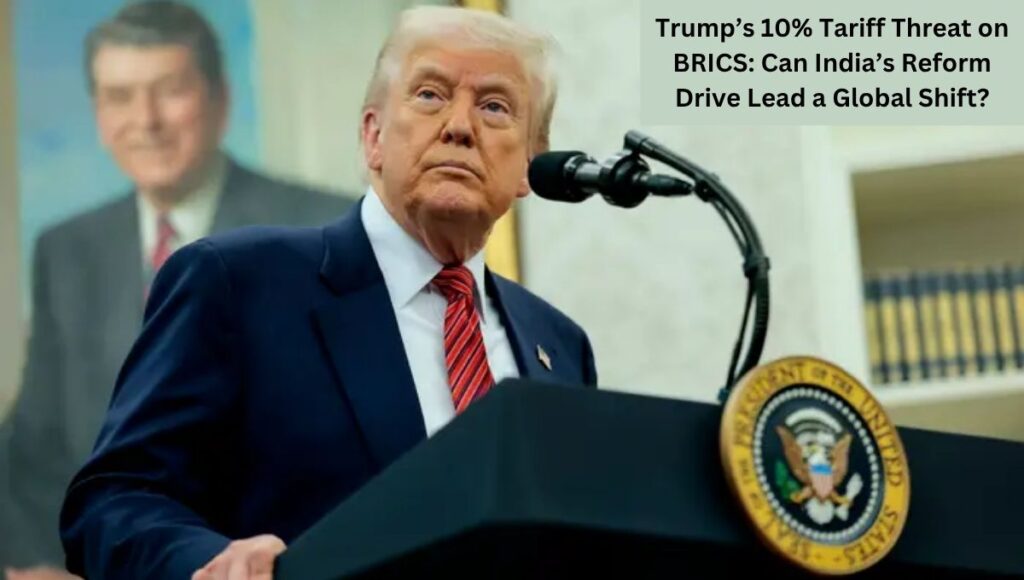
Trump’s 10% Tariff Threat on BRICS: Can India’s Reform Drive Lead a Global Shift?
BRICS: Expanding Ambitions, Not Anti-American
Despite Trump’s sharp rhetoric, BRICS nations have rejected claims of being anti-American. Instead, the group now expanded to include Iran, Indonesia, Egypt, Ethiopia, and Saudi Arabia has focused on reforming global financial systems and promoting multilateral development.
One such initiative is BRICS Pay, a cross-border payment platform that aims to enable trade in local currencies. The system, though still in early stages, is a direct attempt to reduce dependency on the U.S. dollar, increase financial sovereignty, and boost intra-BRICS trade.
While Brazil has stepped back from the idea of a common BRICS currency, efforts to establish financial independence from Western-controlled systems continue to gain traction despite diverging views among member nations.
India’s Central Role in Shaping Global Financial Reform
Amid growing geopolitical polarization, India is emerging as a pivotal force in reforming the global financial architecture.
At the 2024 BRICS Summit in Rio, Prime Minister Narendra Modi reaffirmed India’s commitment to modernizing multilateral institutions like the IMF and World Bank.
India’s aim? To act as a reformer, not a disruptor, giving the BRICS bloc a more structured, inclusive, and efficient form.
As India prepares to host the BRICS Summit in 2026, its leadership role in global governance is becoming increasingly pronounced.
Modi’s approach reflects a strategy of building bridges, not walls balancing relations with both the Global South and Western powers.
The Singh-Summers Report: A Blueprint for MDB Reform
India’s ambitions are underpinned by the Singh-Summers report, commissioned during its G20 presidency in 2023.
Co-authored by N.K. Singh and former U.S. Treasury Secretary Lawrence Summers, the report lays out a detailed roadmap to make Multilateral Development Banks (MDBs) “bigger, better, and bolder.”
Key recommendations include:
- Tripling MDB lending to $360–400 billion annually by 2030
- Harmonizing project pipelines across institutions
- Reducing disbursement delays
- Promoting blended finance and portfolio guarantees
- Reforming governance to give more say to nations like India, Brazil, and Indonesia
MDB reform isn’t just about bureaucracy it’s about unlocking $3 trillion in financing needed for global climate, health, and digital goals.
Reform Resistance: Pushback from the West and China
Despite the momentum for reform, significant resistance remains. Western powers are reluctant to dilute their historical control over MDB governance, while China is viewed with suspicion for seeking to centralize its influence through institutions like the New Development Bank (NDB).
This is where India’s balancing act becomes essential. Trusted by the West and respected across the Global South, India is in a unique position to bridge divides reassuring skeptics that reform doesn’t mean rebellion, but renewal.
A Three-Year Strategic Opportunity
India’s ability to lead reform is bolstered by a rare alignment in global leadership:
- Brazil’s G20 presidency in 2024
- South Africa’s in 2025
- India’s BRICS presidency in 2026
This sequence presents a powerful window for synchronized reform. At the São Paulo finance ministers’ meeting, India proposed a joint G20-BRICS reform platform with shared dashboards, task forces, and finance minister-level cooperation to streamline MDB reform efforts.
Why MDB Reform Matters to India’s National Interest
India’s reform push isn’t just global idealism it’s deeply tied to national priorities.
MDB funding is vital for India’s:
- Urban development and smart city projects
- Energy transition away from fossil fuels
- Digital infrastructure to power growth
- Regional connectivity from Central Asia to Africa
Without access to timely and scaled-up MDB finance, India risks slowing its strategic and developmental ambitions.
Trump’s Policy: Isolation or Protection?
Trump’s tariffs and unilateralism reflect a sharp contrast to India’s multilateral diplomacy. His rejection of a U.S. central bank digital currency (CBDC) and continued attacks on BRICS suggest a strategy focused on preserving dollar dominance rather than evolving with a changing world.
“They wanted to try and take over the dollar,” Trump claimed. “We hit them very, very hard.”
His America First stance may win support domestically but risks alienating allies and fueling further fragmentation of global systems.
The 50% tariff imposed on Brazilian imports is a case in point—targeting a BRICS member already taking a cautious, moderate stance.
India’s Diplomatic Leverage: Not East, Not West
India’s advantage lies in its neutral credibility:
- Not seen as hegemonic like China
- Not isolated like Russia
- Not burdened by colonial legacies like Europe and the U.S.
This makes India the most credible voice to lead reforms that address the real needs of the Global South beyond token inclusion in global institutions.
India’s diplomatic success during the G20 Delhi Summit, where it brokered a consensus on the Delhi Declaration, is proof of this convening power.
What Lies Ahead: Vision to Execution
To turn vision into reality, India must:
- Keep the Singh-Summers reform agenda alive at key platforms like the IMF-World Bank annual meetings
- Advocate for public scorecards to track MDB reform progress
- Build coalitions with Brazil, South Africa, and Indonesia
- Link governance reforms to climate financing goals and sustainable development agendas
If India can deliver, it will reshape global multilateralism not just for BRICS, but for the world.
Final Thoughts: Will India Seize the Moment?
As Trump doubles down on tariffs and threats, India is offering a very different path—collaborative leadership through reform.
While Trump’s comments brand BRICS as “fading fast,” the bloc’s expanding influence, development agenda, and reform push suggest otherwise. With India preparing to chair the BRICS Summit in 2026, its choices now will determine whether this moment sparks a new global order or another missed opportunity.
India stands at a crossroads: with strategic clarity, moral leadership, and diplomatic capital, it could transform BRICS into a driver of inclusive global governance. And if it does? BRICS won’t fade. It may just begin anew with India at the helm.
Also Read: NATO Chief Warns BRICS of 100% Tariffs Over Russian Trade
Also Read: Trump threatens extra 10% tariff on nations siding with Brics