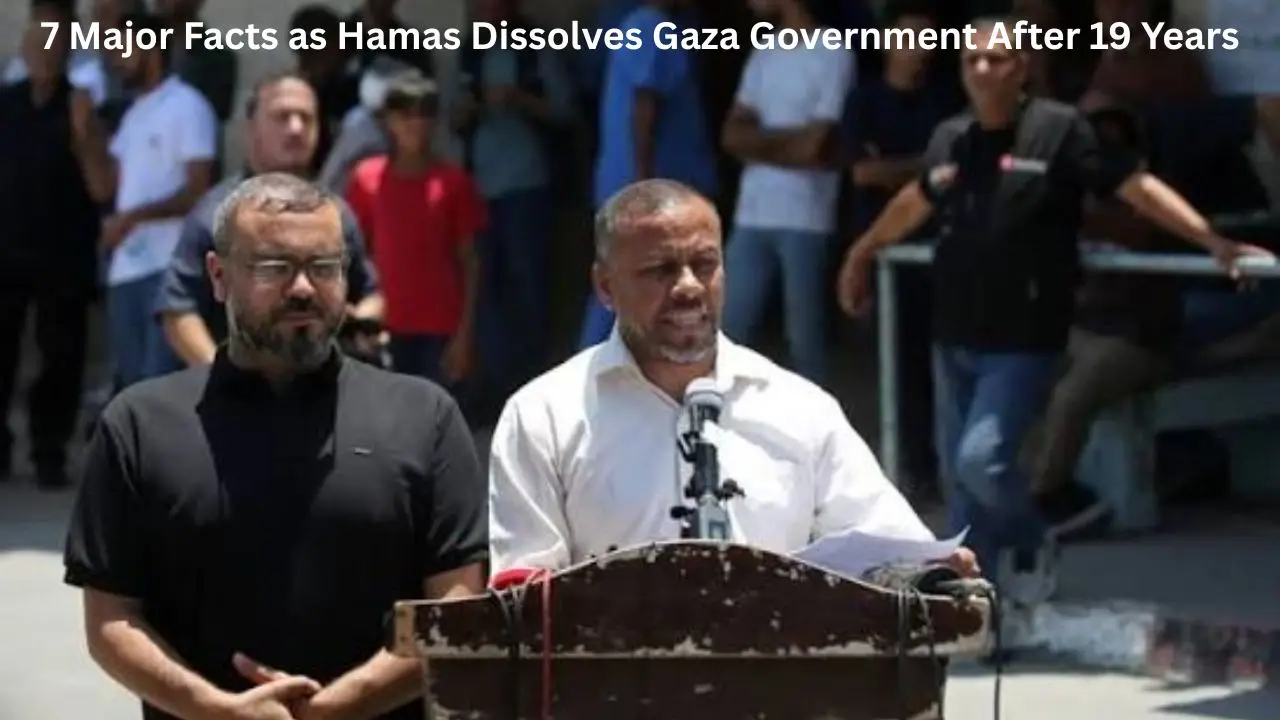
7 Major Facts as Hamas Dissolves Gaza Government After 19 Years, paving the way for a technocratic administration. In one of the most significant political developments in the Middle East in recent years, Hamas announced on Monday that it has dissolved the governing body that administered the Gaza Strip for nearly 20 years.
The move represents a major shift in Gaza’s political landscape and is intended to facilitate the transfer of civilian governance to a Palestinian technocratic committee under an internationally backed post-war framework.
The announcement comes amid ongoing efforts to revive a stalled peace process following months of fragile ceasefire negotiations and international diplomatic engagement.
Although the decision has been welcomed by some international observers as a potentially positive political signal, experts caution that the practical impact will depend on whether additional commitments—including security arrangements, reconstruction, and disarmament—are ultimately implemented.
7 Major Facts as Hamas Dissolves Gaza Government After 19 Years
A Historic Political Shift After Nearly 20 Years
Hamas has governed Gaza since 2007 after taking control of the territory following violent clashes with rival Palestinian faction Fatah.
For almost two decades, the Hamas-led administrative body managed ministries responsible for education, healthcare, municipal services, finance, and other civilian functions throughout Gaza.
With Monday’s announcement, Hamas said the governing body supervising these ministries would be dissolved, allowing civilian administration to transition toward a technocratic committee envisioned under an internationally supported peace framework.
The decision marks one of the biggest institutional changes inside Gaza since Hamas assumed power.
What Exactly Is Changing?
According to Hamas officials, the governing authority overseeing ministries will cease operating. However, the ministries themselves will continue functioning.
Existing civil servants and ministry employees are expected to remain in their positions to ensure continuity of essential public services, including:
- Healthcare
- Education
- Water and sanitation
- Electricity coordination
- Municipal administration
- Social welfare
The transition is designed to avoid disrupting everyday life for Gaza’s civilian population while administrative responsibility gradually shifts to a new governing structure.
Technocratic Committee Expected to Assume Civilian Administration
The proposed replacement is a Palestinian technocratic committee composed of non-partisan professionals rather than political leaders.
Its primary responsibilities would include:
Restoring essential public services
The committee would oversee daily government operations and coordinate humanitarian assistance.
Managing reconstruction
One of its largest responsibilities would involve supervising rebuilding efforts across Gaza following extensive wartime destruction.
Coordinating international aid
International organizations and donor governments have indicated they prefer civilian administrative structures for distributing reconstruction funding and humanitarian assistance.
Preparing for long-term governance
The committee could eventually serve as an interim administrative authority while broader political negotiations continue.
Supporters believe such a structure could increase transparency and improve international cooperation.
Why Did Hamas Make This Decision?
Several factors appear to have influenced Hamas’s announcement.
Pressure from Peace Negotiations
The dissolution aligns with provisions contained in an internationally backed peace proposal aimed at establishing a post-war governance model for Gaza.
The plan envisions civilian administration by technocrats rather than direct rule by Hamas.
Humanitarian Conditions
Gaza continues to face severe humanitarian challenges after years of conflict.
Large sections of residential neighborhoods, hospitals, schools, roads, and infrastructure remain damaged or destroyed.
International donors have repeatedly emphasized that stable civilian governance is essential before major reconstruction funding can proceed.
Diplomatic Signaling
Political analysts say the announcement may also serve as a signal to international mediators that Hamas is willing to make institutional concessions if broader agreements move forward.
Security Remains the Biggest Question
While Hamas has agreed to dissolve its governing body, the organization indicated that security and policing arrangements in areas still under its control would remain unchanged for now.
This distinction is significant. Civilian governance and military authority are separate issues.
Many international stakeholders, including Israel, have consistently argued that any lasting peace agreement would require clear arrangements regarding armed groups operating inside Gaza.
Hamas, meanwhile, has maintained that discussions over weapons and military capabilities are linked to broader issues such as Israeli military withdrawal and long-term political guarantees.
Israel Yet to Fully Respond
Israeli officials had not immediately issued a comprehensive response following Hamas’s announcement.
Previous Israeli positions have maintained that administrative reforms alone would not resolve core security concerns unless accompanied by concrete changes regarding armed operations and security control.
Israeli leaders have repeatedly argued that any permanent post-war arrangement must ensure Gaza cannot again be used to launch attacks against Israel.
Whether Hamas’s latest move satisfies any of those concerns remains uncertain.
International Community Watching Closely
Governments and international organizations involved in mediation are expected to closely monitor whether the announced transition is fully implemented.
Officials associated with the peace framework stressed that practical implementation—not public declarations—will determine whether meaningful progress has been achieved.
Diplomatic observers say several milestones will likely be monitored, including:
- Formal transfer of administrative authority
- Functioning of the technocratic committee
- Humanitarian access
- Reconstruction planning
- Security coordination
- Continued ceasefire compliance
Challenges Facing the Transition
Despite the announcement, significant obstacles remain.
Security Issues
Questions surrounding military authority and armed groups remain unresolved.
Reconstruction Needs
Large areas of Gaza require enormous investment to restore homes, hospitals, schools, electricity networks, and water infrastructure.
Humanitarian Crisis
Millions of Palestinians continue facing shortages of housing, healthcare, clean water, food supplies, and employment opportunities.
Political Consensus
Long-term governance will likely require broader agreement among Palestinian political factions as well as support from regional and international actors.
What This Means for Palestinians
For ordinary Palestinians living inside Gaza, immediate changes may be limited. Government ministries are expected to continue operating without interruption.
However, if the technocratic administration becomes fully operational, residents could eventually see improvements in:
- Delivery of humanitarian assistance
- Public administration
- Reconstruction efforts
- International funding
- Essential public services
Much will depend on whether diplomatic negotiations continue progressing.
Why This Matters Globally
The political transition carries implications beyond Gaza.
The conflict has affected regional security, global diplomacy, humanitarian aid operations, energy markets, and international relations.
A successful administrative transition could:
- Improve humanitarian coordination.
- Encourage greater international investment in reconstruction.
- Reduce political uncertainty.
- Support broader peace negotiations.
- Create conditions for longer-term regional stability.
Conversely, failure to implement the transition could prolong political uncertainty and complicate future diplomatic efforts.
Key Takeaways
- Hamas has dissolved the governing body that administered Gaza for nearly two decades.
- Civilian governance is expected to shift toward a Palestinian technocratic committee.
- Government ministries and civil servants will continue operating during the transition.
- Major questions remain regarding security arrangements and Hamas’s armed wing.
- Israel has maintained that broader security concerns must still be addressed.
- International mediators view implementation—not announcements—as the true test of progress.
- The transition could significantly influence Gaza’s reconstruction and future peace negotiations.
Conclusion
Hamas’s decision to dissolve its governing body represents one of the most consequential political developments in Gaza since the movement assumed power in 2007.
By opening the door to a technocratic civilian administration, the organization has taken a step that could reshape governance in the territory and potentially advance broader diplomatic efforts.
Nevertheless, the announcement alone does not resolve the fundamental issues that have long fueled the conflict.
Security arrangements, humanitarian recovery, reconstruction, Israeli withdrawal, and the broader political future of Gaza remain subjects of intense negotiation.
Whether this move becomes a genuine turning point or remains largely symbolic will depend on the willingness of all parties to translate political commitments into concrete action.
For now, the international community will be watching closely as Gaza enters a potentially transformative chapter in its modern history.
Also Read: 7 Explosive Facts About Trump’s $1 Billion Gaza Peace Board
Also Read: Hamas dissolves Gaza government: What happens next?
Related Posts:
- 7 Key Takeaways as the UN Approves Trump’s Gaza Peace Plan

- Trump’s 20-Point Gaza Peace Plan Gains Urgent Global…

- 5 Key Developments from Gaza Peace Talks in Egypt…

- 11 Powerful Moments as Tarique Rahman Returns to…

- 7 Powerful Facts About Ayatollah Ali Khamenei’s…
- Hamas Disarmament Deal: 7 Historic Facts Behind…